

5 Ways RPA Improves Logistics Customer Service
by CR Express Team, Logistics Team • 8 min read
5 Ways RPA Improves Logistics Customer Service
Robotic Process Automation (RPA) is transforming logistics customer service by automating repetitive tasks like order processing, data entry, and shipment tracking. It delivers faster results, reduces errors, and allows employees to focus on complex customer needs. Here's a quick summary of how RPA enhances logistics:
- Faster Order Processing: Speeds up handling times from 20 minutes to just 2 minutes per order, ensuring 24/7 operations.
- Improved Accuracy: Eliminates manual errors in data entry and billing, improving reliability.
- 24/7 Availability: Provides real-time shipment tracking and updates, keeping customers informed anytime.
- Boosted Productivity: Frees up employees to address customer concerns, improving service quality.
- Scalability During Peak Times: Handles high-volume periods without additional staffing, maintaining consistent service.
RPA not only simplifies workflows but also strengthens customer experiences and operational efficiency.
5 Ways RPA Improves Logistics Customer Service: Key Statistics and Benefits
RPA in Supply Chain - Robotics Process Automation & DHL Case study
sbb-itb-c0b8770
1. Faster Response Times with Automated Order Processing
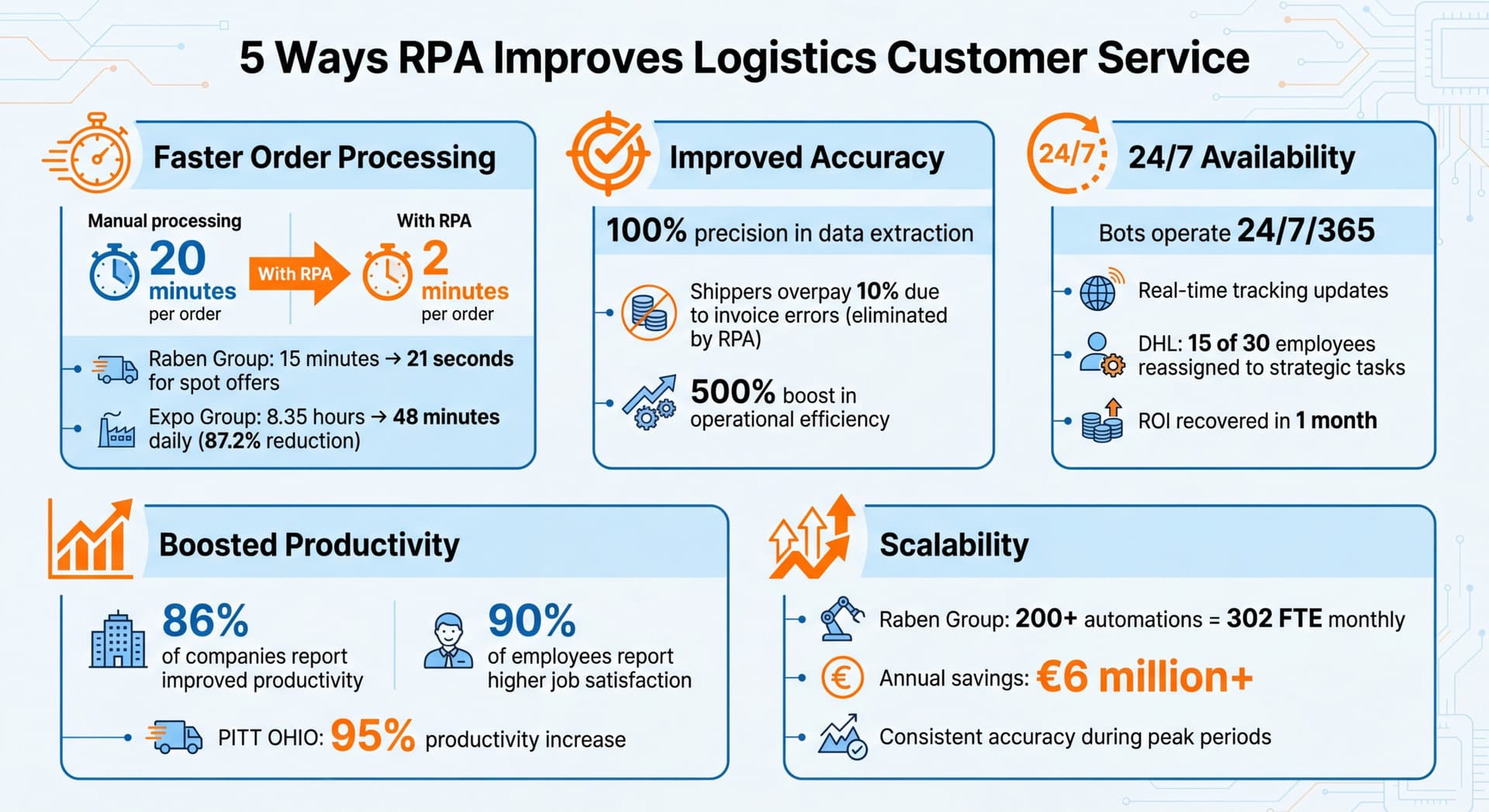
Processing orders manually can be a time-consuming task, often taking 20 minutes per order. With RPA (Robotic Process Automation), this process is streamlined, cutting the time down to just 2 minutes.
Here's how it works: RPA bots leverage Optical Character Recognition (OCR) to scan incoming customer emails and pull out key details like SKUs, quantities, and shipping addresses from attached files, such as PDFs or Excel spreadsheets. The bots then validate this data against live inventory in your Warehouse Management System (WMS), input the information into your ERP system, generate an invoice, and send a confirmation email to the customer - all without requiring a single human touch. This automation drastically reduces processing time and ensures accuracy.
Take Raben Group as an example. By automating their spot offer generation, they slashed processing time from 15 minutes per quote to just 21 seconds, enabling their sales team to respond to inquiries almost immediately. Similarly, Expo Group in Bangladesh automated their export freight forwarding process, reducing average handling time from 8.35 hours per day to just 48 minutes - a staggering 87.2% time reduction.
Another advantage? RPA bots work around the clock, 24/7/365, meaning orders placed in the middle of the night are processed just as quickly as those during business hours. Customers benefit from real-time updates via email or client portals as their shipments progress, keeping them informed and minimizing delays.
These bots don’t just work quickly - they work accurately. With 100% precision in data extraction and entry, they eliminate common errors like typos or miskeyed information. This accuracy reduces the need for follow-up customer service calls and ensures orders move swiftly from placement to shipment.
2. Fewer Errors and Better Data Accuracy
Manual data entry is often a breeding ground for costly mistakes. A simple typo when inputting SKUs, shipping addresses, or invoice amounts can spiral into billing disputes, shipment delays, or compliance headaches. By using RPA (Robotic Process Automation), these risks are significantly reduced. RPA leverages OCR (Optical Character Recognition) technology to extract data directly from digital documents and validates it against master records before integrating it into core systems.
Unlike humans, who are susceptible to errors during repetitive, high-volume tasks, software bots handle data with perfect precision. As Fahad from Cargo Docket explains:
"You don't lose money in big mistakes, you lose it in small errors repeated across hundreds of documents."
These small errors add up fast. For instance, shippers often end up paying 10% more than necessary due to inaccuracies in freight invoices. RPA solves this by automatically cross-checking invoices against master data, flagging any discrepancies before they can escalate into costly problems.
The reliability of RPA doesn’t stop at billing. Bots are tireless and maintain their accuracy even during high-pressure periods, such as the holiday season, when shipment volumes surge and manual entry errors typically spike. In fact, implementing RPA for tasks like error detection and report generation can boost operational efficiency by as much as 500%. This allows teams to shift their focus to more nuanced customer issues that require human insight.
For customers, this level of accuracy means fewer billing disputes and no delays caused by minor data entry mistakes. The result? A smoother, more reliable experience that fosters trust and keeps operations running seamlessly. With RPA handling the repetitive tasks, teams are better equipped to address more complex challenges and deliver higher-quality service.
3. 24/7 Support and Real-Time Shipment Tracking
Round-the-clock support takes customer service to a whole new level by being available whenever it's needed.
In logistics, flexibility is key. RPA bots operate 24/7, handling tasks like processing orders, verifying inventory, and sending shipment updates - even during weekends or late-night hours. This means customers can get answers to routine questions at any time, without waiting for normal business hours.
Real-time shipment tracking is another game-changer. RPA bots continuously check carrier websites like FedEx, UPS, and DHL, scraping the latest updates hourly. They then push this information directly to customer portals or send automated alerts. This eliminates the lag that comes with manual tracking, ensuring customers always have the most current information about their shipments.
DHL Global Forwarding offers a great example of this in action. Their "Post Flight" pilot project used software robots to extract flight status data and sync it with their shipment operations system. The bots automatically reported delays, allowing DHL to reassign 15 out of 30 employees to more strategic tasks. Even better, they recouped their investment in just one month.
FedEx has also embraced automation by integrating self-service lockers with backend systems. This setup automates notifications, letting customers pick up shipments at their convenience without needing staff assistance.
These automated systems don't just keep customers informed - they also help businesses stay ahead of potential problems. For instance, bots can instantly alert teams to delays, enabling quick and proactive solutions. As Roman Zomko, Co-Founder and CEO of Impressit, puts it:
These bots run nonstop, eliminating manual errors and significantly reducing turnaround times.
The result? A support system that’s always on, keeps errors to a minimum, and ensures customers are never left in the dark.
4. Better Employee Productivity and More Personal Customer Service
When routine tasks like data entry, invoice processing, and shipment tracking are automated using RPA, employees can shift their focus to tackling complex customer issues that require human judgment. This change not only enhances productivity but also allows teams to deliver more meaningful customer experiences.
Here’s what the numbers say: 86% of companies using RPA report improved productivity, while nearly 90% of employees experience higher job satisfaction when repetitive tasks are automated. A great example is PITT OHIO, which saw a 95% boost in productivity among its customer service representatives after implementing RPA for invoice creation.
Jon Moeller, CEO of Procter & Gamble, highlighted the impact of RPA on their operations:
Now, the company is deploying the freed-up cash to implement robotic process automation, a type of intelligent software that replaces white-collar roles…That delivers on a key pledge that P&G made to restless shareholders – to reduce non-manufacturing costs.
With RPA taking care of repetitive processes, customer service teams can focus more on connecting with clients, understanding their specific needs, and offering tailored solutions that build long-term loyalty.
5. Easy Scaling and Reliable Service During High-Volume Periods
RPA doesn’t just ensure faster processing and precision - it also shines when it comes to scaling operations during peak demand. Think about those hectic holiday seasons or massive sales events that can overwhelm logistics teams. With RPA, businesses can handle these surges without scrambling to hire temporary staff or compromising on quality. Bots operate around the clock, effortlessly managing demand spikes.
Take the example of Raben Group. They implemented over 200 automations that handle tasks equivalent to the work of 302 full-time employees every month. This approach has saved the company more than €6 million annually. In one case, a bot reduced the time to generate spot offers from 15 minutes to just 21 seconds.
What makes RPA indispensable during high-volume periods is its ability to maintain flawless data accuracy, no matter the workload. Whether it’s processing transactions or avoiding errors like mis-picks and incorrect labeling, bots deliver consistent results. Achieving this level of reliability through traditional hiring and training would be a major challenge.
This ability to scale effortlessly ensures businesses can provide reliable, consistent customer service - even when demand reaches its peak.
Conclusion
RPA is reshaping logistics customer service by tackling long-standing challenges through automation. Tasks like data entry and documentation are handled efficiently, leading to faster processing, near-perfect accuracy, and 24/7 availability. This shift not only boosts productivity but also frees up teams to focus on more strategic, high-value activities.
With RPA, logistics providers can deliver real-time updates and respond quickly to customer inquiries, creating a better overall experience that encourages loyalty. Plus, the cost savings from reducing manual labor and avoiding errors make it easier to modernize operations and scale seamlessly. Whether managing routine shipments or dealing with peak-season demand surges, software bots operate consistently without the expense or time needed to hire and train additional staff - a critical edge in the fast-paced global supply chain.
These operational improvements also pave the way for broader transformation. By moving employees away from repetitive tasks, companies can foster a culture centered on problem-solving and personalized customer interactions.
In a logistics world where speed, precision, and reliability are non-negotiable, RPA offers a powerful tool for growth and outstanding service. It doesn’t replace human expertise - it enhances it, enabling teams to focus on their strengths while automation takes care of the rest.
At CR Express, we leverage RPA to optimize our logistics processes and elevate customer service. This dedication to innovation reinforces our commitment to delivering exceptional, customer-first solutions.
FAQs
Which logistics tasks should be automated with RPA first?
Focusing on automating tasks that are repetitive, rule-based, and time-consuming - like order processing, shipment tracking, data entry, and document management - can make a big difference. These types of tasks are perfect for Robotic Process Automation (RPA) because they boost efficiency, minimize errors, and let employees shift their attention to more strategic work.
Other areas like inventory management, order fulfillment, and fleet coordination can also see major benefits. Automation in these areas can lead to better cash flow, fewer costly mistakes (like mis-picks), and an improved customer experience thanks to faster and more accurate operations.
How does RPA connect with systems like WMS, ERP, and carrier tracking sites?
Robotic Process Automation (RPA) works seamlessly with systems like Warehouse Management Systems (WMS), Enterprise Resource Planning (ERP), and carrier tracking platforms by automating data exchange and synchronization. This automation ensures real-time updates, minimizes manual errors, and simplifies processes. For instance, RPA can pull shipment status details directly from carrier tracking sites and update WMS or ERP systems. This allows for accurate, up-to-date information sharing, ultimately improving supply chain efficiency.
How long does it take to implement RPA and see results?
Robotic Process Automation (RPA) is known for its quick implementation in logistics, often delivering noticeable results in just a few weeks and typically within three months. If a pilot project stretches beyond that timeframe, it might indicate an overly ambitious scope. By automating repetitive tasks like order processing and shipment tracking, RPA brings immediate operational benefits and cost reductions, offering an effective way to address common logistics hurdles.