
Order Fulfillment Cycle Time: Best Practices
by CR Express Team, Logistics Team • 12 min read

Order Fulfillment Cycle Time: Best Practices
Want faster deliveries and happier customers? Understanding and improving Order Fulfillment Cycle Time (OFCT) is the key. OFCT measures the time it takes from when an order is placed to when it’s delivered. Reducing this time improves efficiency, saves costs, and boosts customer satisfaction.
Here’s what you need to know:
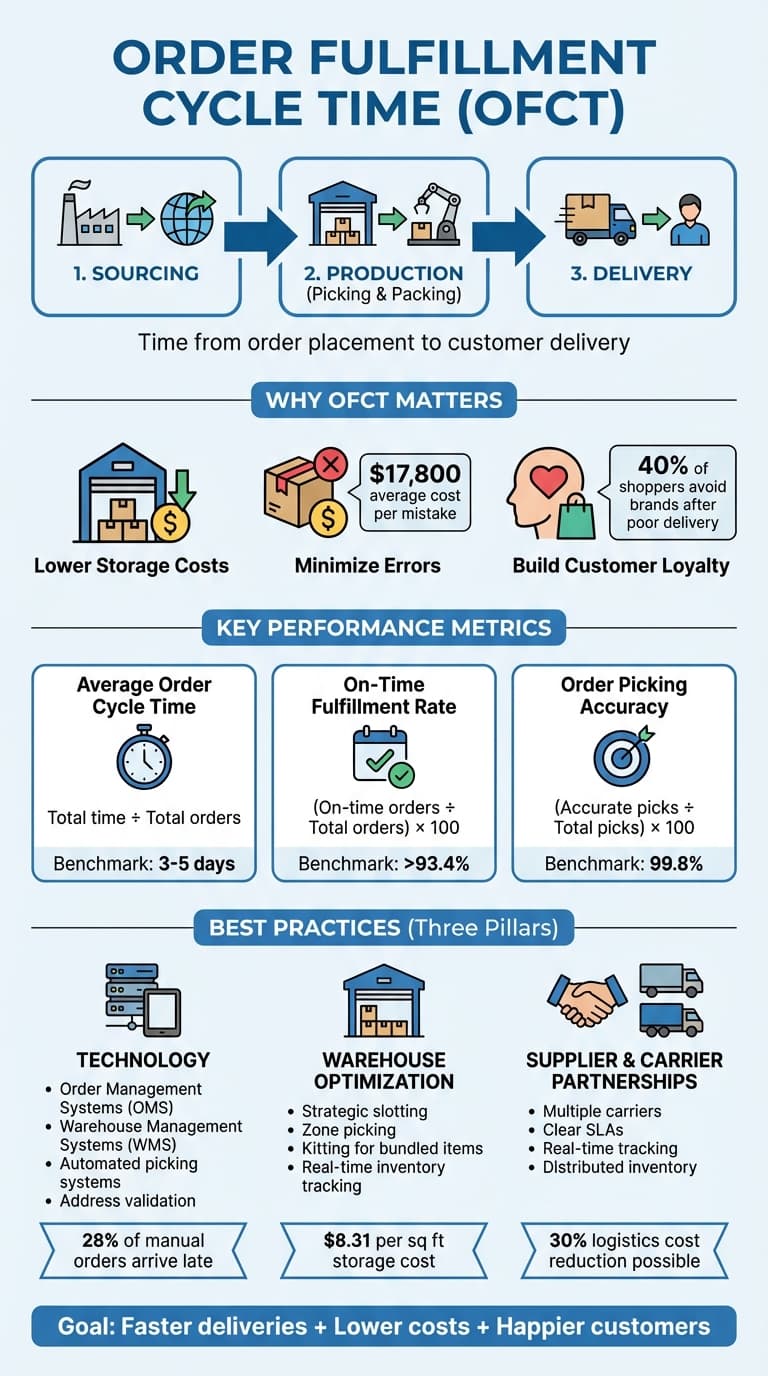
- Stages of OFCT: Sourcing, production (picking, packing), and delivery.
- Why it matters: Shorter cycle times lower storage costs, minimize errors (which can cost up to $17,800 per mistake), and build loyalty.
- Key metrics to track: Average Order Cycle Time (benchmark: 3–5 days), On-Time Fulfillment Rate (>93.4%), and Customer Satisfaction Scores.
- Best practices:
- Use automation tools like Order Management Systems (OMS) and Warehouse Management Systems (WMS) to eliminate errors and delays.
- Optimize warehouse layouts with strategic slotting and zone picking.
- Partner with reliable suppliers and carriers, and leverage real-time tracking for transparency.
Reducing OFCT is not just about speed - it’s about delivering better experiences while cutting costs.
Order Fulfillment Cycle Time Optimization: Key Metrics and Best Practices
Boost Your Warehouse Efficiency: Mastering Order Cycle Time
Key Metrics for Measuring Order Fulfillment Performance
Tracking the right metrics is essential for identifying and addressing delays in your order fulfillment process. Without clear indicators, it’s tough to pinpoint where issues arise or how to resolve them. Here are some key performance indicators (KPIs) that provide a clear picture of your fulfillment operations, helping you identify and reduce bottlenecks.
Average Order Cycle Time
Average Order Cycle Time (AOCT) measures the time it takes from when a customer clicks "buy" to when the package leaves your facility. To calculate this, divide the total fulfillment time by the number of shipments. For U.S. retailers, the typical AOCT benchmark is 3 to 5 days.
Breaking this metric into segments can help you uncover specific delays. For example, you can divide AOCT into phases like inventory sourcing, order processing, and shipping. If the AOCT starts to climb, this breakdown can reveal whether the issue stems from supplier delays, inefficiencies in the warehouse, or carrier problems. Reducing delays at each stage is critical.
"The shorter the order cycle time, the more responsive the company is toward customer orders." - ShipBob
On-Time Fulfillment Rate
This metric reflects how well your operation meets promised shipping deadlines. It’s calculated by dividing the number of orders shipped on time by the total number of orders, then multiplying by 100. A rate below 93.4% suggests there’s room for improvement.
Low on-time rates often point to capacity issues or integration problems. Leading companies are now able to ship same-day orders for purchases made before 5 P.M., a standard that’s becoming more common as customers expect faster delivery, inspired by platforms like Amazon.
Customer Feedback and Satisfaction Scores
Customer feedback offers insights that internal metrics might miss. While your data may show orders leaving the warehouse on time, customer reviews can highlight issues like damaged goods, poor carrier performance, or lack of communication.
40% of shoppers avoid a brand after a poor delivery experience, making customer satisfaction a key indicator of future business success. Tools like address validation at checkout and automated tracking updates can help improve transparency and reduce dissatisfaction, even during longer delivery windows.
KPI Summary Table
Here’s a quick reference for the KPIs discussed:
| KPI | Formula | Benchmark |
|---|---|---|
| Average Order Cycle Time | Total time to ship orders ÷ Total orders shipped | 3–5 days |
| On-Time Shipping % | (Orders shipped on time ÷ Total orders) × 100 | > 93.4% |
| Order Picking Accuracy | (Accurate picks ÷ Total picks) × 100 | 99.8% |
These KPIs are essential for monitoring and improving your fulfillment performance, ensuring that your operations meet customer expectations and support long-term growth.
Best Practices for Reducing Order Fulfillment Cycle Time
To speed up your order fulfillment process, it's crucial to identify delays using key performance indicators (KPIs) and tackle bottlenecks effectively. Below, we’ll break down strategies across three key areas: technology, warehouse operations, and partnerships with suppliers and carriers.
Use Technology to Streamline Order Processing
Manual processes are a major culprit behind delays and errors. In fact, 28% of manually processed orders arrive late, and errors occur 200% more often compared to digital systems. These mistakes can be costly, averaging $17,800 per error when factoring in make-good offers and customer churn.
Order Management Systems (OMS) can automate critical steps like routing orders to the nearest fulfillment center, printing packing slips and labels, and prioritizing orders based on shipping speed. This eliminates delays caused by misplaced paperwork or manual processes.
Warehouse Management Systems (WMS) take efficiency further by providing real-time inventory visibility and optimizing picking routes to cut down on travel time. When paired with AI tools, WMS can even convert unstructured data (like emailed purchase orders) into ERP-compatible files in under two minutes with perfect accuracy, removing the need for manual data entry.
Technologies like pick-to-light and voice-directed picking allow warehouse employees to work hands-free, improving both accuracy and speed. For operations handling high volumes, Automated Storage and Retrieval Systems (ASRS) and Autonomous Mobile Robots (AMRs) can deliver items directly to workers, drastically reducing the time spent on physical picking.
Another game-changer is address validation at checkout, which ensures shipping details are accurate before orders are finalized. This simple step prevents delivery failures, which can double fulfillment time. It’s worth noting that only 2% of companies relying on manual processes achieve on-time delivery rates above 95%, underscoring the importance of automation.
Improve Inventory and Warehouse Organization
How your warehouse is organized has a direct impact on how quickly orders move through the system. For example, strategic slotting - placing high-demand items close to packing stations - reduces picker travel time and cuts costs, especially since warehouse storage averages $8.31 per square foot.
Using a zone picking system, where employees focus on specific areas, minimizes unnecessary movement and balances workloads. Organizing picking routes logically also prevents backtracking, ensuring a smoother workflow.
For items often ordered together, kitting - pre-assembling them under a single SKU - can save time by reducing the number of individual picks needed. Additionally, keeping similar-looking items apart helps avoid confusion and time-consuming picking errors.
Maintaining real-time inventory visibility is another critical step. Using barcodes and multiple checkpoints ensures accurate inventory data and eliminates errors from manual entry. To keep active picking zones clutter-free, designate a separate area for handling returned merchandise until it’s sorted.
These practices, combined with automation, create a faster and more dependable fulfillment process.
Work Closely with Suppliers and Carriers
Even the most efficient internal operations can fall apart if your external partners - suppliers and carriers - aren’t reliable. Building strong relationships here is key to maintaining end-to-end efficiency.
Start by establishing long-term contracts with clear service-level agreements (SLAs) that define delivery timelines, volumes, and penalties. Regular communication, like weekly updates or calls, can help identify potential disruptions early. Diversifying your supplier base further reduces risks tied to delays from any one partner.
On the carrier side, partnering with multiple shipping providers ensures you can maintain delivery commitments, even during peak seasons or labor shortages. Leveraging technology for automatic carrier selection allows you to choose the best provider based on real-time speed and cost data. As Jenni-Lyn Williams, Founder and CEO of Snarky Tea, shared:
"We are saving an average of $25,000 per month with Shopify... That's about $305,000 per year on shipping costs".
For international shipments, bonded warehouses near major transit hubs can simplify customs handling and shorten recovery times. Sarah Johnson, Supply Chain Director, highlighted their value:
"CR Express has been instrumental in streamlining our supply chain operations. Their bonded warehouse services and seamless customs handling have reduced our logistics costs by 30% while improving delivery times".
Finally, distributing inventory across multiple warehouse locations reduces the distance to customers, cutting transit times. Integrated technology that automatically sends order data to carriers also eliminates manual entry errors and delays, ensuring a smoother process overall.
sbb-itb-c0b8770
How Real-Time Tracking Improves Fulfillment
Real-time tracking transforms order fulfillment into a streamlined and transparent operation. By knowing the exact status of every order - from the moment a customer clicks "buy" to the final delivery - you eliminate guesswork and can address problems as they arise. This visibility extends across the entire process, including order transmission, picking, packing, routing, and the handoff to the carrier. It creates an environment where systems work together seamlessly and customers are kept in the loop.
Integrated Technology Platforms
Modern Warehouse Management Systems (WMS) and Order Management Systems (OMS) provide a centralized view of fulfillment operations. These platforms link directly to sales channels, offering around-the-clock visibility into inventory levels and order statuses without requiring manual updates. Automated order routing is another key feature, instantly prioritizing orders, directing them to the closest fulfillment center, and selecting the best carrier based on the package details and destination.
Barcode tracking at every step - receiving, picking, packing, and loading - updates the system in real time, ensuring accuracy and reducing errors. This digital record helps avoid common issues like stockouts, overstocks, and backorders, while also allowing managers to quickly address any bottlenecks. These efficiencies shorten the overall order cycle time, making fulfillment faster and more reliable.
Real-time GPS tracking for freight adds another layer of transparency. It provides continuous updates for both operations teams and customers. When paired with automated "out for delivery" notifications, this technology ensures a steady flow of information from the warehouse to the customer's doorstep.
Take CR Express as an example. The company uses integrated platforms to provide real-time tracking and automated order routing, ensuring smooth communication and efficient fulfillment. This integration naturally extends to keeping customers informed every step of the way.
Keeping Customers Informed
Automated updates eliminate the need for customers to reach out with questions. Integrated systems automatically send status updates at every stage of fulfillment and share tracking details as soon as the carrier picks up the package. This level of transparency builds trust, especially for time-sensitive orders like gifts. When customers can track their orders in real time, they feel confident that deliveries will arrive as expected.
Address validation at checkout is another important feature, preventing failed deliveries before they happen. Data shows that speed and transparency often outweigh price when it comes to customer satisfaction. Vague delivery timelines and inconsistent shipping reviews are among the top reasons for cart abandonment. By offering clear, real-time updates throughout the fulfillment process, businesses can reduce friction, respond quickly to challenges, and encourage repeat purchases.
Evaluating and Adjusting Fulfillment Processes
To establish a solid starting point for your fulfillment performance, calculate your Order Fulfillment Cycle Time (OFCT) using this formula: Sourcing time + Production time + Delivery time. Break down and document each step of your workflow to pinpoint where delays might occur. Are the issues internal, like warehouse inefficiencies? Or are they external, such as supplier lead times or carrier delays? This analysis is key to uncovering the root causes of slowdowns.
Next, compare your performance to key benchmarks like order accuracy, picking speeds, and on-time fulfillment rates. For example, in 2021, one fulfillment provider reported an inventory accuracy rate of 99.991% and an on-time shipping rate of 99.965%. These numbers underscore the value of tight monitoring and well-defined processes. Also, ensure that customer details are accurate to avoid unnecessary reprocessing delays. With these insights, you can establish clear procedures and set the stage for continuous improvement.
Set Clear Operating Procedures
Using your baseline metrics, create specific timelines for each stage of your fulfillment process. For example, one fulfillment provider guarantees moving inventory from the receiving dock to the picking shelves within two business days, with a $50 penalty if the deadline is missed. This type of accountability ensures smoother operations.
Streamline packing by preparing materials in advance and standardizing setups for different product categories. This reduces decision-making time and improves efficiency. You can also use takt time to align processing speed with incoming order volumes. For instance, if you need to process 1,000 orders in 10 hours, you’d aim for a 36-second cycle per order. Takt time helps in both staffing decisions and setting realistic performance goals.
Monitor Performance Regularly
Consistent monitoring is crucial to staying ahead of potential bottlenecks. Regularly review cycle time metrics to spot issues before they escalate. Focus on indicators like putaway time (how long it takes to move inbound stock to picking shelves), picking speeds, and SKU velocity. These metrics reveal where your operation is thriving and where it needs attention.
Adjust safety stock levels and reassess your Economic Order Quantity (EOQ) as seasonal demand fluctuates to prevent stockouts that could disrupt fulfillment. Frequent reviews not only help identify and address bottlenecks but also validate process tweaks and ensure your key performance indicators (KPIs) stay on target.
Conclusion
Shortening the order fulfillment cycle isn't just about speeding things up - it's about building trust and loyalty with your customers. By blending automation with a well-thought-out warehouse layout, businesses can achieve noticeable improvements in efficiency. For instance, integrating your eCommerce platform with a warehouse management system helps cut down on manual errors. Placing high-demand products close to packing stations and adopting batch or wave picking in high-volume scenarios can also make a big difference.
Having real-time inventory visibility is another game-changer. It ensures accurate tracking and allows for clear communication about delivery times. As Red Stag Fulfillment emphasizes:
"The most relevant experience for your customer is your transparency about delivery times".
This transparency, combined with streamlined operations, can turn fulfillment into a powerful competitive edge.
The financial upside is just as compelling. Supply Chain Director Sarah Johnson shared how CR Express transformed their logistics:
"CR Express has been instrumental in streamlining our supply chain operations. Their bonded warehouse services and seamless customs handling have reduced our logistics costs by 30% while improving delivery times".
To keep improving, focus on metrics like order accuracy, picking speed, and on-time fulfillment rates. These efforts not only boost operational efficiency but also enhance the customer experience. After all, the goal isn't to achieve perfection overnight - it's to create a system that gets better every single day.
FAQs
How can automation tools help reduce errors in the order fulfillment process?
Automation tools like robotic process automation (RPA) and warehouse management systems (WMS) are game-changers when it comes to reducing errors in repetitive tasks. By automating processes such as generating shipping documents, customs declarations, and compliance reports, these tools ensure accurate data handling and cut down on manual entry mistakes. They also flag inconsistencies by validating information against pre-defined rules, helping to avoid problems like incorrect shipments or mis-picks.
In warehouse operations, technologies such as barcode scanners, pick-to-light systems, and automated sorting take accuracy to the next level. These tools provide real-time checks, matching items to orders and eliminating errors caused by fatigue or miscommunication. For logistics providers like CR Express, automation has proven especially valuable for managing complex shipments, including hazardous materials, temperature-sensitive goods, and international deliveries. The result? Smoother workflows and greater precision across the board.
What are the best ways to improve warehouse organization and efficiency?
Improving how a warehouse is organized starts with a smart layout that cuts down on travel time and makes high-demand items easy to grab. Set up distinct zones for receiving, storage, picking, packing, and shipping. Use slotting techniques to position fast-moving products in the most accessible spots, while keeping slower-moving items in less central locations. Clear, standardized labeling and real-time inventory tracking - often powered by warehouse management systems - can drastically reduce search time and errors.
Adding automation can take efficiency to the next level. Tools like handheld scanners, automated conveyors, or pick-to-light systems make order picking faster and more accurate. Applying lean practices such as 5S (Sort, Set in order, Shine, Standardize, Sustain) and scheduling regular audits keeps the space tidy and helps spot inefficiencies. Techniques like cross-docking and flexible storage options allow incoming shipments to go straight to outbound docks when possible, cutting down on handling and speeding up the process. CR Express uses these strategies in its advanced facilities, which feature climate-controlled storage, SKU-level sorting, and live shipment tracking to streamline fulfillment.
How does real-time tracking enhance customer satisfaction in order fulfillment?
Real-time tracking offers customers immediate updates on their order's progress, removing any guesswork and fostering a sense of transparency. With precise details about their shipment's location and expected delivery time, customers feel more informed and in control, which naturally boosts their satisfaction.
For businesses, this feature is equally beneficial. It enables them to address delays or problems proactively, ensuring clear communication and faster problem-solving. This approach not only builds trust but also elevates the customer experience as a whole.