
9 Steps To Improve Cross-Docking Efficiency
by CR Express Team, Logistics Team • 21 min read
9 Steps To Improve Cross-Docking Efficiency
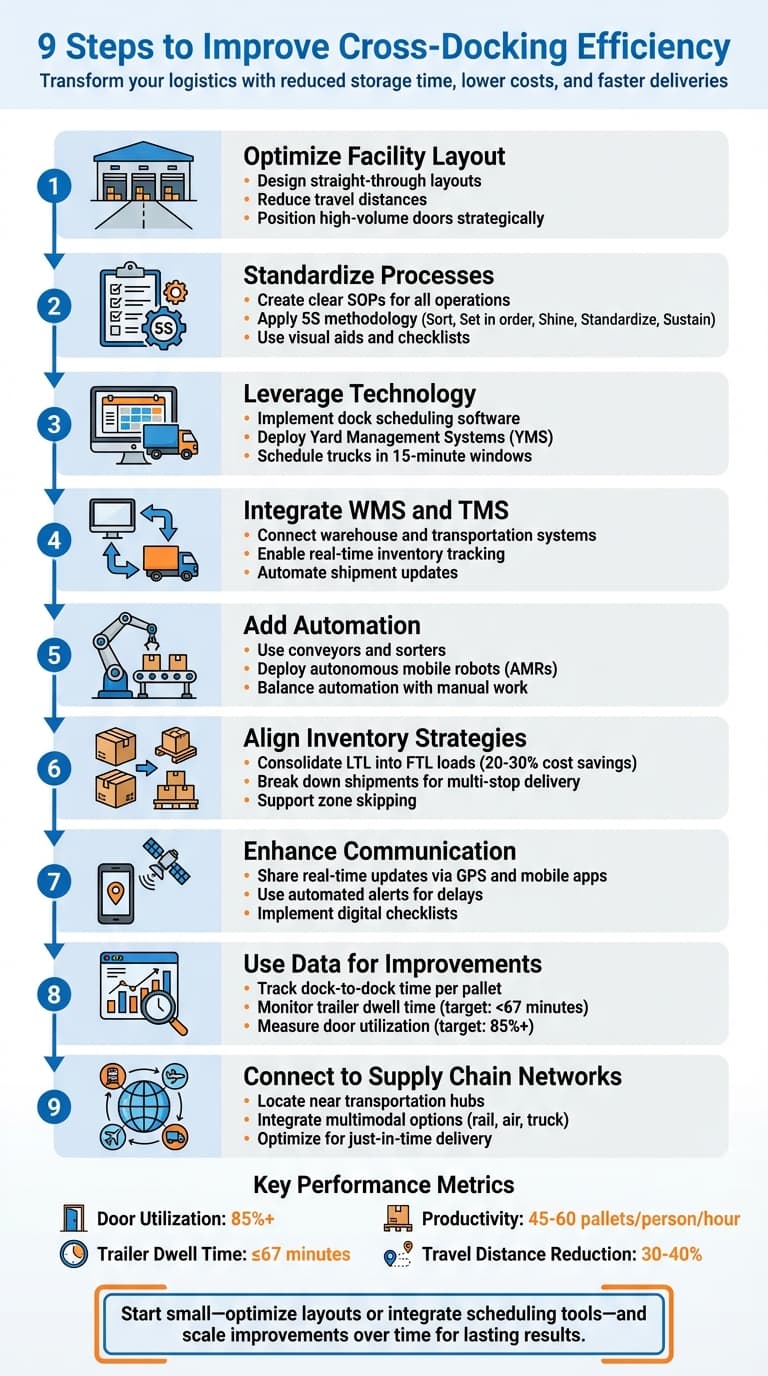
Cross-docking can transform your logistics by reducing storage time, cutting costs, and speeding up deliveries. But to achieve these results, you need precise planning, smart design, and the right tools. Here's a quick summary of the nine steps to improve cross-docking efficiency:
- Optimize Facility Layout: Design straight-through layouts and reduce travel distances for smoother operations.
- Standardize Processes: Use clear SOPs and lean practices like 5S to keep docks organized and efficient.
- Leverage Technology: Implement dock scheduling software and Yard Management Systems (YMS) to coordinate truck arrivals and trailer movements.
- Integrate WMS and TMS: Link warehouse and transportation systems for real-time inventory and shipment tracking.
- Add Automation: Use conveyors, sorters, or robots to handle repetitive tasks and reduce bottlenecks.
- Align with Inventory Strategies: Consolidate LTL shipments into FTL loads or break down shipments for multi-stop deliveries.
- Enhance Communication: Share real-time updates and establish clear protocols to keep teams aligned.
- Use Data for Improvements: Track KPIs like dock-to-dock time and door utilization to identify bottlenecks and refine processes.
- Connect to Supply Chain Networks: Locate facilities near transportation hubs and integrate multimodal options like rail, air, and truck.
Facilities implementing these strategies report improved door utilization (85%+), faster trailer dwell times (67 minutes or less), and higher productivity (45–60 pallets per person per hour). Start small - optimize layouts or integrate scheduling tools - and scale improvements over time for lasting results.
9 Steps to Improve Cross-Docking Efficiency in Logistics Operations
What Operational Conditions Support Efficient Cross-Docking?
Step 1: Design Your Facility Layout for Better Flow
The physical layout of your facility plays a huge role in how efficiently goods move from inbound to outbound docks. If workers or equipment need to travel unnecessary distances, it drives up labor costs, slows down operations, and creates bottlenecks. A smart layout eliminates these inefficiencies by reducing travel distances and avoiding congestion that can stall the entire process.
One of the most effective designs is a straight-through layout, where inbound doors are positioned on one side of the building and outbound doors are directly opposite. This setup creates clear, uninterrupted paths for freight movement. For example, when a Chicago retail distribution cross-dock shifted from fixed door assignments to dynamic scheduling with strategic door placement, they saw dramatic results: trailer dwell time dropped from 95 minutes to 67 minutes, and internal travel distances for key flows were cut by 30–40%. These kinds of layout improvements directly affect material flow, which we'll dive into next.
Improve Material Flow
To streamline material flow, start by positioning high-volume destination doors as close as possible to the primary inbound doors serving those lanes. This setup shortens pallet travel distances and speeds up operations. Grouping doors by region, customer, or route ensures freight destined for similar locations flows logically to clearly marked zones, rather than zigzagging across the facility.
The right equipment also makes a big difference. For carton and case-level moves, gravity or powered conveyors create continuous paths, freeing up forklifts for heavier pallet handling. When it comes to palletized freight and longer distances, forklifts are the best choice, especially if you design wide, straight aisles with minimal turns. For shorter, tighter moves in dock areas, pallet jacks - either manual or electric - are ideal. Using the right tools for the right tasks helps keep freight moving smoothly and avoids bottlenecks.
Staging areas should be shallow, clearly marked, and free of clutter. However, they should never block lift-truck aisles or pedestrian pathways. Wide, dedicated travel lanes that separate forklift traffic from staging zones reduce congestion and improve safety. Regular housekeeping is essential - clutter or stray pallets in travel lanes not only slow down forklifts but also increase the risk of accidents.
Measure Layout Performance
To ensure your layout is working as intended, track performance with quantitative metrics. Start by measuring the average travel distance per pallet to identify productivity gains. Use tools like warehouse management system (WMS) timestamps and telematics to monitor labor hours per unit and dock-to-dock time. A key metric to watch is dock-to-dock time per pallet, which measures the time from receiving to loading. Many cross-docks aim for a productivity benchmark of 45–60 pallets per person per hour.
To get a full picture, combine WMS data with time-and-motion studies using stopwatches and floor plans. Forklift telematics can also provide insights into actual routes and distances traveled. Comparing data from before and after changes - using lane samples over several weeks - gives you clear, evidence-based proof of how well your layout adjustments are working.
Step 2: Create Standard Processes and Keep Docks Organized
A well-thought-out facility layout can only succeed if it's supported by clear, consistent processes. Standard operating procedures (SOPs) take the guesswork out of daily operations, preventing misroutes, missed scans, and unsafe shortcuts - issues that can quickly lead to delays and damaged goods in fast-paced cross-docking environments. When every team member understands exactly how to handle freight from arrival to departure, errors and delays are minimized. SOPs are the foundation of a well-organized and efficient dock.
In addition to detailed SOPs, maintaining a clean and clutter-free dock is essential. Cluttered areas can block forklift paths, hide pallets, and create safety risks that slow down operations. Lean practices, such as the 5S methodology (Sort, Set in order, Shine, Standardize, Sustain), transform housekeeping into a system that directly enhances both safety and efficiency.
Write Clear SOPs
Your SOPs should address the core activities of cross-docking: unloading, staging, scanning, and reloading. For unloading, include steps like securing vehicles, performing door safety checks, verifying counts and condition against paperwork, and assigning pallet placement. Staging procedures should define standard zones based on destination, route, or carrier, and set rules for pallet limits per lane and escalation timelines for freight delays. Scanning protocols should cover all stages - unloading, staging, and loading - and include steps for handling exceptions, such as unreadable labels or OS&D (over, short, and damaged) situations. Reloading SOPs should detail trailer loading by route stop or delivery window, weight distribution checks, load securement, and final verification scans to ensure no freight is left behind.
Use visual formats to document these processes, such as one-point lessons, step-by-step checklists, and diagrams showing door assignments, staging lanes, and material flows. Write in plain language, use U.S. units (feet, pounds, °F), and provide translations in the primary languages spoken by your team. Each SOP should include its purpose, scope, roles, step-by-step instructions, safety notes, and measurable goals - e.g., "Unload a 53-ft trailer in 30 minutes with zero safety incidents." Post laminated copies at workstations, integrate them into handheld or tablet workflows, and use digital checklists for routine audits and inbound/outbound checks.
Apply Lean Practices
Once SOPs are in place, lean practices like 5S can take your operations to the next level. The 5S methodology ensures your dock stays organized and efficient. Start with Sort by removing unnecessary items like obsolete pallets, empty packaging, and unused equipment that block pathways. Then Set in order by clearly marking lanes, labeling dock doors, painting forklift routes, and assigning fixed spots for tools like pallet jacks, scales, and scanners. This reduces time wasted searching for equipment and prevents congestion. Regular cleaning of docks, ramps, and staging areas (Shine) minimizes debris-related accidents and keeps labels and floor markings visible. Use consistent labeling systems, color codes, and signage across shifts to Standardize the workspace. Finally, Sustain these improvements with regular audits and team huddles to ensure standards are maintained under pressure.
Practical visual aids can make 5S more effective in real time. For example, use color-coded floor markings to differentiate inbound and outbound lanes or designate specific carriers and routes. Hang overhead signs with door numbers and route IDs, install shadow boards for equipment, and label parking spots for forklifts and pallet jacks. Add large barcodes or QR codes at each lane and door so workers can scan and verify their location.
Track the impact of these practices with metrics like average dock-to-dock time per pallet, trailer dwell time, door utilization rates (aim for 80–85%), touchpoints per unit, and error rates. Many facilities see noticeable improvements in processing times and error reduction within months of implementing SOPs and 5S, all while maintaining high safety standards.
Step 3: Use Technology for Scheduling and Yard Management
Even with well-structured SOPs and lean practices, uncoordinated truck arrivals can lead to chaos. Without proper scheduling, your yard can quickly become congested with standby trailers, drivers might face long waits for dock doors, and staging lanes can turn into bottlenecks. Technology steps in to solve these problems by syncing truck schedules with dock capacity and enabling real-time tracking of trailers.
Two essential tools for tackling these challenges are digital dock scheduling software and Yard Management Systems (YMS). Scheduling software helps control truck arrivals, while a YMS tracks and assigns trailers to the right docks. Together, they streamline operations, cut down on waiting times, and ensure freight moves smoothly through your facility. These systems are the backbone of a well-coordinated cross-docking process.
Coordinate Schedules
Appointment systems help align truck arrivals with your available dock doors, labor, and equipment. By scheduling trucks in tight 15-minute windows, you can avoid congestion, reduce detention fees, and improve overall efficiency. Advanced tools like C3 Dock Scheduling integrate with your warehouse management system (WMS) and transportation management system (TMS) to factor in load details, shipment priorities, and real-time delays. Facilities that use dynamic scheduling and door assignments have seen major reductions in trailer dwell times during busy periods.
Tracking carrier compliance with appointment times also allows you to monitor on-time performance. This data can help you adjust scheduling rules, giving priority to reliable carriers during peak hours while assigning others to less busy times. Once appointments are set, a YMS ensures the yard operates smoothly without unnecessary delays.
Deploy Yard Management Systems
When combined with an efficient yard layout and standardized processes, a YMS can significantly reduce delays by managing trailer movements in real time. Once a truck arrives, a YMS tracks its location, status, and dwell time. By integrating with gate check-in, dock scheduling, and your WMS, it eliminates the problem of "lost trailers" and minimizes time spent searching for specific loads. Yard personnel can quickly move trailers between staging areas and dock doors, improving overall efficiency.
Many YMS platforms use door scoring algorithms to assign docks dynamically. These algorithms consider factors like carrier reliability, shipment volume, and destination priority. For instance, during peak times, high-volume outbound loads might be assigned to docks near staging areas, while lower-priority shipments are directed to less central locations. Facilities using this approach have reported a 30–40% reduction in internal dock travel distances, allowing forklifts and pallet jacks to focus on loading and unloading rather than excessive movement.
Drivers can check in digitally and receive real-time door assignments, while yard staff use tablets to monitor trailer locations, cutting down on wait times. Live dashboards provide updates on door utilization (aiming for 85% or higher), trailer queuing times, and resource allocation, ensuring productivity levels remain high - typically around 45–60 pallets per person per hour.
For maximum efficiency, choose YMS and scheduling systems that integrate seamlessly with your existing WMS and TMS. Real-time API connections provide accurate carrier ETAs, automatic schedule updates, and a unified view of appointments, dock status, inventory, and yard assets. With these tools in place, you can create a synchronized cross-docking operation where every truck, trailer, and dock door works together to keep freight moving smoothly and without delays.
Step 4: Connect WMS and TMS Systems
After setting up scheduling and yard management tools, the next logical step is linking your Warehouse Management System (WMS) with your Transportation Management System (TMS). Without this connection, your warehouse and transportation teams end up working in isolation, leading to delays, errors, and inefficient cross-docking processes.
A WMS is responsible for tracking inventory, managing picking and sorting tasks, and overseeing warehouse operations. On the other hand, a TMS focuses on transportation planning, carrier scheduling, and optimizing routes. When these systems are integrated using real-time API connections, they create a seamless flow of information. This integration provides a clear, unified view of your operations - from the moment freight arrives at the dock to when it’s dispatched for delivery. Breaking down data silos ensures everyone has access to accurate, up-to-date information.
Track Inventory and Shipments in Real-Time
By connecting WMS and TMS systems, you gain instant visibility into freight locations and progress. For instance, when a truck arrives, the TMS updates the WMS, which then adjusts inventory, assigns sorting tasks, and provides teams with precise carrier ETAs. Using tools like barcode scanners and mobile devices, both systems stay updated in real time, allowing workers to make quick adjustments. This synchronization helps eliminate bottlenecks and boosts productivity, with facilities often achieving targets of 45–60 pallets per person per hour.
Here’s a real-world example: A retail cross-dock facility in Chicago implemented dynamic scheduling tied to integrated WMS and TMS data. This change cut trailer dwell time from 95 minutes to 67 minutes. Automated alerts now notify managers when dwell times exceed two hours, enabling them to address issues proactively. This improved visibility reduces yard congestion and increases door utilization rates to over 85%.
Coordinate Cross-Dock Tasks
With real-time inventory insights, integrated systems take dock task coordination to the next level. For example, wave planning becomes much more efficient when WMS and TMS systems share data. Instead of manually grouping orders, the WMS automatically batches shipments based on destination priorities provided by the TMS. Tasks are then released to the dock in timed waves, while door scoring algorithms assign the best dock doors based on shipment volume, carrier reliability, and routing needs. Facilities using this approach have reported reductions in dock-to-dock travel distances by 30–40%.
Another key advantage is scan-based tracking, which uses mobile devices or automated sorters to log data at every stage - receiving, sorting, staging, and loading. Each scan updates both the WMS inventory records and TMS shipment manifests in real time, enabling fast routing decisions and immediate reporting of issues like damaged or mislabeled freight. Workers receive task assignments directly on handheld devices, eliminating paperwork and minimizing errors. Meanwhile, live KPI dashboards pull data from both systems to track throughput, carrier compliance, and processing times. These insights help managers make quick, informed decisions during busy periods.
Step 5: Add Automation for High-Volume Operations
Once your systems are integrated, the next step is to strategically introduce automation to make operations smoother and faster. The goal here is to clear up bottlenecks caused by manual processes, speed up freight movement, minimize errors, and allow your team to focus on more complex tasks that need human oversight.
Use Mechanized Handling Equipment
One way to achieve this is by using modular conveyor networks. These systems can be adjusted quickly to adapt to changes in volume, unlike traditional gravity conveyors, which are less flexible. Another great tool is smart sorters with scan-and-go capability. These devices automatically read barcodes or RFID tags and send items to the correct staging areas without requiring manual input.
For even more flexibility, consider deploying autonomous mobile robots (AMRs). These robots are particularly useful during busy periods when dock space is limited. Unlike fixed conveyors, AMRs can adjust to shifting floor layouts and manage variable routes between receiving and shipping areas. Facilities that combine these technologies with workforce tools often see noticeable efficiency improvements, especially when paired with dynamic scheduling systems.
Balance Automation with Manual Work
While automation is a game changer, it’s essential to maintain a balance with manual processes. Automation works best for high-volume, repetitive tasks, such as sorting and pallet movement, where delays are most common. However, manual workflows are still critical for handling exceptions, like quality checks, damaged freight, or irregular loads that need human judgment.
Start by integrating Warehouse Management Systems (WMS) and Transportation Management Systems (TMS), then build on that foundation with automation tools. To ensure smooth operations, equip workers with task management apps and digital checklists that align with automated workflows without causing confusion. Monitor performance using key metrics like door utilization rates (aim for 85% or higher), dock-to-dock time per pallet, and overall processing time. If automation helps cut down touchpoints and keeps trailer queuing time under two hours, you’re moving in the right direction.
sbb-itb-c0b8770
Step 6: Match Cross-Docking with Inventory Strategies
To optimize your supply chain, align cross-docking operations with your inventory goals by focusing on how freight is handled at the dock. Whether you're merging shipments or breaking them down, these actions can significantly impact the efficiency of inventory movement. Two key methods - consolidation and deconsolidation - can help streamline operations and cut costs when applied strategically.
Consolidate LTL Shipments into FTL Loads
Consolidation involves combining multiple Less-Than-Truckload (LTL) shipments into a single Full Truckload (FTL) for outbound delivery. This method reduces storage time and inventory carrying costs by enabling just-in-time movement. By consolidating shipments at the dock, you minimize touchpoints. Fewer touches mean lower risks of damage and delays, resulting in faster and more reliable operations.
The cost savings are significant. Consolidating LTL shipments into FTL loads can cut transportation expenses by 20-30% due to economies of scale, while also lowering warehousing fees and speeding up delivery times. This strategy is especially effective for high-demand SKUs, promotional items with strict delivery windows, and time-sensitive products where prolonged storage could increase risks or costs.
Facilities near major transportation hubs have a distinct advantage. For instance, operations around Chicago O'Hare or key railyards can consolidate LTL shipments into FTL trunk routes between major hubs. This not only reduces costs per mile but also improves delivery service levels when timed correctly. CR Express, for example, uses its Chicago hub to offer warehousing, cross-docking, and nationwide FTL/LTL services, ensuring efficient consolidation with real-time visibility into inventory.
Break Down Shipments for Multi-Stop Delivery
While consolidation focuses on high-volume efficiency, deconsolidation offers the flexibility needed for multi-stop deliveries.
Deconsolidation, also known as break-bulk cross-docking, involves breaking down large inbound FTL shipments or containers into smaller loads for multiple outbound destinations. This approach supports regional delivery needs, shortens cycle times, and prevents overstocking at end locations. By maintaining flexibility, deconsolidation helps balance inventory flow.
A standout use case for deconsolidation is zone skipping. This process involves breaking down shipments at a cross-dock to bypass intermediate zones, sending loads directly to their final or farther destinations. By doing so, you can reduce transit times and fuel costs while keeping inventory moving efficiently. For example, receiving full containers at a gateway facility, breaking them down by region or delivery route, and injecting them into last-mile networks closer to the customer can dramatically shorten delivery times.
To make both consolidation and deconsolidation successful, strong system integration is key. Seamless integration of your Warehouse Management System (WMS) and Transportation Management System (TMS) ensures that pre-labeled and pre-assigned moves are ready for both methods. This includes matching inbound advance ship notices (ASNs), purchase orders, and outbound orders in advance. Regularly review KPIs - such as dock-to-dock time per pallet and cost-per-unit - to refine these strategies. Aim for 85% or higher door utilization and a throughput of 45-60 pallets per person per hour.
Step 7: Improve Communication and Real-Time Coordination
Cross-docking thrives on precision and speed, but without clear communication among warehouse staff, drivers, dispatchers, and carriers, things can quickly spiral out of control. A small misstep can lead to delayed shipments, frustrated customers, and higher costs. When everyone isn’t on the same page, inbound and outbound operations lose sync, creating a ripple effect of inefficiency.
To prevent this, it’s crucial to establish open communication channels that allow for quick responses to unexpected changes. Effective coordination ensures everyone stays informed, minimizes downtime, and keeps delays from snowballing into bigger problems. Achieving this level of coordination requires the right tools and well-defined protocols to handle the unpredictable nature of daily operations. This is where real-time updates prove invaluable.
Share Real-Time Updates
Real-time visibility can completely change how teams operate at the dock. GPS tracking, for example, offers around-the-clock monitoring of shipments, making it easier to recover quickly from delays. Mobile apps are another game-changer: drivers can check in and get door assignments instantly, while dock supervisors use live KPI dashboards on their phones to monitor operations without disrupting workflows.
The best systems integrate cloud-based Warehouse Management Systems (WMS) and Transportation Management Systems (TMS) with carrier APIs. This integration provides accurate ETAs, exception reporting for damages, and dynamic scheduling that prioritizes shipments based on urgency and carrier reliability. These tools ensure smoother operations and faster responses to challenges.
Set Up Communication Protocols
Real-time updates are powerful, but they work best when paired with clear communication protocols. For instance, digital checklists can streamline inbound quality checks, while automated alerts flag dwell times that exceed two hours. Tablet-based reporting can simplify the process of documenting damages and OS&D (over, short, and damaged) events. These structured processes keep everyone in the loop, allowing for quick adjustments like accommodating tight appointment windows.
Technology further strengthens these protocols. Tools like task management apps, live productivity monitoring, and daily carrier compliance reports reduce errors and improve efficiency. Many facilities maintain high throughput by using these tools to handle 45–60 pallets per person per hour. A great example is CR Express, which employs real-time GPS tracking across its Full Truckload (FTL) and Less-Than-Truckload (LTL) services. This approach ensures constant cargo monitoring and seamless coordination for cross-docking in industries like retail and pharmaceuticals.
Step 8: Use Data to Drive Improvements
In modern cross-docking operations, data plays a critical role in driving efficiency and eliminating guesswork. It provides clear insights into delays, resource inefficiencies, and labor management, helping facilities identify bottlenecks, reduce waste, and allocate resources more effectively. Today’s cross-docking facilities rely heavily on real-time data and analytics to fine-tune processes like door assignments, trailer staging, and load building, ensuring smoother operations and better outcomes.
Track Key Performance Indicators (KPIs)
Tracking the right KPIs is essential for measuring and improving your cross-dock’s performance. For instance, dock-to-dock cycle time - a metric that tracks the time from an inbound trailer’s arrival to an outbound trailer’s departure - should ideally stay below two hours. Similarly, monitoring trailer turn time (or dwell time) is crucial. Leading facilities aim to keep this under 90 minutes, with the best performers achieving times between 60 and 70 minutes.
Other important KPIs include:
- Door Utilization Rate: Aim for at least 85% to maximize efficiency.
- Handling Cost Per Unit: Break this down by handling type to spot savings opportunities.
- Processing Time Per Shipment: Helps identify delays in individual shipments.
- Error Rates: Track issues like misloads, incorrect destinations, or labeling mistakes.
- Shipment Delay Rates: Monitor for patterns and address recurring issues.
Many facilities also set automated alerts for dwell times exceeding two hours, prompting immediate action from supervisors. For example, CR Express uses integrated technology platforms to monitor KPIs such as trailer turns and handling costs. Their systems provide real-time GPS visibility and live shipment tracking, enabling precise, data-driven decisions that support just-in-time delivery near Chicago’s major transportation hubs.
Find Bottlenecks with Data Analysis
Data analysis is invaluable for identifying operational slowdowns. Regularly reviewing metrics like processing times, error rates, and delays using dashboards can uncover patterns you might otherwise miss. For example, you might notice trailer queues spiking at specific times, carriers arriving late consistently, or certain product types requiring more time to process.
To pinpoint bottlenecks, review your data weekly, use forecasting tools to anticipate demand changes, and gather team feedback to validate trends. If dwell times are consistently higher during peak hours, you might test solutions like reassigning doors or increasing labor during those periods. After implementing changes, measure the results to ensure they’re effective.
Step 9: Connect Cross-Docking with Your Supply Chain Network
Cross-docking works best when it’s seamlessly integrated into your entire supply chain, rather than treated as a siloed warehouse task. By weaving cross-docking into your freight operations, you can slash storage costs, improve delivery timelines, and cut transportation expenses per unit. Companies that incorporate cross-docking into their network design often experience deliveries arriving 1–2 days sooner for regional shipments, better trailer utilization, and fewer last-minute shipping emergencies. This is because freight is managed holistically, from origin to destination, instead of being handled in disjointed steps. When tied to your broader supply chain, cross-docking leverages data-driven efficiencies to further reduce costs and speed up delivery times.
Choose Locations Near Transportation Hubs
Location is everything. Cross-docking facilities near ports, intermodal rail ramps, and airports can significantly lower drayage time, fuel consumption, and additional fees. Major hubs like Chicago, Los Angeles/Long Beach, Dallas–Fort Worth, and Atlanta are prime choices, as they sit at key intersections of highway, rail, and air networks. These locations are ideal for time-sensitive and multimodal operations. To maximize efficiency, choose facilities with spacious yards and ample dock capacity near these transportation nodes. This reduces travel distances and ensures carriers have easy access.
Take Chicago as an example. CR Express’s location near O’Hare International Airport (ORD) and major rail yards allows for quick airfreight recovery and smooth intermodal transfers. This strategic positioning minimizes fuel costs and detention fees while supporting high-volume operations without bottlenecks.
Combine Cross-Docking with Multiple Transportation Modes
Once you’ve secured the right locations, integrating multiple transportation modes can take your efficiency to the next level. Multimodal integration is where cross-docking truly excels. By combining air, rail, and truck transport, you can streamline load planning and lower per-unit costs. For instance, you can use intermodal drayage to pull containers from ports or rail ramps, deconsolidate them at your hub, and then rebuild them into optimized full truckload (FTL) linehauls or regional less-than-truckload (LTL) routes. For air freight, recover cargo directly from the airport, sort it by destination region in the cross-dock, and dispatch same-day or next-day ground deliveries. Similarly, full truckloads can be broken down into efficient multi-stop regional routes, improving truck utilization while meeting tight delivery windows.
CR Express demonstrates how effective this approach can be. By coordinating schedules, standardizing load plans, and using real-time tracking, they maintain just-in-time delivery even during disruptions. Success in multimodal cross-docking depends on precise scheduling with rail cut-offs and air cargo recovery windows, pre-planned load configurations for inbound shipments, and well-organized dock-door zoning to keep different transportation modes separate while minimizing forklift travel. This level of coordination ensures smooth operations and reliable delivery performance.
Conclusion
Boosting cross-docking efficiency hinges on an integrated approach that brings together smart facility design, standardized workflows, advanced technology, automation, inventory alignment, clear communication, data-driven insights, and network optimization. By implementing the nine steps outlined earlier, you can cut delays, streamline operations, and improve team coordination across your supply chain. A well-thought-out layout, standardized procedures, connected WMS and TMS systems, and the use of real-time data create an environment where products move swiftly, errors are minimized, and costs come down. Each strategy complements the others, creating a more agile and responsive operation.
The benefits are clear. Facilities that adopt these practices report impressive outcomes, including door utilization rates of 85% or higher and worker productivity levels of 45–60 pallets per person per hour. These gains translate to lower labor costs, faster inventory turnover, and enhanced customer satisfaction.
"CR Express has been our go-to logistics partner for over 10 years. Their bonded warehouse services and customs expertise have streamlined our international operations, saving us both time and money. The team's responsiveness and attention to detail is unmatched." – Michael Chen, Operations Manager
Start by evaluating your current processes against these strategies to identify areas for improvement. Pinpoint bottlenecks - whether they stem from inefficient layouts, disconnected systems, or a lack of real-time visibility - and focus on changes that deliver quick wins. Many experts suggest beginning with a single system, like dock scheduling or yard management, to build momentum and team buy-in before tackling larger integrations. Regularly tracking metrics like processing times, error rates, and trailer dwell times will help you measure progress and refine your approach over time.
For businesses managing time-sensitive or high-value shipments, partnering with a well-positioned provider can amplify these results. CR Express exemplifies how a strategic location, combined with cross-docking, warehousing, and multi-modal transportation services, supports just-in-time delivery and strengthens supply chains nationwide. By adopting these nine steps, you’ll set your operation up to compete more effectively, serve customers faster, and achieve measurable cost savings.
FAQs
What are the cost-saving benefits of cross-docking in logistics?
Cross-docking plays a key role in cutting logistics costs by reducing storage time, which helps lower warehousing expenses significantly. By limiting the need for extra handling, it simplifies operations and trims labor costs. On top of that, quicker shipment turnaround enhances inventory flow and decreases transportation costs, making the supply chain more efficient and economical.
How does technology help improve cross-docking efficiency?
Technology plays a key role in making cross-docking operations more efficient. With tools like real-time tracking, advanced GPS, and transportation management systems (TMS), shipments can be scheduled with precision, delays can be minimized, and load handling becomes more streamlined.
Digital platforms further enhance efficiency by enabling smooth communication across different parts of the supply chain. This allows for quick updates and faster responses to disruptions, which helps reduce waiting times and improves accuracy. The result? Cross-docking processes operate more smoothly and reliably, ensuring better overall performance.
What are the benefits of integrating WMS and TMS systems in cross-docking operations?
Integrating Warehouse Management Systems (WMS) with Transportation Management Systems (TMS) can take cross-docking operations to the next level. These systems complement each other by simplifying inventory tracking, automating key processes, and providing real-time visibility throughout the supply chain.
With fewer manual tasks and better team coordination, this integration helps cut down delays, make smarter use of resources, and speed up shipments with greater accuracy. The result? More efficient operations and happier customers.