

Checklist for Warehouse Perimeter Security
by CR Express Team, Logistics Team • 17 min read
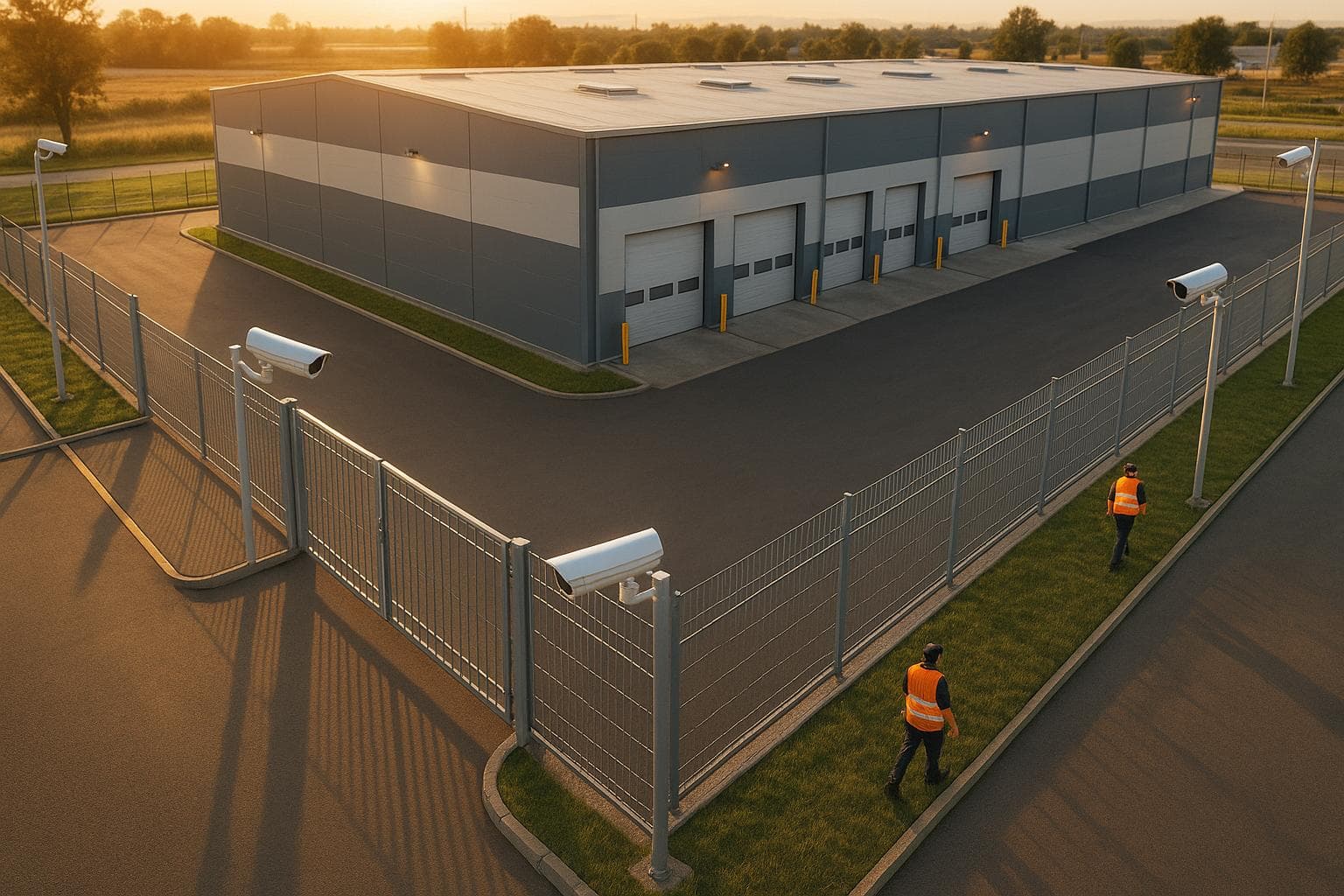
Checklist for Warehouse Perimeter Security
Securing a warehouse perimeter is critical to protecting assets and preventing incidents like theft, intrusion, or vandalism. A well-planned system integrates physical barriers, surveillance, and access controls to deter breaches and ensure compliance with regulations. Here's a quick summary of key steps:
- Evaluate vulnerabilities: Map access points, review past incidents, and assess surroundings.
- Define zones: Separate areas like public access, operational yards, and high-security zones with clear rules.
- Reinforce barriers: Use sturdy fencing, tamper-proof gates, and secure doors and windows.
- Improve surveillance: Combine lighting, CCTV, and intrusion sensors for comprehensive monitoring.
- Control access: Implement electronic systems for employees, visitors, and contractors.
- Regular inspections: Schedule daily, weekly, and monthly checks for maintenance and reliability.
- Train staff: Ensure employees understand protocols and reporting procedures.
- Incident response: Have a clear plan for handling breaches and documenting findings.
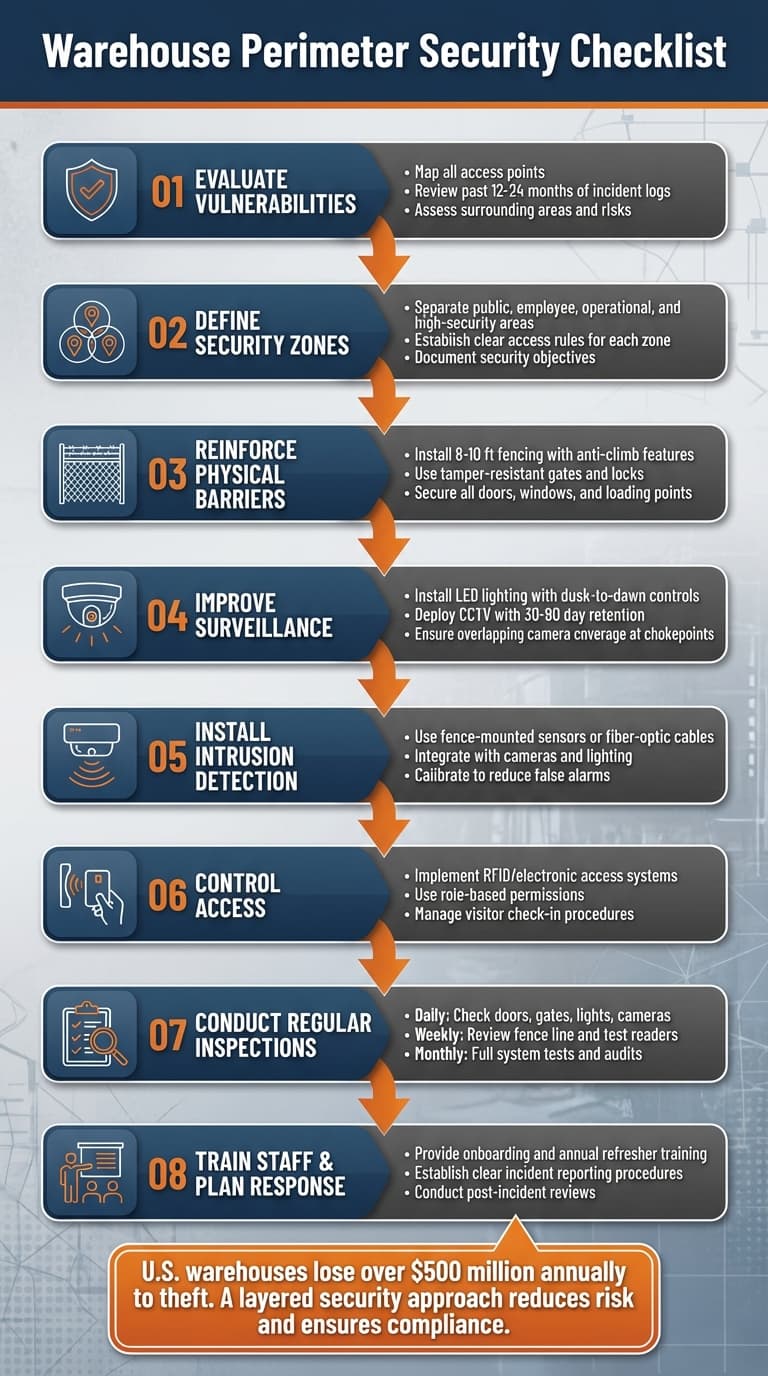
8-Step Warehouse Perimeter Security Checklist
How To Prevent Theft in Warehouse
Pre-Inspection and Planning
Before upgrading any security measures, it's essential to evaluate all assets and identify vulnerabilities. Pre-inspection and planning transforms perimeter security into a proactive strategy. This process focuses on three key activities: assessing the site and its surroundings, ensuring compliance with regulatory standards, and defining security zones tailored to your facility's operations.
Site and Surroundings Assessment
Start by mapping your property and listing every access point - vehicle gates, pedestrian doors, loading docks, rail spurs, and paths used by employees or contractors. Walk the perimeter both during the day and at night to uncover weak spots like poor lighting, damaged fencing, gaps under gates, or areas where overgrown vegetation could provide cover for intruders. Pay attention to what's beyond your fence line as well - vacant lots, truck stops, wooded areas, or shared access roads can heighten risks by offering hiding spots or quick escape routes for potential thieves.
Dive into your incident logs from the past 12 to 24 months. These logs should include thefts, attempted intrusions, trespassing, vandalism, and even near-misses like propped doors or unauthorized individuals in restricted areas. By mapping these incidents by location and time, you can spot patterns. For example, repeated fence cuts in a specific corner, thefts at loading docks during shift changes, or unauthorized tailgating through vehicle gates during peak traffic hours. Use these patterns to guide your countermeasures. If high-value cargo or bonded storage areas are frequent targets, they might need stronger barriers, stricter access controls, and better surveillance.
Facilities near major transportation hubs - like those close to Chicago O'Hare or intermodal railyards - should also factor in traffic patterns and cargo flows. Document areas like container parking lots, truck courts, and any airside or rail interfaces. Large-scale operations with constant vehicle movement and hundreds of containers can inadvertently create opportunities for intrusions or allow organized theft rings to monitor cargo movement unnoticed.
These observations will shape both your compliance efforts and your targeted security upgrades.
Regulatory and Industry Compliance
If your facility deals with air freight under TSA regulations, your perimeter must ensure a secure chain of custody with controlled access to screened cargo zones and ramp-side areas. For facilities operating as CBP Customs Bonded Warehouses (CBW), the perimeter must separate bonded zones from general areas and maintain accurate records of all entries and exits. Meanwhile, facilities storing pharmaceuticals under GDP (Good Distribution Practices) must have perimeter controls that prevent unauthorized access, supported by traceable access logs and comprehensive CCTV coverage.
CR Express integrates these regulatory requirements into clear perimeter security goals. For example, "prevent unauthorized entry to bonded yard gate" or "restrict access to TSA-controlled air cargo zones to SIDA-badged personnel." This approach ensures that your design, technology, and procedures align directly with compliance needs and audit readiness.
Security Zone Definition
Using insights from your site assessment and compliance review, divide your facility into distinct security zones, each with specific access rules and monitoring requirements. Common zones might include public access areas (like visitor parking and reception), employee areas (such as parking lots and common entrances), operational yards (docks, trailer and container parking, cross-dock lanes), and high-security zones (like bonded storage, pharmaceutical areas, high-value cages, or hazmat bays). Clearly define entry rules, authentication processes, and surveillance protocols for each zone.
Keep vehicle and pedestrian traffic separate to reduce crossover risks, and enforce controlled access between public, operational, and high-security areas. For facilities with multi-modal operations - such as general warehousing, GDP-compliant pharma rooms, CBW zones, and secured loading docks for screened air freight - documented security objectives for each zone ensure consistent protection and simplify audits.
Physical Barriers and Access Points
After mapping out your security zones and understanding compliance requirements, the next step is to establish physical barriers to keep unauthorized individuals and vehicles out. This includes fencing, gates, doors, and loading points, which form the first layer of defense - provided they are well-designed, properly installed, and regularly maintained. Weaknesses like corroded fence sections, misaligned gates, or unsecured dock doors can compromise even the most advanced surveillance and access control systems. These physical barriers lay the groundwork for secure access systems, which will be discussed later.
Fencing and Walls
For standard warehouse operations, your perimeter fence should be at least 8 feet high. Facilities handling high-value goods, customs-bonded items, or pharmaceuticals should aim for 9–10 feet. Options like steel or aluminum palisade fencing, welded wire mesh, or heavy-gauge chain link with rigid posts provide better resistance to cutting and climbing compared to lighter residential fencing. The type of fencing should align with the security needs of your designated high-risk areas.
Where permitted by local regulations, add anti-climb features such as tight mesh that eliminates footholds, outward-angled tops, or barbed wire along the top rail. Fences should be installed so that rails and mesh face inward, making them harder to scale from the outside. Embed fence posts in concrete to resist impacts and tampering. Maintain a clear zone of 3–6 feet on both sides of the fence to prevent stacked pallets, shrubs, or parked equipment from being used as climbing aids. Trim any tree branches near the fence and keep ground cover low to ensure clear sight lines for cameras and patrols.
Regular inspections are essential - walk the fence line to look for cuts, gaps under gates, loose sections, damaged posts, or signs of rust. For facilities near transportation hubs, such as intermodal yards with large numbers of containers, design the layout to ensure container rows don’t obstruct visual or camera coverage of the fence.
The next priority is securing vehicle and pedestrian entry points.
Vehicle and Pedestrian Gates
Gates are often the weakest link in perimeter security and must match or exceed the strength of the surrounding fence. Use heavy-duty steel frames with welded mesh or palisade panels mounted on sturdy posts. Hinges should be tamper-resistant or have internal hinge pins. Gates should close flush with no gaps to prevent prying. For sliding gates, protect the tracks and rollers from being lifted and install stops to keep the gate from being forced off its rails.
Use tamper-resistant locks that log every opening and closing. Automate gate operations with RFID systems, license plate recognition, or pre-approved IDs for efficient and trackable access. Pedestrian gates should be narrow enough to block vehicle entry, self-closing, and self-latching, with emergency egress hardware installed inside as required by fire codes.
For high-security zones like customs-bonded areas, consider installing visible anti-ram barriers such as fixed bollards or reinforced posts. These barriers should be well-lit and clearly marked to prevent accidental collisions by authorized drivers.
Doors, Windows, and Loading Points
Main warehouse entry doors should be built from reinforced metal and securely anchored into concrete. Use heavy-duty hinges with non-removable pins and at least three points of attachment. Reinforced strike plates should be secured with long screws that penetrate the structural framing. Install ANSI Grade 1 deadbolts or mortise locks designed for commercial use, with minimal exposed hardware to deter tampering. Where electronic access controls are used, combine card readers or keypads with mechanical locks to ensure doors remain secure while allowing safe emergency exits.
Overhead and dock doors should be constructed from heavy-gauge steel with tamper-resistant tracks. When closed, these doors must fit snugly into the floor and frame to prevent prying or lifting. Add locking bars or bolts to secure the structure, and use padlocks or integrated locks that resist cutting. During operating hours, monitor door opening heights and use dock locks or vehicle restraints to prevent trucks from moving prematurely or unauthorized access beneath doors. Dock man-doors should meet the same standards as exterior doors and be integrated with access control systems and CCTV.
For windows and skylights in high-risk zones, consider eliminating them altogether. If that’s not possible, reinforce them with laminated or polycarbonate glazing, internal window bars, or external grilles secured from the inside. Rolling shutters on ground-level or truck-accessible windows can be closed after hours and locked to resist tampering. Ventilation louvers and other mechanical openings should have welded mesh or metal grilles installed behind the blades to prevent human entry.
Conduct annual inspections of all access points, including roof hatches and utility doors, and maintain a master register for audits. Roof hatches and fixed ladders should be secured with high-security hasps and padlocks or integrated into the electronic access control system. Protect or remove ladder rungs below a certain height using guards or cages. Any unused doors or openings should be permanently sealed with masonry or welded plates for maximum security.
Lighting, Surveillance, and Intrusion Detection
Once physical barriers are in place, the combination of lighting, CCTV, and intrusion detection systems plays a crucial role in securing a site. These elements work hand in hand - poor lighting can reduce camera effectiveness, and cameras without intrusion sensors may only document incidents instead of helping to prevent them.
Exterior and Yard Lighting
A well-lit perimeter is essential for security. Areas like fence lines, gates (both vehicle and pedestrian), loading docks, parking lots, and walkways must have consistent, glare-free lighting to eliminate dark spots where intruders could hide. LED floodlights with photocell controls (dusk-to-dawn operation) are ideal for maintaining steady illumination, while motion sensors in less-trafficked areas like side alleys or rear fences can draw attention to movement and save on energy costs.
Use vandal-resistant, weather-rated LED fixtures mounted at heights that reduce tampering. Coordinate light placement with camera angles to avoid glare that could obscure footage. For larger areas like container yards or trailer parking lots, pole-mounted LED lights with wide beam patterns ensure even lighting across rows without blocking sight lines. Regular maintenance is key - inspect lighting monthly, clean lenses quarterly, and replace any failed bulbs immediately to avoid blind spots. To reinforce security, post "CCTV in operation" signs at entrances and along the perimeter.
Good lighting does more than deter potential intruders - it enhances camera performance, making it an essential part of a reliable surveillance system.
CCTV and Video Surveillance
A proper camera setup ensures thorough coverage of critical zones with no blind spots. Place cameras strategically to monitor areas like perimeter fences (both top and base), gates, loading docks, entry and exit points, parking lots, and blind corners. Overlapping fields of view at chokepoints, such as gates and dock doors, ensure that at least two cameras capture activity in these key areas, providing better evidence if an incident occurs.
Different cameras serve different purposes:
- Bullet cameras are great for fence lines, driveways, and other corridors needing directional coverage.
- Dome cameras work well in loading docks, entrances, or areas requiring wide-angle views or vandal resistance.
- PTZ (pan-tilt-zoom) cameras are ideal for large spaces like parking lots or yards, allowing active tracking of vehicles or individuals.
Outdoor cameras must be weather-resistant (IP-rated) and equipped with infrared (IR) or low-light capabilities for clear nighttime footage. Protect cables using conduits or armored runs to prevent tampering or cutting.
Establish a video retention policy - most operations store footage for 30 to 90 days, but high-risk zones or regulated cargo may require longer retention periods. Restrict access to video footage to authorized personnel and keep audit logs of who accessed it and when. To ensure uninterrupted recording, back up critical equipment with uninterruptible power supplies (UPS) and consider redundant storage options, such as edge storage on cameras paired with central NVR systems. This layered approach strengthens surveillance and supports intrusion detection efforts.
Intrusion Detection Systems
Perimeter intrusion detection systems alert security teams to breaches before intruders reach critical areas. Various sensors can be used depending on the site:
- Fence-mounted vibration or microphonic sensors detect unusual activity like cutting, climbing, or lifting of fence panels.
- Fiber-optic cable sensors can be attached to fences or buried underground to sense digging, climbing, or vehicle movement, pinpointing the intrusion to a specific segment.
- Microwave or radar-based sensors create invisible detection zones in open yards or building approaches, triggering alarms when crossed.
When a sensor detects an intrusion, the system should automatically activate nearby cameras - PTZ cameras can focus on and track the source - while turning on additional lighting in the affected area to improve visibility and deter further action. Alerts, often with camera snapshots, should be sent to security staff or remote monitoring centers. In some cases, doors or gates near the breach can lock automatically until the situation is resolved.
To avoid unnecessary alarms, calibrate sensors to filter out non-threatening triggers like wind or wildlife. Establish clear procedures for handling alarms, including verification steps (e.g., checking video footage), priority levels, and escalation paths for guards or law enforcement. Regular testing is crucial - simulate scenarios like fence climbs or gate openings monthly or quarterly to confirm that alarms function properly and logs are accurate. Document all tests, inspections, and maintenance as part of your security protocol to ensure long-term reliability.
sbb-itb-c0b8770
Access Control and Yard Operations
Securing a yard goes beyond just physical barriers - it’s about controlling access and managing cargo effectively. By combining access control systems with clear yard procedures, you can protect high-value freight and improve operational efficiency. These measures significantly reduce theft risks, which cost U.S. warehouses over $500 million annually, while also ensuring compliance with regulations.
Electronic Access Control
Electronic access systems create a detailed record of every entry and exit, making them a key tool for security. Using RFID cards or fobs at pedestrian doors and vehicle gates ensures that only authorized individuals can enter. Role-based profiles further enhance security by limiting access to specific areas.
For sensitive zones like control rooms, high-value storage areas, or customs-bonded warehouses, consider adding PIN pads or dual-factor authentication (e.g., card plus PIN) to prevent badge sharing. In facilities with heightened security needs - such as GDP-compliant pharmaceutical sites - biometric readers like fingerprint or facial recognition scanners provide even stronger identity verification and eliminate issues with lost badges. For added oversight, integrate these systems with video logs to speed up investigations if needed.
Keep detailed logs of all entries and exits, including time stamps, user IDs, and locations. Retain these records long enough to meet audit and claim requirements. Conduct quarterly audits to remove inactive credentials, tighten permissions, and deactivate badges for former employees or expired contractors.
While electronic systems cover employees, visitor and contractor access needs separate management.
Visitor and Contractor Management
Non-employees, such as truck drivers, contractors, and delivery personnel, should check in at a controlled gate or guard station before entering the yard. Verify their identity using a valid government-issued photo ID or commercial driver’s license. Record key details like vehicle make, license plate, trailer or container number, company name, and the purpose of their visit. Issue temporary badges that are clearly marked and automatically expire after their visit.
For frequent drivers, maintain a pre-approved list and link it to dock scheduling or transportation management systems. This allows gate staff to quickly match arriving trucks with expected shipments. A brief safety and security orientation at check-in - covering speed limits, restricted areas, and escort policies - can further enhance security. At the end of each shift, reconcile logs to ensure all temporary badges are returned and all visitors have exited the premises.
Once access is controlled, focus on optimizing the yard layout to eliminate blind spots and improve security.
Yard Layout and Container Security
A well-organized yard boosts both security and efficiency. Designate separate zones for visitor parking, employee parking, loaded trailers, empty trailers, and high-value or regulated cargo. Use numbered and mapped parking spots so every trailer or container location can be easily tracked. Plan traffic flow with a single controlled entry/exit gate, clear truck lanes, and pedestrian walkways to reduce risks. Straight rows and unobstructed camera views help minimize blind spots where tampering could occur.
Keep meticulous logs for seal integrity and chain-of-custody tracking. For high-value or long-stay trailers, consider using additional security tools like kingpin locks, glad-hand locks, or wheel boots to prevent unauthorized movement. Conduct regular yard checks - either manually or with electronic audits - during each shift to verify that trailers are in their assigned spots, properly secured, and free from unauthorized vehicles.
Facilities handling time-sensitive, high-value, or regulated freight, such as CR Express locations near major hubs, should align their yard zones and access protocols with regulatory standards. Documenting all chain-of-custody events not only meets compliance requirements but also builds trust with customers.
Inspections, Staff Training, and Incident Response
Routine inspections help catch problems early, thorough training equips employees to spot potential threats, and clear incident protocols ensure a swift, organized response when issues arise. Together, these measures create a solid foundation for effective security management.
Scheduled Inspections and Maintenance
Divide inspections into daily, weekly, and monthly cycles to ensure nothing is overlooked. Daily checks, often handled by security guards or shift supervisors, should confirm that all perimeter doors and gates are secure, exterior lights are working, CCTV cameras are recording properly, and access control panels are functioning without errors. Weekly inspections should include a thorough review of the entire fence line for damage or objects that could assist climbing, testing card readers and keypads, and analyzing recent logs for recurring issues. Monthly or quarterly audits should go deeper, covering full system tests like activating motion sensors to confirm alarm responses, reviewing CCTV footage retention to spot blind spots, testing backup power systems, and ensuring signage is visible and compliant.
Document every inspection carefully. Record details like the date, inspector's name, items checked, pass/fail outcomes, and any corrective actions taken. Using digital tools like checklists or maintenance platforms can make it easier to track trends, attach photos, and generate reports for audits or insurance purposes. Preventive maintenance - such as tightening hinges, replacing light bulbs, cleaning camera housings, and updating firmware - should follow a set schedule, typically quarterly or semiannually for critical equipment. These documented efforts not only maintain system reliability but also support regulatory compliance.
Once inspections are routine, properly trained staff are critical to maintaining these standards.
Staff Training and Responsibilities
All employees and contractors should go through onboarding and annual refresher training to understand perimeter security protocols. This includes securing doors and gates, using badges correctly, and identifying suspicious activities like loitering near fences, unfamiliar vehicles at access points, or attempts to bypass controls. Security officers require more in-depth training on patrol routes, CCTV operation, incident documentation, evidence handling, and working with law enforcement. Yard staff and forklift operators must focus on securing dock doors, verifying seals, and following established barriers. Drivers, including third-party carriers, need clear instructions on check-in procedures, speed limits, and restricted area rules.
Assigning roles and responsibilities helps prevent security gaps. Supervisors should verify end-of-shift lockups and review logs, while security and yard staff should handle patrols, escort visitors, and document any exceptions. Management should review quarterly security reports and sign off on policy updates. Encourage a "see something, say something" mindset by establishing clear reporting channels so employees feel confident raising concerns.
Incident Reporting and Response Plans
Even with strong security systems, breaches can happen. A written incident response plan is essential for managing these situations effectively. Outline steps from detection to recovery, including alarm verification, securing the scene, notifying leadership and law enforcement, and completing a standardized incident report. This report should include details like the date, time, location, people involved, a description of the incident, and any supporting media. Preserve evidence immediately by saving relevant CCTV footage with timestamps, locking access control logs, and avoiding disturbance of physical evidence like damaged locks or footprints until authorities complete their review.
After significant incidents, conduct a post-incident review to identify the root cause - whether it's equipment failure, human error, process gaps, or even collusion. Use the findings to implement corrective actions, such as upgrading locks, adding cameras, revising access protocols, or providing targeted retraining. Update security checklists and training materials to address any newly discovered vulnerabilities. For operations involving sensitive or regulated freight, coordinate with logistics partners and customers to ensure timely notifications and compliance with any required filings.
Conclusion
Creating effective perimeter security means combining physical barriers with advanced technology to establish a strong, layered defense. Each measure should work in harmony with the others. To make this system work, it’s essential to enforce clear policies and train staff to handle alarms, verify identities, and follow proper sign-in protocols. When people, processes, and technology align, warehouses can better safeguard inventory, protect employees, and keep operations running smoothly.
Strong perimeter security also plays a critical role in meeting regulations and ensuring business continuity. A breach at the perimeter doesn’t just risk inventory - it can disrupt shipping schedules, damage customer trust, and lead to higher insurance premiums. By focusing on these areas, businesses can strengthen their overall security framework and maintain steady operations. Regularly revisiting and improving your security measures is key to keeping the system effective.
To stay ahead of evolving threats, make updates and inspections part of your routine. Use this checklist as a living document, adapting it whenever there are changes to the facility or new risks emerge. Establish a schedule for perimeter checks - daily inspections of fences, gates, and lighting, paired with monthly tests of CCTV systems and alarms - and keep detailed records of your findings. Assign a security manager or operations supervisor to oversee these efforts, address repairs quickly, and refine the checklist as needed. Small, consistent improvements, like better lighting, stricter gate protocols, or expanded camera coverage, add up over time to create a stronger security system. Taking a proactive stance now helps protect your people, inventory, and reputation while ensuring smooth logistics and operational reliability.
FAQs
What steps can I take to identify and address vulnerabilities in my warehouse perimeter?
To properly evaluate and secure your warehouse perimeter, begin with a thorough inspection of the entire boundary. This means checking fences, gates, and all entry points for any vulnerabilities. Keep an eye out for damaged sections, poor lighting, or areas that lack proper surveillance.
After that, take a close look at your security systems to confirm everything is functioning as it should. Test your CCTV cameras, motion sensors, and alarm systems. If necessary, consider upgrading to advanced, integrated security technologies to improve monitoring and ensure quicker responses.
Lastly, implement clear access control measures to prevent unauthorized entry. This could include using keycards, biometric scanners, or stationing security personnel at key access points. Regularly reviewing and updating these protocols will help keep your logistics facility safe and secure.
What are the best practices for implementing electronic access control in a warehouse?
To set up electronic access control in a warehouse, begin by pinpointing the critical entry and exit points that need oversight. Equip these areas with secure access tools like key card readers, biometric scanners, or PIN pads to restrict entry to authorized individuals only. Make it a priority to update user permissions regularly as staff roles change, and perform routine audits to uphold security standards.
For an extra layer of safety, consider integrating the access control system with CCTV cameras and motion-activated lighting. This allows for real-time monitoring of activities around the facility. Connecting the system to a centralized platform simplifies management and reporting, making it easier to track access and detect issues. Lastly, ensure all staff members are trained in using the system correctly to minimize risks and maintain seamless operations.
What are the best practices for designing a secure and efficient warehouse yard layout?
To keep your warehouse yard both safe and efficient, focus on a design that emphasizes visibility, controlled access, and smooth traffic flow. Start by installing full-coverage CCTV systems and motion-activated lighting to monitor activities and discourage unauthorized entry. Clearly marked entry and exit points, equipped with gates or security checkpoints, can help regulate the movement of vehicles and personnel.
Set aside specific zones for loading, unloading, and parking to reduce congestion and keep operations running smoothly. Incorporating features like secured loading docks and providing enough yard space for vehicles to maneuver safely can make a big difference. By combining smart planning with solid security measures, you can enhance your logistics operations significantly.