

RPA in Logistics: Cost Benefits for Small Businesses
by CR Express Team, Logistics Team • 11 min read
RPA in Logistics: Cost Benefits for Small Businesses
Robotic Process Automation (RPA) is transforming logistics by automating repetitive tasks like data entry, shipment tracking, and invoice processing. Small businesses, often constrained by limited budgets and resources, are leveraging RPA to cut costs, improve accuracy, and boost efficiency. Key takeaways include:
- Cost Savings: Businesses report labor cost reductions of up to 30% and overall cost savings between 30%–70%.
- Quick ROI: Most companies see a return on investment within 6–9 months.
- Error Reduction: RPA minimizes manual errors, which cause 71% of supply chain issues, saving money on corrections and avoiding disruptions.
- Scalability: Bots work 24/7 without added costs, handling seasonal demand and business growth without hiring more staff.
For small logistics businesses, RPA simplifies processes like e-commerce order management and billing, enabling them to stay competitive while reducing operational expenses.
RPA in Supply Chain - Robotics Process Automation & DHL Case study
How RPA Reduces Costs: Key Study Findings
Research highlights how Robotic Process Automation (RPA) delivers noticeable financial benefits for small logistics businesses. Companies that integrate RPA into their supply chain operations report cost reductions between 30% and over 70%. For small and medium-sized enterprises, a 2022 study revealed that RPA adoption in logistics processes cut total organizational costs by about 10%.
And these benefits don’t take long to show. Most organizations see a return on their investment within six to nine months. This quick payback period makes RPA one of the most attractive technology investments, especially for businesses operating with tight budgets. Let’s take a closer look at how automation helps reduce labor expenses.
Reducing Labor Costs Through Automation
Labor is one of the largest expenses in logistics, and RPA offers a direct solution to this challenge. By automating repetitive tasks, businesses can lower labor costs by as much as 30% while boosting productivity by 40%. In contrast, manual processes often result in 15% higher labor expenses.
The workload reduction is striking. RPA can handle up to 50% of overall workloads, taking over tasks like data entry, shipment tracking, and invoice processing. For example, SF Supply Chain saved 74,000 working hours across multiple locations by automating these manual tasks.
These savings are especially valuable given the ongoing skilled labor shortage. Instead of hiring additional employees to manage increasing transaction volumes, small businesses can deploy RPA bots. These bots operate 24/7 without breaks, benefits, or overtime pay. To put it in perspective, the cost of maintaining an RPA bot is roughly the same as paying a human worker minimum wage for a 40-hour workweek.
But the cost benefits don’t stop at labor. RPA also significantly reduces the financial burden caused by errors.
Cutting Costs by Reducing Errors
Manual processes account for 71% of all supply chain errors, and these mistakes can be expensive. Correcting a single data entry error can cost anywhere from $50 to $200, while inventory discrepancies can lead to losses of up to $1,000 per SKU. On a larger scale, inefficient manual data entry can drain as much as 20% of a company’s annual revenue.
RPA steps in with near-perfect accuracy, minimizing these costly mistakes. Errors in shipment details, customer addresses, and inventory quantities - which often result in incorrect routing or hefty storage fees - are almost entirely eliminated when bots handle data transfers between systems. While manual inventory management achieves only 63% accuracy, RPA-driven systems can reach close to 100%.
The financial impact goes beyond fixing errors. Manual mistakes often lead to supply chain disruptions, which cost U.S. companies an average of $228 million annually. By preventing these issues, RPA helps small businesses avoid compliance fines, unhappy customers, and the cascading costs of correcting errors. For instance, HBL Bank implemented RPA for sanction screening, saving 341,000 working hours annually while achieving a 98% accuracy rate.
How Small Businesses Use RPA in Logistics
Small logistics businesses are turning to RPA (Robotic Process Automation) to tackle repetitive tasks that drain time and resources. This isn't just a theoretical fix - companies are seeing real improvements in their daily operations. These savings make RPA an appealing tool for specific logistics challenges. Let’s explore two areas where RPA is making a noticeable impact.
E-Commerce Order Processing
For small businesses, managing e-commerce orders can be a time-consuming process. RPA bots simplify this by automating tasks like extracting order data from emails and other channels. Once gathered, the bots verify customer details and input the information directly into logistics management software - no manual data entry required.
This automation speeds up order processing, ensuring shipments move faster and customers receive their orders sooner. Employees, in turn, can focus on more complex tasks, like resolving exceptions, instead of being bogged down by routine data entry.
RPA also enhances the entire order-to-cash process. Bots handle tasks such as generating invoices, creating shipping labels, sending payment reminders, and performing inventory checks in real time. They even place new stock orders when inventory levels drop too low, preventing both stockouts and overstocking that could strain finances. These efficiencies allow smaller logistics providers to stay competitive by keeping operations lean and responsive.
Billing and Invoice Management
Billing errors can be costly, but RPA helps by using optical character recognition (OCR) to extract data from invoices, shipping documents, and bills of lading. The bots then input this data directly into accounting or transportation management systems, eliminating the need for manual entry.
Beyond data entry, RPA automates invoice validation and generation. Bots verify order details, apply tariff rates or discounts, and perform three-way matching between invoices, purchase orders, and receipts. They can even approve or flag invoices based on predefined rules. For accounts receivable, bots send payment reminders, monitor payment statuses, and prioritize collections based on aging reports.
This automated approach is particularly useful during seasonal spikes in invoices, as it scales effortlessly without requiring additional staff. By maintaining error-free and efficient billing processes, small logistics businesses can continue operating cost-effectively, even during peak periods.
sbb-itb-c0b8770
Measuring Cost Benefits and ROI
Manual vs RPA Processes Cost Comparison in Logistics
Expanding on earlier insights, the financial advantages of RPA make a compelling case for small logistics businesses to invest in automation. Manual inefficiencies often chip away at profit margins, while the reductions in labor costs and errors discussed earlier directly contribute to faster returns on investment.
Cost Comparison: Manual vs. RPA Processes
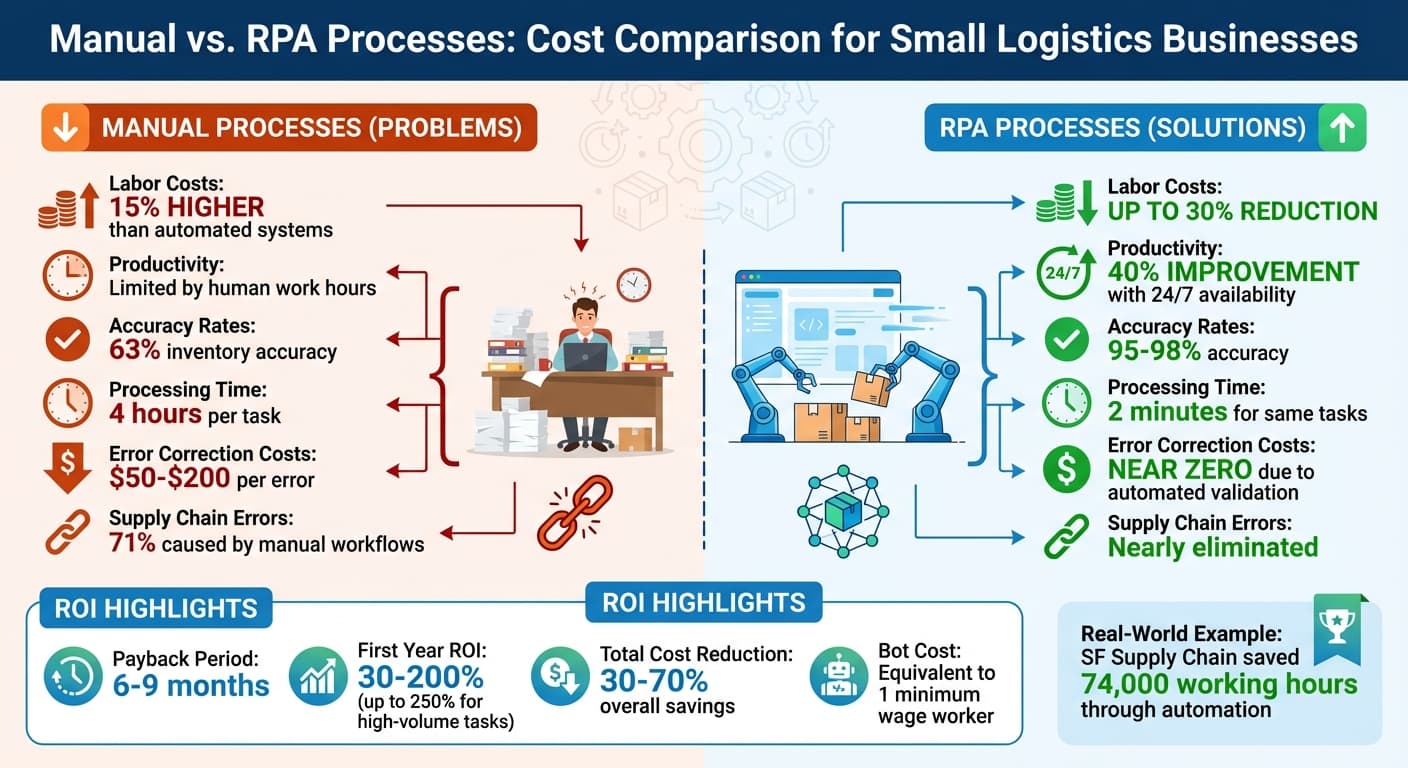
Companies sticking to manual processes spend, on average, 15% more on labor and face a 15% increase in overall supply chain costs. On top of that, 71% of supply chain errors stem from outdated, manual workflows. These inefficiencies come with a hefty price tag, underscoring the need for automation.
| Metric | Manual Processes | RPA Processes |
|---|---|---|
| Labor Costs | 15% higher than automated systems | Up to 30% reduction |
| Productivity | Limited by human work hours | 40% improvement with 24/7 availability |
| Accuracy Rates | Around 63% inventory accuracy | Between 95% and 98% accuracy |
| Processing Time | 4 hours per task | 2 minutes for the same tasks |
| Error Correction Costs | $50–$200 per error | Near zero due to automated validation |
Source:
One standout example is SF Supply Chain, which automated repetitive logistics tasks across multiple locations. This shift saved the company a staggering 74,000 effective working hours. Such results highlight the dramatic cost and time savings that automation can deliver.
Expected ROI Timelines
For small businesses, RPA implementations typically pay for themselves within six to nine months. First-year ROI can range from 30% to 200%, and in some cases, even hit 250% when applied to high-volume, rule-based tasks. Additionally, RPA can reduce total organizational costs by about 10% for small and medium enterprises. The initial investment is also quite manageable - equivalent to the cost of employing one full-time minimum wage worker. This affordability makes RPA an attractive option for smaller logistics companies aiming to stay competitive without overspending.
Implementation Challenges and Growth Potential
Tackling Initial Setup Barriers
For small businesses, the biggest challenge often lies in the perceived costs and complexity of implementation. In fact, 54% of supply chain professionals identify implementation costs as the primary obstacle to adopting RPA. Typically, deploying a bot can range from $5,000 to $15,000.
The solution? Start small. Take DHL Global Forwarding, for example. Their "Post Flight" pilot project introduced a software robot to reconcile flight status data with shipment operations. This bot managed tasks previously handled by 15 out of 30 employees. Remarkably, DHL recouped the entire investment within just one month. Testing RPA on a single high-impact process like this can help businesses minimize risks while building confidence in the technology.
Another common worry is integrating RPA with older software systems. However, RPA is designed to work alongside existing systems without requiring costly replacements or complex code changes. When direct integration proves difficult, middleware or APIs can act as bridges, connecting bots to legacy systems.
Employee resistance is another hurdle, often fueled by concerns about job security. In fact, 44% of enterprises cite poor change management as a reason for RPA failures. One effective way to address this is by framing automation as a tool to eliminate repetitive tasks rather than replace jobs. For instance, when Raben Group rolled out over 200 RPA automations, they saved 78,815 employee workdays and over €6 million in a single year. Importantly, employees were reassigned to more meaningful, higher-value work.
Once the initial setup challenges are overcome, RPA’s ability to scale ensures it can meet growing business demands.
Managing Seasonal Demand and Supporting Business Growth
After successfully implementing RPA, its scalability becomes a game-changer. Bots can work around the clock without needing overtime pay, sick days, or breaks. During busy periods, such as holiday seasons or unexpected surges in demand, bots handle tasks like order entry, shipment tracking, and invoicing seamlessly. This eliminates the need to hire and train temporary staff, saving both time and money.
For businesses experiencing growth, RPA offers an efficient way to expand. Adding more bots costs significantly less than hiring and training new employees. Unlike manual scaling, which often comes with rising operational expenses, RPA keeps costs steady, allowing businesses to maintain lean operations even as revenue increases.
Conclusion: RPA Benefits for Small Logistics Businesses
For small logistics businesses aiming to stay competitive, RPA (Robotic Process Automation) offers a game-changing solution. By implementing RPA, companies can achieve impressive results - cost savings ranging from 30% to 70%, a productivity boost of 40%, and a return on investment (ROI) typically within six to nine months. Consider this: manual data entry alone can consume up to 20% of annual revenue. Automation is not just an option; it’s a proven strategy for improving profitability.
RPA systems also excel in accuracy, nearly eliminating manual errors. Unlike humans, bots work tirelessly around the clock, processing orders, tracking shipments, and managing billing with unmatched speed and precision. This is critical, as manual errors are responsible for 71% of all supply chain issues. With RPA, businesses can achieve accuracy rates approaching 100%.
"RPA can contribute to solving challenges such as increased service demands from customers, combined with cost pressures and a shortage of skilled labor." - Jan Krakau, Carsten Feldmann, and Victor Kaupe
This insight underscores the urgency for automation in the logistics sector. With 66% of supply chain professionals already planning to integrate RPA into logistics and warehousing operations, businesses that delay risk falling behind. Today’s customers expect real-time tracking, faster deliveries, and error-free service - and RPA makes these expectations achievable, even for smaller operations.
To start, focus on automating a high-impact process like order processing or invoice management to quickly demonstrate ROI. From there, scaling becomes easier. The cost of deploying a single bot ranges from $5,000 to $15,000, which is far more cost-effective than hiring and training additional staff. By adopting RPA, teams can shift their attention to strategic, value-driven tasks instead of repetitive administrative work.
FAQs
How does robotic process automation (RPA) enhance accuracy in logistics operations?
RPA improves accuracy in logistics by automating tasks like creating shipping documents, verifying data, and keeping detailed audit trails. By removing the need for manual data entry, it minimizes transcription mistakes and ensures records are consistent and error-free.
This kind of automation doesn’t just cut down on human errors - it also simplifies workflows. Businesses can redirect their focus to strategic priorities while staying compliant and boosting operational efficiency.
What are the upfront costs and common challenges of adopting RPA in logistics for small businesses?
Implementing Robotic Process Automation (RPA) in a small logistics business comes with some upfront costs. These include software licensing, bot development, and training or consulting services. Software subscriptions can range from a few hundred to several thousand dollars per month. Custom bot development, depending on the complexity, might set you back anywhere from $5,000 to $20,000. On top of that, training staff or bringing in consultants could add an extra $2,000 to $10,000 to your expenses. At first glance, these costs might seem high, especially before seeing a clear return on investment (ROI).
Small businesses also face a few hurdles when adopting RPA. One of the biggest challenges is deciding which processes to automate. RPA thrives on repetitive, rule-based tasks, but trying to automate complex workflows with too many exceptions can lead to errors and increased maintenance needs. Limited technical know-how can push small businesses to rely on external developers, which adds risk to the project. There’s also the human factor - employees may worry about job security or find it difficult to adapt to new digital workflows. Plus, ongoing maintenance, like monitoring bots and managing updates, adds recurring costs to the equation.
To tackle these challenges, starting with a pilot program and careful planning can make a huge difference. This approach allows small businesses to test the waters, address potential issues early, and better understand how RPA can lead to long-term savings.
How soon can small businesses see cost savings with RPA in logistics?
Small businesses that adopt Robotic Process Automation (RPA) in their logistics operations often notice measurable cost savings within just 6 to 12 months. Take a task like generating shipment documents - automating this process can save thousands of hours that would otherwise be spent on manual work, leading to a noticeable drop in labor expenses.
Research highlights even more impressive results: RPA can slash operational costs by 30% to 70% and reduce workloads by approximately 50%. These efficiencies make RPA a smart investment for smaller logistics companies. In fact, the upfront costs of implementing RPA are often recouped within the first year, thanks to the significant savings it delivers.