
Smart Contracts for Customs Clearance
by CR Express Team, Logistics Team • 15 min read
Smart Contracts for Customs Clearance
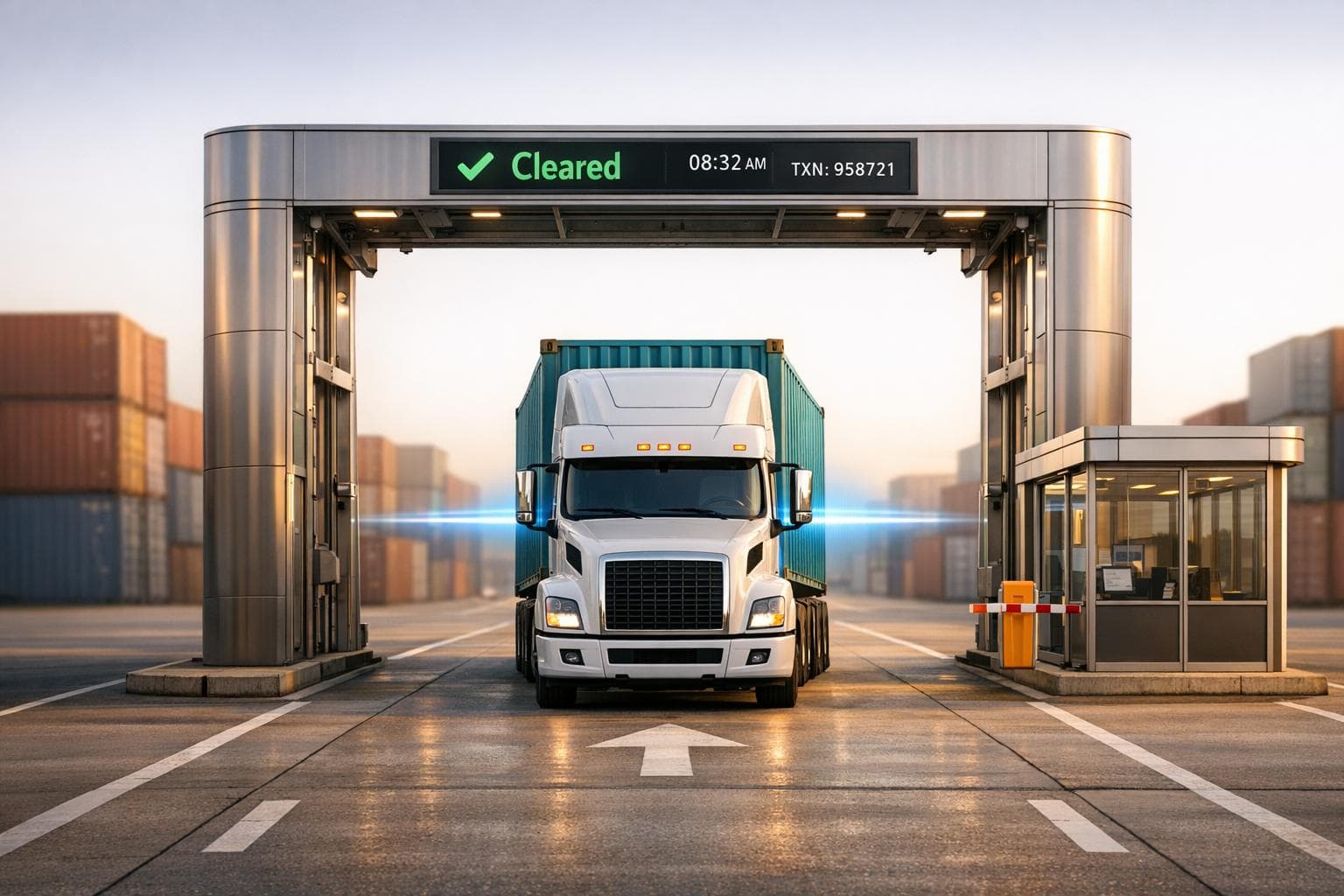
Smart contracts are transforming customs clearance by automating processes, reducing errors, and cutting costs. These blockchain-based programs handle document verification, goods classification, and payment processing when predefined conditions are met. Here's why they matter:
- Faster Processing: Clearance times drop from 3–5 days to minutes or hours.
- Lower Costs: Automation reduces compliance costs by up to 40%.
- Fewer Errors: AI-driven systems cut classification errors by 90%.
- Improved Transparency: Blockchain's shared ledger ensures tamper-proof records accessible to all parties.
For example, a GCC-based e-commerce company using smart contracts reduced border delays by 75% and compliance costs by 40%. With global trade becoming more complex, smart contracts offer a practical solution to outdated, paper-heavy systems. They simplify compliance, improve accuracy, and integrate seamlessly with logistics operations, making them a game-changer for global trade.
Problems with Traditional Customs Clearance
Manual Documentation and Delays
International shipping is a paperwork-heavy process. On average, a single shipment involves 36 original documents and 240 copies, shared among more than 30 different parties - including shippers, freight forwarders, carriers, and customs brokers. At every stage, data must be manually re-entered: from the shipper's ERP system to the forwarder's TMS, then to the carrier's booking platform, and finally to the broker's customs software. This repetitive process means customs brokers spend 30 to 60 minutes just to process one Bill of Lading, while clearance times stretch to 3 to 5 days.
The financial impact is staggering. Errors in data entry across global supply chains cost businesses over $600 billion annually. Even worse, 80% of customs delays result from missing or incorrect documentation rather than physical port congestion. These inefficiencies add approximately 15% to the cost of international shipments, making manual processes a significant burden, especially as regulations grow more complex.
Complex Compliance Requirements
Navigating customs compliance is no small feat. The Harmonized System (HS) includes over 5,000 six-digit headings, but many countries extend these to 10 or more digits for greater specificity. For instance, when GCC nations adopted 12-digit HS codes in 2025, the level of detail required for compliance became even more demanding. This complexity often leads to 5–6% duty overpayments, while errors in classification can result in hefty penalties. U.S. Customs and Border Protection (CBP) fines for HS misclassification typically range between $20,000 and $50,000 for mid-sized importers.
The problem grows when importers rely on multiple brokers. Product master databases - housing approved HS codes and duty rates - often become inconsistent because updates aren’t synchronized across systems. This lack of coordination can lead to retroactive liabilities. A single misclassified code doesn’t just affect one shipment; it can result in back-duties, interest, and penalties on all previous imports using that code. These challenges highlight how compliance complexity and fragmented systems exacerbate delays.
Limited Transparency and Auditability
Traditional customs systems are siloed, with shipment data scattered across disconnected platforms like the shipper's ERP, the forwarder's TMS, the carrier's booking system, and the broker's software. This fragmentation makes it nearly impossible for any single party to have a complete view of all documents in real time. The result? Blind spots that only become apparent when cargo reaches the border.
Customs authorities face their own challenges. Manually cross-checking documents - such as the commercial invoice, packing list, and Bill of Lading - is labor-intensive and impractical given the sheer volume of imports. Discrepancies in these documents often lead to physical inspections, which further delay clearance times. For companies relying on just-in-time production, these delays can disrupt entire supply chains.
Billing transparency is another pain point. Between 2–8% of total freight spend is recoverable through systematic auditing, but manually reviewing every invoice is too costly and time-consuming. As a result, many overcharges go unnoticed.
These fragmented and inefficient systems highlight the need for smarter, more integrated solutions in customs clearance processes.
sbb-itb-c0b8770
BA's Guide: Blockchain for Supply Chain Optimization (Master Traceability & Smart Contracts)
How Smart Contracts Improve Customs Clearance
Smart contracts are blockchain-based programs that automatically execute actions like releasing customs duty payments or verifying documents when specific regulatory conditions are satisfied. These contracts integrate Harmonized System (HS) codes, tariff rates, and VAT requirements directly into their code, enabling instant validation of trade agreements and compliance rules without needing human intervention.
Automated Compliance Verification
What sets smart contracts apart is their ability to streamline repetitive tasks like product classification. Using AI, they can match product descriptions to detailed 10- or 12-digit HS codes in mere seconds - a process that traditionally takes customs brokers 15 to 30 minutes per item. By 2026, AI-powered classification systems are expected to achieve 95% accuracy at the full tariff line level. This means fewer errors, faster processing, and reduced manual workload.
Smart contracts also consolidate and cross-check data from multiple sources - such as pro forma invoices, bills of lading, and certificates of origin - using a shared blockchain ledger. This automated approach ensures consistent and accurate filings. Pre-clearance risk scoring further enhances efficiency by analyzing shipment data for accuracy, valuation, and restricted-party screening days before the cargo arrives, allowing low-risk goods to be pre-cleared. These advancements have led to a 90% drop in classification errors and 30–40% savings on penalties and delays.
This level of automation naturally extends to real-time processing of documents and payments.
Real-Time Documentation and Payment Processing
Smart contracts go beyond compliance checks - they also automate document generation and payment processing. When predefined conditions are met (e.g., HS code validation or delivery confirmation), the contract triggers actions like releasing payments to carriers, transferring duties to customs authorities, or auto-filling customs declarations. This instant processing can reduce clearance times from days to just minutes.
By integrating with IoT sensors and ERP systems, smart contracts validate compliance requirements in real time. For instance, if a pharmaceutical shipment exceeds a critical temperature threshold, the contract can send immediate alerts before the goods reach their destination.
"Smart contracts for automated customs clearance are self-executing blockchain programs that automatically verify documents, classify goods, and process payments when predefined conditions are met." - Ivy Tse, Author, FreightAmigo
A practical example of this technology in action is the Korean Customs Service (KCS), which partnered with Malltail in 2018 to create a blockchain-based customs platform for e-commerce. This system shares data across distribution centers in the US, Japan, and Germany, automating customs declarations and simplifying the clearance process.
Permanent Records for Transparency
Beyond speed and automation, smart contracts enhance transparency through their use of blockchain’s immutable records. Once data is entered into the blockchain, it cannot be altered or erased. This creates a tamper-proof history accessible to all parties - suppliers, transporters, buyers, and regulators - ensuring everyone works from the same real-time data.
This shared single source of truth is crucial for audits. Customs authorities can track the location, status, and documentation of goods in real time, ensuring a clear chain of custody. The inability to modify records also minimizes risks of corruption or collusion, which are frequent challenges in global trade.
"The distributed ledger concept would guarantee the integrity of the data stored in the blockchain... when it is presented to the authorities of the importing countries they can rely on every piece of information having been generated by its originator." - Smartz
Benefits of Smart Contracts in Customs
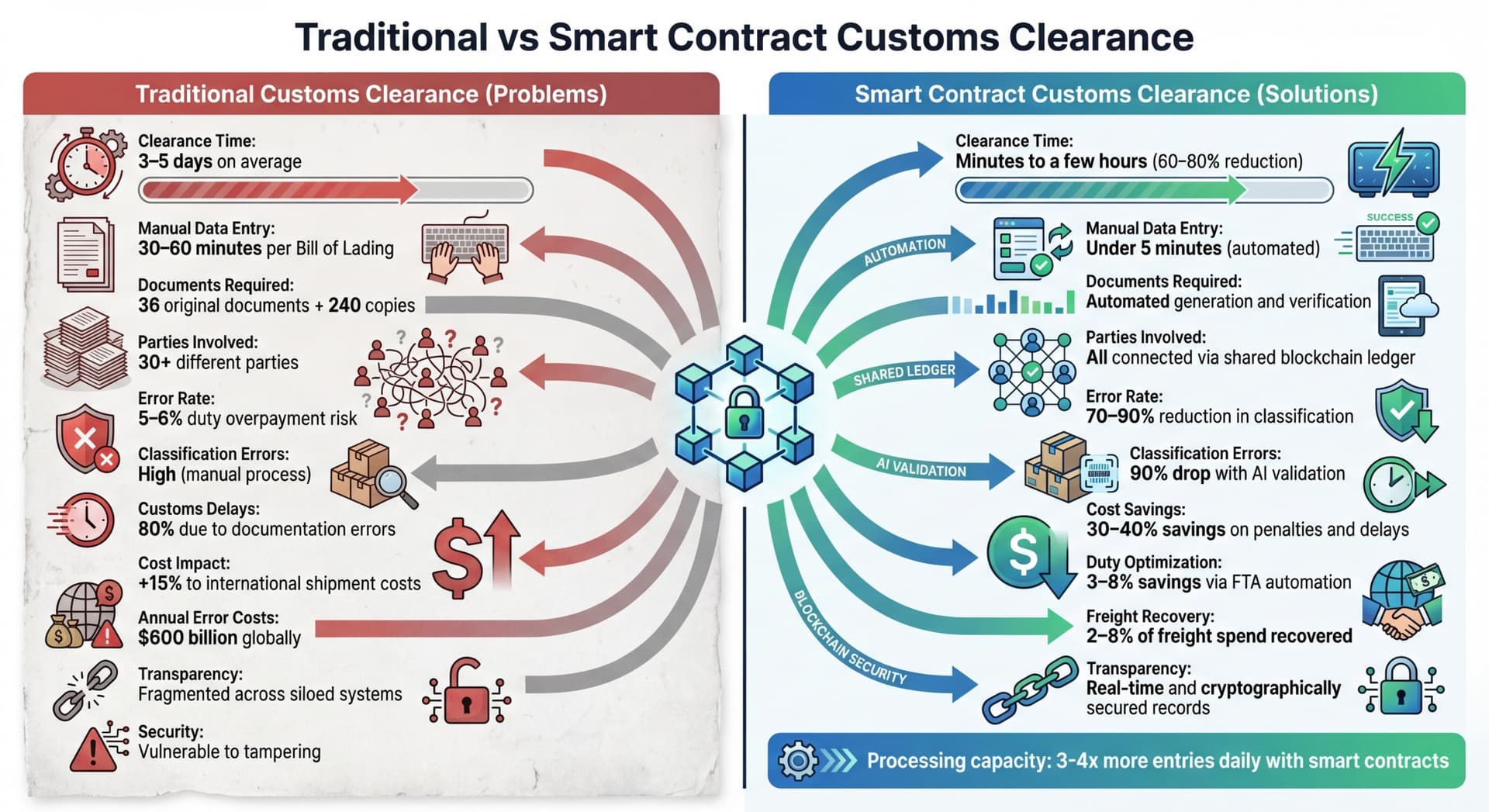
Traditional vs Smart Contract Customs Clearance: Time, Cost, and Error Comparison
Smart contracts are changing the game for customs processes by speeding up clearance times, cutting costs, and boosting security. These systems bring measurable improvements to international trade, making operations faster, more efficient, and more reliable.
Faster Clearance Times
One of the standout advantages of smart contracts is their ability to drastically reduce clearance times. Tasks that used to take three to five days can now be completed in just minutes or hours. This is thanks to automated data extraction, which slashes manual data entry from 30–45 minutes down to under five minutes. With this efficiency, customs brokers can handle three to four times more entries daily. In fact, smart contracts and automated systems can cut clearance times by 60–80%, solving one of the biggest bottlenecks in the process. These time savings also pave the way for other benefits, like lower costs and improved security.
Cost Savings and Fewer Errors
Smart contracts don't just save time - they also save money by reducing errors. AI-validated entries result in 70–90% fewer classification mistakes compared to traditional manual methods. This translates to 30–40% savings on penalties and delays caused by errors. Additionally, automated systems ensure shipments qualify for preferential duty rates under Free Trade Agreements, cutting annual duty payments by 3–8%. Freight invoice audits also recover 2–8% of total freight spend, which would otherwise be lost to rating mistakes and incorrect surcharges. These savings add up quickly, making smart contracts a cost-effective solution for customs operations.
Better Security and Trust
The use of blockchain technology in smart contracts ensures that records are tamper-proof and accessible in real time, building trust among all involved parties. Once data is added to the blockchain, it’s permanent - no one can alter or erase it. This feature creates a reliable record that all stakeholders can depend on. Blockchain’s cryptographic security and decentralized setup also reduce risks of corruption and collusion, which are common issues in global trade. By giving importers, exporters, carriers, and customs agents access to the same real-time data, smart contracts ensure accountability and foster confidence among trading partners.
| Feature | Traditional Process | Smart Contract Process |
|---|---|---|
| Clearance Time | 3–5 days on average | Minutes to a few hours |
| Error Rate | High; 5–6% duty overpayment risk | 70–90% reduction in errors |
| Transparency | Fragmented across siloed systems | Real-time shared ledger access |
| Security | Vulnerable to tampering | Immutable and cryptographically secured |
CR Express: A Partner in Smart Contract Integration
CR Express combines its expertise in physical logistics with smart contract technology to streamline customs clearance and enhance operational efficiency. By integrating blockchain-based customs systems with their robust logistics infrastructure, CR Express ensures that the speed of digital processes is matched by equally efficient physical execution. Their services, including customs bonded warehousing, Container Freight Station (CFS) operations, and strategic location advantages, create a seamless link between technology and logistics.
Customs Bonded Warehouse (CBW) Capabilities
CR Express operates a massive 227,000 sq ft CBW Class 3 certified facility, where goods can be stored duty-free for up to five years. Through smart contracts, duty payments are automatically triggered when goods are withdrawn for domestic use, helping importers optimize their cash flow. Since documentation errors are a leading cause of customs delays, the warehouse's structured data system significantly reduces errors, cutting misclassification rates by up to 90%.
The facility is equipped to handle specialized industries like pharmaceuticals, automotive, and electronics. It complies with GDP standards for pharmaceuticals and integrates specific regulatory requirements into smart contracts. For instance, temperature logs for pharmaceutical shipments or HS codes for electronics are embedded into the contracts to ensure compliance before clearance. Michael Chen, Operations Manager, shared his experience:
"CR Express has been our go-to logistics partner for over 10 years. Their bonded warehouse services and customs expertise have streamlined our international operations, saving us both time and money."
CR Express extends its efficiency and integration capabilities beyond warehousing to its CFS and air freight operations.
CFS and Air Freight Operations
CR Express's Container Freight Stations act as critical checkpoints, where physical cargo data is cross-verified with digital records. These operations provide the clean, structured data that smart contracts require to function smoothly, minimizing disruptions in automated systems. By automating filings such as the Automated Manifest System and Electronic Air Waybills directly from CFS data, CR Express reduces the risk of human error and penalties. This automation has cut processing times to under 2 minutes.
The company’s air freight services include TSA-approved, SIDA-badged drivers with ramp-side access at Chicago O’Hare and Rockford airports. These services integrate IoT sensors that feed real-time data - like temperature readings for pharmaceuticals - into smart contracts. If shipments stay within regulatory thresholds, compliance is automatically validated; if not, stakeholders are alerted before the cargo reaches customs. This system is particularly valuable in air freight, where clearance times can be reduced from days to mere minutes.
CR Express’s strategic location further enhances its ability to support high-speed logistics and smart contract integration.
Location Near Chicago O'Hare
Located less than 5 miles from Chicago O'Hare International Airport, CR Express offers same-day recovery and plane-side pickups. This proximity allows for immediate movement of goods following digital customs clearance, enabling just-in-time delivery for industries like automotive and pharmaceuticals, which rely on strict customer SLAs.
The bonded storage near O’Hare also provides a significant advantage. Smart contracts can defer duty payments until goods leave the bonded area for local distribution, aligning physical and digital processes. This capability will become even more critical with upcoming 2025 regulatory changes, including the elimination of the U.S. de minimis threshold and mandatory HTS filings, which are expected to increase the volume of formal entries at major hubs like O’Hare.
How to Implement Smart Contracts in Customs
Setting up smart contracts for customs clearance involves a detailed and compliant process. Businesses need to ensure their internal systems are up-to-date with the latest regulatory changes. This often includes connecting enterprise resource planning (ERP) systems to official customs portals via APIs, enabling smooth data exchange between business operations and government platforms. Below, we’ll break down the key steps to successfully implement smart contracts in customs clearance.
Select a Blockchain Platform
Picking the right blockchain platform is a crucial step. Permissioned blockchains are typically the go-to choice since they limit access to authorized participants, safeguarding sensitive trade data. The platform must also integrate seamlessly with systems like the U.S. Customs and Border Protection's Automated Commercial Environment (ACE) and handle large trade volumes using layer-2 scaling solutions. Privacy is another key factor - platforms with zero-knowledge proof capabilities can ensure compliance while keeping transaction details private. Additionally, modular code is essential for quick updates when tariff regulations change, such as updates to the EU’s Combined Nomenclature. A well-chosen platform enhances transparency and automates compliance, addressing inefficiencies in traditional systems.
| Factor | Consideration for Selection |
|---|---|
| Access Type | Permissioned networks are preferred for regulatory compliance and data privacy. |
| Privacy | Platforms with zero-knowledge proofs can protect sensitive transaction details. |
| Scalability | Layer-2 solutions are necessary to manage high trade volumes. |
| Compliance | Must support updates like the 2025 HS code and regional requirements such as GCC codes. |
| Integration | Requires robust APIs for linking to customs portals (e.g., ACE) and IoT devices. |
Integrate IoT for Real-Time Data
IoT devices act as oracles, supplying external data to smart contracts so they can execute based on real-world conditions. For instance, GPS sensors can automatically trigger duty payments or document releases when a shipment enters a specific geofence or arrives at a port. This eliminates manual re-entry errors - responsible for 80% of customs delays - and ensures that physical shipments align with digital documentation before reaching the border.
Define Milestones and Automate Processes
Once the platform is selected and IoT integration is in place, the next step is defining clear contractual triggers. Smart contracts should include precise if-then conditions to automate actions. For example, a contract could be set to release a duty payment if the HS code is validated and IoT temperature data falls within the required range. Automating filings like AMS, ISF, and eAWB can dramatically cut processing times and reduce misclassification errors by up to 90%, as noted by World Customs Organization benchmarks.
Middleware solutions can bridge existing systems with blockchain networks, enabling automation without requiring a complete overhaul. Additionally, it’s important to train logistics and compliance teams on blockchain basics and the management of smart contracts. This ensures that exceptions or complex scenarios, which automated systems might miss, are handled appropriately by human oversight.
Future Developments in Blockchain for Customs Clearance
Blockchain technology continues to evolve, offering solutions that promise even greater automation and reliability in customs clearance processes. As global trade grows and regulatory requirements become more complex, these advancements are tackling some of the most persistent challenges.
Cross-Chain Solutions for Global Trade
One of the biggest hurdles in global trade is the lack of interoperability between different blockchain systems. Cross-chain solutions are stepping in to solve this by enabling smooth data exchange between platforms like a U.S. customs system and its EU counterpart - without forcing everyone onto the same blockchain network. Modular smart contracts are also helping by adapting to varied regional standards. Additionally, Layer-2 scaling solutions are being adopted to handle thousands of shipments simultaneously, ensuring that trade keeps flowing without overloading the main blockchain.
Privacy Improvements with zk-SNARKs
Privacy concerns have long been a sticking point in customs clearance. Zero-knowledge proofs (zk-SNARKs) are changing the game by allowing verification of sensitive details - like HS codes or duty payments - without exposing underlying trade data to all participants. This is especially useful in permissioned blockchains where competitors share infrastructure. By offering a more granular level of privacy, zk-SNARKs protect trade secrets while still meeting the transparency requirements of customs authorities. These privacy tools are being paired with scalability upgrades to handle growing trade volumes effectively.
Scalability for High-Volume Operations
Handling high trade volumes remains a critical challenge for blockchain systems. To tackle this, hybrid solutions combining AI and blockchain are being implemented. These systems can extract and validate data from various document formats - such as PDFs and EDI files - before feeding the information into smart contracts. This AI-driven approach significantly speeds up document processing, cutting handling times dramatically. Smart contracts also minimize errors, reducing misclassification issues by 90% and slashing delay-related costs by 30–40%. Furthermore, initiatives like the EU's CERTEX are connecting customs with veterinary and phytosanitary authorities, enabling real-time certificate verification and streamlining operations.
Conclusion
Smart contracts are reshaping customs clearance by automating compliance and documentation, slashing clearance times from days to mere minutes and drastically reducing errors. With the ability to cut documentation delays by up to 80% and minimize misclassification errors by 90%, these systems allow businesses to save 30–40% on penalties and costs tied to delays.
When digital automation is paired with physical logistics, the efficiency gains are impressive. For example, CR Express's 280,000 sq ft Class 3 Customs Bonded Warehouse, situated less than five miles from Chicago O'Hare, uses smart contract technology to manage duty-free storage for up to five years. Payments and releases are triggered only when specific conditions are met, ensuring smooth operations while maintaining GDP-compliant handling for pharmaceuticals and other regulated goods.
As global regulations evolve - like the GCC's adoption of 12-digit HS codes or the EU's CERTEX system - manual processes are becoming less viable. By integrating smart contracts with tools such as TSA-approved air freight operations and Container Freight Station capabilities, businesses can adapt to these changes without increasing manual workloads.
With regulatory complexity on the rise, streamlined systems like these are no longer optional - they're essential. CR Express demonstrates how combining proven technology with robust infrastructure can turn customs clearance from a frustrating bottleneck into a strategic advantage.
FAQs
Do smart contracts replace customs brokers?
Smart contracts don't entirely eliminate the need for customs brokers, but they do simplify the customs clearance process. By automating tasks like compliance checks and documentation, they cut down on manual effort and help things move faster. However, brokers remain essential for handling intricate regulations and offering specialized knowledge in unique or challenging situations.
What data is needed to automate customs with smart contracts?
To streamline customs clearance, smart contracts rely on critical data such as shipment details, cargo descriptions, origin and destination, value, weight, and any required permits or licenses. These contracts work by verifying compliance through documents like bills of lading, invoices, and certificates of origin.
By automating the approval process based on predefined conditions, this approach ensures all regulatory requirements are met. The result? Fewer delays, less manual intervention, and a smoother customs clearance process.
How do smart contracts handle privacy for trade data?
Smart contracts enhance the privacy of trade data by automating processes in a secure manner. They rely on encryption and controlled access to carry out predefined tasks without revealing sensitive details. Furthermore, they limit data visibility to authorized parties, ensuring confidential information is shared strictly on a need-to-know basis. This method strikes a balance between maintaining privacy and ensuring transparency, making smart contracts a strong choice for secure and efficient trade processes.