
Blockchain in Logistics: Fraud Prevention Benefits
by CR Express Team, Logistics Team • 12 min read
Blockchain in Logistics: Fraud Prevention Benefits
Blockchain is transforming logistics by tackling fraud and boosting transparency. Here's what you need to know:
- Fraud in logistics is a massive issue, costing industries billions annually, especially in high-value sectors like pharmaceuticals and luxury goods.
- Common fraud problems include document forgery, cargo theft, counterfeit goods, and data silos that obscure supply chain visibility.
- Blockchain offers solutions through tamper-proof records, cryptographic hashing, smart contracts, and real-time tracking with IoT and GPS integration.
- Key benefits include faster payment resolutions, secure documentation, and clear chain-of-custody tracking, reducing risks and costs for businesses.
Blockchain Fraud Prevention Benefits in Logistics: Key Statistics and Cost Savings
Blockchain in Supply Chain & Walmart Case
Major Fraud Problems Blockchain Can Address in Logistics
The logistics industry in the U.S. faces several fraud-related challenges that not only disrupt operations but also lead to massive financial losses. These vulnerabilities expose weak points in traditional systems, leaving supply chains open to exploitation. Blockchain, with its unchangeable records and smart contract capabilities, offers a way to tackle these issues head-on. Let’s break down the four major fraud problems blockchain can help solve.
Document Forgery and Identity Fraud
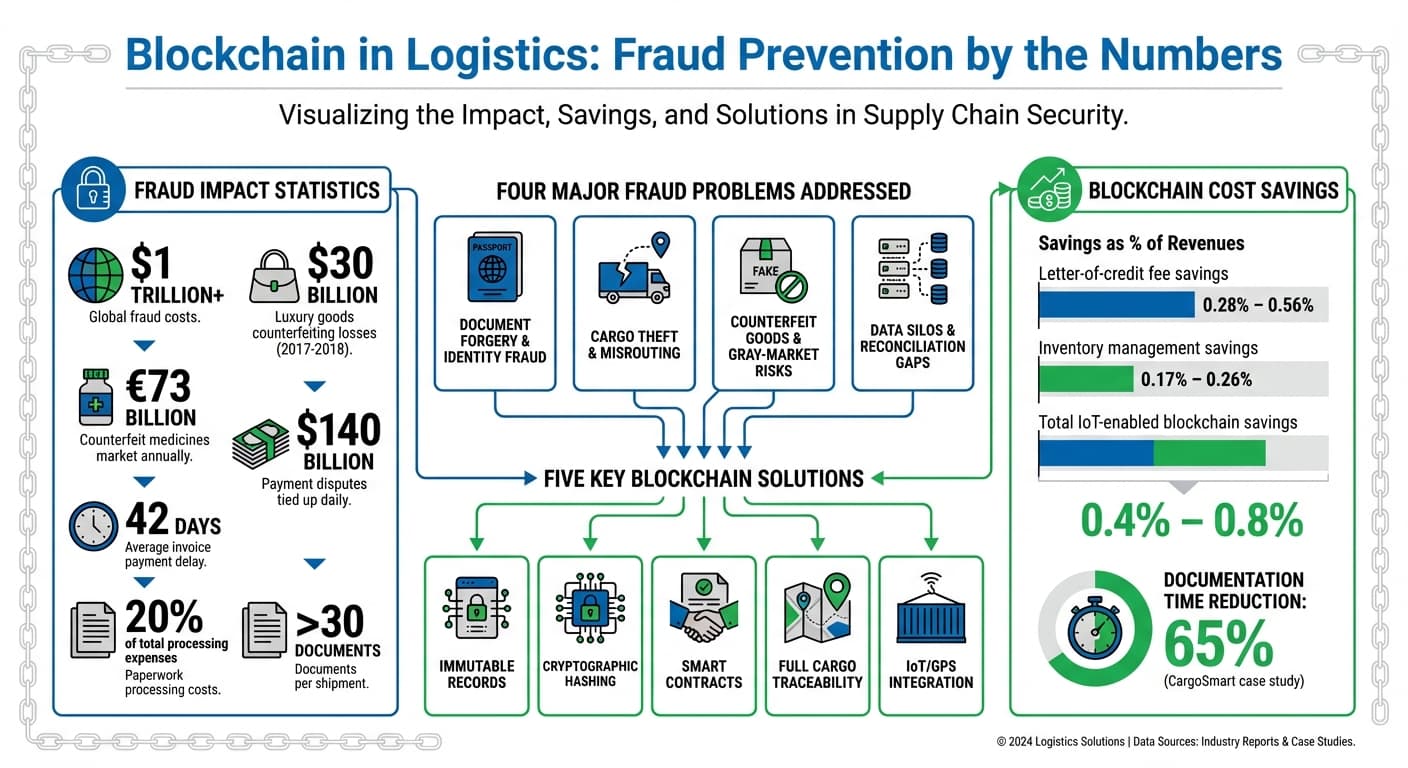
Fake bills of lading, duplicate invoices, and falsified carrier credentials are rampant in logistics. The heavy reliance on paper-based processes drives up costs - paperwork alone accounts for 20% of processing expenses. On top of that, around $140 billion is tied up daily in payment disputes, with companies waiting an average of 42 days to get paid for invoices.
Jeff Garzik, CEO of Bloq, summarizes the problem:
"Supply chains nowadays are extremely inefficient because they rely on paper-based systems, where forms have to pass through multiple approval channels, which increases exposure to loss and fraud."
When fraudulent documents are introduced, they can ripple across the supply chain, creating delays and compounding costs. Manual checks of driver records and carrier credentials add further inefficiencies, especially during time-sensitive operations.
Cargo Theft, Misrouting, and Load Tampering
Unauthorized changes to shipment routes make it difficult to pinpoint when theft or tampering occurs. These deviations, often unnoticed until cargo arrives damaged, incomplete, or missing, drive up dispute resolution costs. Without real-time, tamper-proof tracking, companies are left playing catch-up, trying to piece together what went wrong after the fact.
Counterfeit Goods and Gray-Market Risks
Counterfeiting has become more sophisticated, and the impact is staggering. For instance, the luxury goods sector lost about $30 billion to counterfeit products between 2017 and 2018. The World Health Organization estimates that counterfeit medicines alone generate approximately €73 billion annually. Beyond financial losses, fake pharmaceuticals and automotive parts pose serious health and safety risks. The rise of hyper-realistic "superfakes" and online sales platforms makes spotting counterfeits harder than ever.
Without a reliable, tamper-proof way to verify a product’s journey through the supply chain, businesses are forced to rely on secondhand claims about authenticity - a risky gamble in today’s market.
Data Silos and Reconciliation Gaps
Fragmented systems create blind spots in the supply chain, making it harder to detect and address fraudulent activity. Information is often siloed within individual companies, and centralized systems are vulnerable to tampering, leaving records open to manipulation.
A study by Deloitte highlights the trust issue:
"The quality and opacity of information invariably degrades trust among parties. Technologies like blockchain can help offset such detrimental effects by ensuring the authenticity of information."
Because of these silos, fraud often goes unnoticed until it’s too late. By the time manual audits uncover discrepancies, the damage is done, and assigning responsibility becomes a lengthy and expensive process. Blockchain can eliminate these gaps by creating a shared, tamper-proof record of all transactions and activities across the supply chain.
How Blockchain Technology Prevents Logistics Fraud
When it comes to tackling fraud in logistics, blockchain technology stands out as a game-changer. It’s not just a trendy term - it’s a system designed to address specific vulnerabilities that fraudsters often exploit.
Permanent Records to Ensure Data Integrity
At its core, blockchain functions as an immutable ledger, meaning once a transaction is recorded, it’s locked in place and can’t be altered or erased. This creates a verifiable and permanent history of every transaction and movement within the supply chain.
This immutability eliminates the loopholes fraudsters often take advantage of. Instead of relying on separate, potentially manipulated records, all authorized parties work from the same distributed ledger. This shared access ensures everyone is on the same page, leaving no room for misinformation.
Cryptographic Hashing for Document Security
Every document uploaded to the blockchain is assigned a unique digital fingerprint, known as a cryptographic hash. This hash acts as a tamper-proof seal. If even a tiny change is made to a document - like a customs form or bill of lading - the hash changes instantly, flagging the alteration.
With digital labels and smart tags verifying document integrity, this decentralized system makes tampering nearly impossible. It’s a powerful tool that not only protects documents but also sets the stage for automated agreements that minimize fraud risks even further.
Smart Contracts to Prevent Payment and Invoice Fraud
Smart contracts are like automated agreements that only execute when certain conditions are met. For instance, instead of waiting weeks to resolve invoice disputes, payments can be held in a decentralized escrow and automatically released once delivery is confirmed.
These contracts can even pull GPS or IoT data to verify delivery milestones. For example, once a shipment clears customs or reaches its final destination, the contract triggers the payment automatically.
The team at ilink.dev highlights this efficiency:
"Smart contracts can pull GPS or IoT data to automatically update cargo status at each checkpoint... Funds are automatically released when cargo reaches predefined milestones."
By automating payments and cutting out human intermediaries, smart contracts close common fraud loopholes. They also reduce reliance on costly bank services, like letters of credit, saving businesses between 0.28% and 0.56% of revenues.
Full Cargo Traceability
Blockchain tracks every step of a shipment’s journey, from origin to final destination. This is especially crucial for sensitive or high-value goods, like pharmaceuticals or electronics, where authenticity and security are key.
Each transfer of custody or location change is recorded with a timestamp, creating an unbroken chain of custody. This transparency makes it easier to identify tampering or theft. For industries dealing with economically dense products, this system helps separate genuine goods from counterfeits and reduces the financial impact of fraud.
Tamper-Proof Tracking with IoT and GPS
While IoT devices and GPS provide real-time data on a shipment’s location and condition, blockchain adds a layer of trust by ensuring the data can’t be altered.
For example, Deloitte developed a prototype using Hyperledger Fabric, Thingstream GSM trackers, and AWS technology. Sensors on pallets log location data into an immutable blockchain ledger, accessible to all stakeholders - shippers, senders, and receivers. This prevents any single party from manipulating the data.
The Boston Consulting Group emphasizes this benefit:
"Costs fall as blockchain with IoT-enabled validation makes the need for manual checks and independent, outside assurances obsolete."
From temperature sensors to GPS trackers, IoT devices feed data directly into the blockchain, creating a tamper-proof record. This system eliminates fraudulent claims about cargo conditions or "lost" shipments. In case of disputes, the time-stamped data pinpoints exactly when and where issues occurred, speeding up resolutions.
sbb-itb-c0b8770
Blockchain Use Cases in Logistics Operations
Blockchain technology is making waves in logistics, especially with its ability to combat fraud and streamline operations.
Digital Bills of Lading and Secure Documentation
Traditional paper-based bills are prone to issues like forgery, alterations, and loss. Blockchain steps in by offering tamper-proof digital documentation, creating a single, reliable source of truth.
For instance, in July 2018, CargoSmart, the software division of OOCL, teamed up with Oracle to introduce a blockchain-based shipment documentation platform. The result? A 65% reduction in the time spent on data collection and verification.
Steve Siu emphasized that blockchain simplifies data entry and verification, significantly improving the efficiency of logistics workflows. This solution works across various freight modes - whether it's intermodal containers, air cargo, or ground transportation. Considering that a single shipment often requires over 30 documents exchanged among multiple parties, blockchain eliminates the need for manual revisions and reduces human error, which are common gateways for fraud. This digital approach is paving the way for broader adoption in complex and high-value logistics operations.
Chain of Custody Tracking for Intermodal Operations
Intermodal shipments - those passing through ports, rail ramps, warehouses, and final-mile carriers - face numerous handoffs, each presenting opportunities for fraud, misrouting, or unauthorized cargo releases.
To address these vulnerabilities, Deloitte created a "Track and Trace" prototype using Hyperledger Fabric, Thingstream GSM trackers, and AWS technology. This system provides a tamper-proof record of a shipment's entire lifecycle, ensuring that every handoff is documented and secure.
The system records every exchange involving goods, services, and payments across all stakeholders - shippers, forwarders, carriers, truckers, and customs. With everyone accessing the same unalterable ledger, unauthorized cargo releases or "lost" shipments become nearly impossible. This level of transparency and accountability is particularly valuable for safeguarding high-value shipments.
Better Security for High-Value and Sensitive Cargo
Shipments containing high-value or temperature-sensitive items are frequent targets for fraud. Blockchain, combined with IoT sensors, enhances security by providing tamper-evident tracking. This ensures that goods like pharmaceuticals and luxury items remain secure and intact during transit.
For pharmaceutical shipments, blockchain supports GDP compliance by preserving cold chain integrity. IoT devices like temperature sensors, GPS trackers, and humidity monitors feed real-time data into the blockchain, creating an unalterable record of proper handling throughout the journey.
An example of blockchain's potential is De Beers' "Tracr" platform, which brings transparency to the diamond industry. Each diamond is assigned a unique identifier, recorded on the blockchain to establish its provenance. This prevents fraudulent practices like "double spending", where the same diamond is used as collateral for multiple loans.
Implementing Blockchain for Fraud Prevention in U.S. Logistics
Blockchain adds a tamper-proof layer to existing systems, enhancing fraud prevention for U.S. logistics providers. Instead of replacing core platforms like Transportation Management Systems (TMS), Warehouse Management Systems (WMS), or Enterprise Resource Planning (ERP) platforms, blockchain works alongside them. This integration ensures the operational backbone remains intact while introducing a secure, unalterable layer for critical transactions. The result? Improved data privacy, operational efficiency, and economic advantages.
Data Privacy and Access Control
In logistics, safeguarding sensitive information is non-negotiable. Permissioned blockchain networks are particularly effective, as they strictly control who can access specific data. These networks allow independent parties to collaborate without giving any single participant full control, making it easier to detect and prevent fraudulent changes to records. This balance between transparency and confidentiality is especially important when dealing with high-stakes cargo like pharmaceuticals or valuable electronics.
To further reduce risks, involving cybersecurity experts early in the design process is key. They can address vulnerabilities in smart contracts and data access protocols, ensuring that operations remain resistant to fraud.
Systems Integration with Existing Logistics Platforms
For blockchain to work seamlessly in logistics, it must integrate tightly with tools like IoT sensors and GPS tracking systems. These technologies feed real-time data into the blockchain, automating processes and reducing human error. By establishing consensus on essential proofs - such as digital invoices or certifications - blockchain creates a single, reliable source of truth. This automation not only enhances accuracy but also strengthens overall system reliability.
Cost, Scalability, and Partner Collaboration
Implementing blockchain isn’t just about the technology - it’s also about cost-effectiveness and collaboration. A great example is Walmart, which initially faced challenges with a proprietary supply chain platform because suppliers hesitated to manage duplicate records. By reimagining the system as an industry-wide solution, adoption rates soared. This highlights the importance of collaborative competition and strong leadership in driving blockchain success.
Permissioned networks also offer scalability by using efficient hardware and lightweight consensus mechanisms. However, accurately forecasting network usage remains critical to maintaining performance. Research shows that blockchain in IoT-enabled supply chains can provide measurable cost savings - netting 0.4% to 0.8% of total revenues. Additionally, automating letters of credit with smart contracts can save another 0.28% to 0.56% in bank fees. These savings, coupled with collaborative strategies, make blockchain an effective tool for reducing fraud.
| Challenge | Blockchain Solution | Economic Impact |
|---|---|---|
| Letter-of-Credit Fees | Smart contracts automate payment execution, removing bank intermediaries | 0.28% – 0.56% revenue savings |
| Inventory Management | Real-time traceability reduces the need for buffer stock | 0.17% – 0.26% revenue savings |
| Damaged Goods | IoT sensors ensure immediate accountability for disputes | Reduced tied-up working capital |
| Fraud & Pilferage | Time-stamped logs and route deviation alerts for real-time reporting | Lower insurance and dispute costs |
Conclusion: Blockchain's Role in Logistics Fraud Prevention
Blockchain technology offers a powerful solution to combat fraud in U.S. logistics operations by creating tamper-resistant records. Through its immutable, shared ledger, it breaks down data silos and ensures that all authorized parties - whether shippers, customs officials, or other stakeholders - have access to a unified source of truth. This level of transparency makes it much harder for bad actors to engage in document forgery, cargo theft, or the distribution of counterfeit goods. With fraud costing industries over $1 trillion annually, the need for such preventative measures has never been more pressing.
Beyond fraud prevention, blockchain enhances operational transparency. When paired with IoT sensors and GPS tracking, it allows real-time monitoring of shipment locations and conditions. Smart contracts further streamline processes by automating compliance reporting and payment execution, cutting down on administrative tasks while maintaining audit-ready records. This is especially critical in industries like pharmaceuticals, where counterfeit medicines represent an estimated €73 billion in global trade annually, according to the World Health Organization.
"Blockchain is often referred to as a 'single source of truth.' The visibility, traceability, and immutability of blockchain platforms make the technology well suited to a host of anticounterfeiting applications." – BCG
Major logistics providers are already leveraging these advancements. For instance, CR Express combines blockchain's digital audit trail with physical security measures like 24/7 surveillance and GPS tracking. This dual-layered approach strengthens fraud defenses across various operations, including intermodal transport, air freight, and temperature-sensitive pharmaceutical shipments. By integrating blockchain with these existing systems, logistics companies are building a more secure and transparent supply chain.
FAQs
How does blockchain help verify the authenticity of logistics documents?
Blockchain technology plays a key role in safeguarding logistics documents by storing every transaction on a secure and unchangeable ledger. Once a document is recorded, it becomes permanent - no edits, no deletions - creating a reliable history of its creation and any updates.
This transparency and traceability make it much harder for fraud to slip through the cracks. Everyone involved in the supply chain can instantly verify the document's authenticity and origin. Meanwhile, cryptographic security ensures sensitive information stays protected, building trust throughout the entire logistics process.
How do IoT and GPS enhance blockchain-based logistics systems?
IoT devices like temperature monitors, humidity sensors, motion detectors, and GPS trackers gather real-time data throughout every step of a shipment's journey. When this information is logged onto a blockchain ledger, it becomes a secure, unalterable record that all parties involved can access and verify. This setup ensures transparency, guards against tampering, and provides full visibility, making it easier to spot issues like fraud or loss.
GPS tracking is especially important, as it delivers precise location data that's added to the blockchain each time a shipment moves or reaches a checkpoint. This geolocation data helps stakeholders confirm that shipments are staying on their planned routes and can even trigger automated processes, such as releasing payments, once the goods arrive at their destination. CR Express takes this a step further by integrating GPS tracking and IoT sensors into its blockchain-powered platform, improving traceability and bolstering fraud prevention across its extensive logistics network.
How does blockchain help reduce costs in logistics?
Blockchain is shaking up logistics by replacing cumbersome, paper-heavy processes with a secure, tamper-resistant digital ledger. It tracks every step in the supply chain - like pickup, customs clearance, and delivery - in real time. This eliminates the hassle of duplicate paperwork, manual reconciliations, and the expense of third-party verifications. Smart contracts take it a step further by automating tasks such as payments and inventory reordering, slashing delays and cutting down on administrative costs.
When combined with IoT sensors, blockchain becomes even more powerful. It delivers precise, real-time data on factors like temperature, location, and handling conditions. This helps reduce losses from spoilage or misplaced goods, lowers insurance costs by accurately assessing risks, and enables smarter route planning to cut down on empty miles and warehousing expenses.
For comprehensive service providers like CR Express, blockchain simplifies customs documentation, ensures cargo integrity, and integrates smoothly with existing GPS and warehouse systems. The result? Faster clearances, fewer disputes, and lower operational costs - all while maintaining the high-quality service customers expect.