
AI for Customs Clearance in CFS
by CR Express Team, Logistics Team • 10 min read
AI for Customs Clearance in CFS
AI is transforming customs clearance at Container Freight Stations (CFS) by automating tedious manual processes, improving accuracy, and reducing delays. Here's how:
- Document Automation: AI tools like OCR and NLP extract and standardize data from invoices, packing lists, and other documents, reducing errors and manual work.
- HTS Code Recommendations: Machine learning suggests Harmonized Tariff Schedule (HTS) codes based on product descriptions, minimizing misclassifications.
- Compliance Validation: AI cross-checks shipment details (values, weights, HS codes) against regulatory databases to identify discrepancies before submission.
- Risk Assessment: Predictive analytics flag high-risk shipments for inspection while expediting low-risk cargo through "green-lane" clearance.
- Real-Time Monitoring: AI-powered dashboards provide live updates, helping logistics providers avoid costly fees like demurrage and detention.
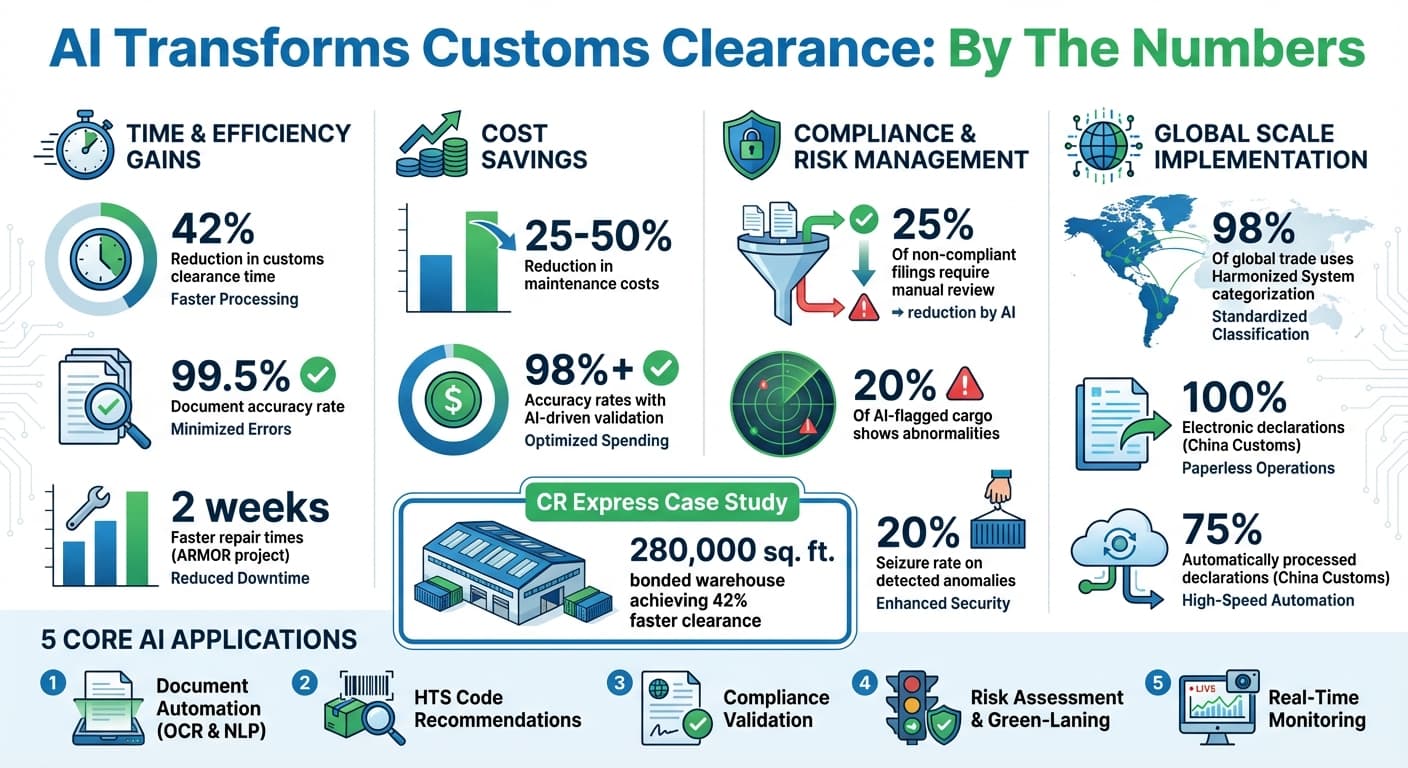
For example, CR Express, a bonded warehouse near Chicago O’Hare, leverages AI to handle complex LCL shipments, cutting customs clearance time by 42% and achieving 99.5% document accuracy. This ensures faster processing, fewer errors, and better compliance.
AI is not replacing human expertise but augmenting it, enabling more efficient, data-driven customs operations.
AI Impact on Customs Clearance: Key Performance Metrics and Benefits
How AI Automates Customs Documentation
Automated Document Capture and Data Entry
AI takes the hassle out of customs paperwork by automating data extraction and entry. Using technologies like Optical Character Recognition (OCR) and Natural Language Processing (NLP), AI can process and standardize information from documents such as commercial invoices, packing lists, bills of lading, and certificates of origin - even when these documents are in unstructured formats.
Once the data is captured, AI goes a step further by cross-checking details like quantities, weights, values, and identifiers. For instance, if an invoice lists a shipment value of $15,000 but the packing list shows a weight mismatch, the system flags the inconsistency before the filing process begins. This kind of reconciliation helps prevent costly rejections. AI also uses machine learning to translate product descriptions, like "stainless steel bolts, M8 x 30mm", into Harmonized Tariff Schedule (HTS) code candidates, complete with confidence scores.
Interestingly, about 25% of non-compliant customs filings require manual review due to unstructured data in supporting documents. AI helps tackle this issue by identifying missing or incorrect information before submission. Only low-confidence or ambiguous cases are routed to human experts for review. This process ensures high "first-time-right" rates while letting staff focus on exceptions instead of routine tasks.
Accurate data capture like this lays the foundation for smooth integration with customs systems.
Integration with Customs Systems
Once data is accurately captured, AI platforms can directly connect with customs systems, such as the Automated Commercial Environment (ACE), to handle tasks like filing Importer Security Filings (ISF) and entry summaries. By linking data from Transport Management Systems (TMS) and ERP platforms to customs systems, AI eliminates the need for duplicate entries. This ensures that shipment details, invoices, and declarations stay aligned across all platforms.
Take the example of CR Express's CBW Class 3 bonded warehouses. Here, AI integration speeds up deferred duty payments and keeps compliance tracking on point. When Less-than-Container-Load (LCL) cargo arrives at a Container Freight Station (CFS), AI captures the necessary documentation during deconsolidation. It maintains data consistency throughout bonded storage and customs clearance. This streamlined process reduces errors that might otherwise lead to inspections or penalties. CR Express, with its 280,000 square feet of bonded warehouse space located just a few miles from Chicago O'Hare, benefits from these automated workflows. The result? Real-time shipment visibility and faster clearance, which is a game-changer for importers managing cash flow during uncertain trade periods.
AI-Driven Validation and Compliance Checks
Validation of Customs Data
Once data is captured automatically, AI steps in to validate each detail against regulatory databases, identifying errors before they reach U.S. Customs and Border Protection (CBP). It meticulously cross-checks HS codes, declared values, and weights across various documents to ensure they align. For instance, if a commercial invoice states a shipment value of $8,500, AI analyzes the description to generate potential HTS codes using legal notes and past rulings. It then compares the declared value to similar shipments and trade lane benchmarks, flagging discrepancies that could indicate under-invoicing or fraud.
This valuation analysis proves especially effective in high-volume Container Freight Station (CFS) operations. AI can quickly identify shipments with unusually low declared values compared to similar cargo. Considering that over 98% of goods in global trade are categorized using Harmonized System terms, the system is designed to detect mismatches - like discrepancies between an invoice and a packing list. When such mismatches occur, AI either generates a correction request or escalates the case to a human expert for further review.
"It is really critical that when building customs machine learning tools these focus on the integrity of the data that goes into their knowledge base".
- William Petty, Global Product Development Manager at Maersk
This detailed validation process ensures that the data is accurate and reliable, laying the groundwork for reducing compliance risks.
Reducing Compliance Risks
With validated data in hand, AI workflows are designed to catch errors that could result in CBP holds, fines, or post-clearance audits. By cross-referencing quantities, weights, values, and party identifiers across invoices, packing lists, and transportation documents, the system highlights inconsistencies before submission. Field studies show that AI-driven validation achieves accuracy rates exceeding 99%, cutting down on manual work while speeding up clearance processes.
For CR Express, which runs CBW Class 3 bonded warehouses near Chicago O'Hare, AI validation plays a key role in maintaining compliance during deferred duty payments and bonded storage. The system logs its reasoning for every automated HS code suggestion, citing legal notes to provide a clear audit trail. This documentation strengthens defensibility during post-clearance reviews. Low-confidence extractions or high-risk flags are routed to human experts, allowing staff to concentrate on complex cases instead of routine tasks.
Predictive Analytics for Risk Assessment
Cargo Risk Screening
AI plays a vital role in assessing shipment risks before they even arrive at Container Freight Stations (CFS). By analyzing transaction data, partner relationships, and compliance records, it generates risk indicators and flags anomalies for further review.
A great example of this is the U.S. Customs and Border Protection's Trade Entity Risk Model, which uses supervised machine learning to create detailed risk profiles. These profiles contribute to broader threat evaluations tied to cargo. Additionally, computer vision technology steps in to analyze X-ray and CT images, detecting density anomalies or contraband signatures. This allows authorities to prioritize which containers require physical inspections. For instance, China's smart customs system reports that 20% of flagged cargo exhibits abnormalities, with a 20% seizure rate following these detections.
This approach, often referred to as "green-laning", speeds up the process for compliant shipments while focusing inspection efforts on high-risk consignments. For CR Express's operations near Chicago O'Hare, this intelligence has streamlined workflows by cutting down on unnecessary physical inspections, ensuring efficient movement of low-risk cargo. Moreover, AI compares declared shipment values to trade lane norms and peer shipments, uncovering patterns that might suggest under-invoicing or carousel fraud.
Such risk profiling not only enhances security but also supports better scheduling and resource allocation for future operations.
Demurrage and Detention Monitoring
Using risk insights, AI also helps optimize workflows to reduce delays and avoid costly fees. Predictive analytics tackle demurrage and detention charges by monitoring real-time data - like vessel AIS signals, weather conditions, and labor availability - to predict backlogs and enable preemptive adjustments. By analyzing port histories and real-time milestones, AI can forecast clearance timelines, allowing logistics providers to take steps to avoid fees.
The U.S. CBP's ARMOR project showcases this in action. By using AI and physical modeling, the project predicts failure dates for Radiation Portal Monitors, cutting repair times by two weeks and potentially slashing costs by 25–50%. This kind of operational intelligence also improves the flow of cargo, reducing detention risks.
For facilities like CR Express's bonded warehouse near key railyard hubs, AI-driven forecasts of cargo arrival waves and staffing needs help prevent bottlenecks. The system can even suggest alternate routing or issue correction requests when delays or discrepancies occur, ensuring containers stay on schedule and avoid unnecessary fees.
sbb-itb-c0b8770
AI-Powered CFS Operations
Automated Filing and Clearance
AI has transformed customs filing by automating the entire process, removing the need for manual intervention. Using Document AI, which combines OCR (optical character recognition) and natural language processing, these systems can process invoices, packing lists, and bills of lading. They automatically cross-check details like quantities, weights, and values, ensuring accuracy while enabling CFS operations to handle higher volumes without increasing staff.
To maintain accuracy, field-level confidence thresholds are applied. Only documents flagged with low confidence require human review, while validated documents are directly filed with customs authorities. If discrepancies are detected, the system generates correction requests instantly. Every transaction is timestamped and logged, creating a detailed audit trail for legal compliance. For example, CR Express's customs bonded warehouse near Chicago’s major railyards benefits from this automation, allowing faster processing of the diverse LCL cargo passing through daily. Additionally, these automated filings integrate with real-time dashboards, ensuring operational transparency throughout the process.
Real-Time Monitoring and Reporting
Beyond filing, AI also revolutionizes real-time monitoring, providing complete visibility into CFS operations. AI dashboards offer live updates on every shipment, turning what was once an opaque process into a transparent, predictive system. By integrating data across platforms, these dashboards eliminate duplicate entries and reduce errors.
The predictive features go beyond tracking. AI uses historical port and terminal data to estimate clearance times, helping logistics providers coordinate quicker pickups - essential since many CFS facilities allow only 5–7 days of free storage before fees kick in. The system also analyzes vessel AIS signals, flight schedules, weather patterns, and labor availability to predict arrival surges or potential bottlenecks, enabling better staffing and resource allocation.
China Customs showcases the impact of this technology on a large scale, achieving 100% electronic declarations with 75% processed automatically. Their AI-driven "enterprise portraits" integrate declaration, logistics, and financial data to create detailed profiles for tailored supervision measures. Similarly, CR Express’s 280,000 sq. ft. warehouse, equipped for container transloading, benefits from predictive intelligence to manage cargo efficiently. This ensures smooth sorting and segregation, allowing containers to move through the facility without incurring costly demurrage or detention charges.
AI in Customs Explained | How AI Is Transforming Border Control & Trade Compliance
Conclusion
AI has reshaped customs clearance processes in Container Freight Stations (CFS), delivering measurable benefits in cost savings, operational efficiency, and compliance. A striking example is the U.S. Customs and Border Protection's (CBP) ARMOR project, launched in December 2025. By combining AI with physical modeling, the project enabled predictive maintenance for Radiation Portal Monitors, identifying equipment issues before they escalated. This approach slashed maintenance costs by up to 50% and reduced repair times by two weeks. The same predictive techniques are now driving efficiency in CFS operations.
Throughout this guide, we've seen how AI enhances cost efficiency, compliance, and operational flexibility in CFS. Automated customs processing, for instance, cuts clearance times by 42% and delivers document accuracy rates as high as 99.5%. For logistics providers managing large volumes of LCL (Less-than-Container Load) cargo, this translates into fewer post-entry corrections, lower demurrage fees, and the ability to scale operations without a proportional increase in staffing. Machine learning models also streamline customs by pre-scoring shipments before arrival, allowing authorities to fast-track low-risk cargo while focusing inspections where they're most needed.
One real-world example of AI integration is CR Express's customs bonded warehouse near Chicago's major railyards. This facility, with 280,000 sq. ft. of scalable storage, container transloading services, and customs clearance support, showcases how AI-driven solutions operate in practice. Automated filing systems and real-time monitoring enable the efficient handling of diverse LCL shipments. Its proximity - just 5 miles from Chicago O'Hare - further accelerates the processing of complex cargo.
"AI is not replacing the judgment of customs officers or the expertise of brokers; it's augmenting both." - Customs Declarations UK
But the benefits of AI extend far beyond speed and accuracy. With tools for landed-cost planning and tariff simulation, businesses can restructure supply chains to reduce duty exposure and adapt to shifting trade policies. Organizations that implement AI responsibly are setting the benchmark for secure and seamless global trade. For CFS operators handling the complexities of LCL shipments, AI is proving to be the cornerstone of staying competitive in an evolving industry.
FAQs
How does AI enhance accuracy in customs clearance at container freight stations?
AI improves customs clearance accuracy by automating the classification of products into HS/HTS codes, leveraging confidence scores to boost precision. It also verifies documentation against regulatory standards, significantly reducing manual mistakes and the chances of misclassification.
This automation doesn’t just enhance compliance - it also helps prevent expensive delays, ensuring operations at container freight stations run more efficiently.
How does AI improve risk assessment for shipments at a Container Freight Station (CFS)?
AI has become a game-changer in assessing risks for shipments arriving at a Container Freight Station (CFS). By processing vast amounts of pre-arrival data - like commercial invoices, packing lists, HS codes, and carrier histories - AI can detect patterns that might signal non-compliance, security threats, or potential fraud. This level of analysis is far quicker and more precise than traditional manual methods.
These systems assign risk scores to shipments, streamlining the process. Low-risk cargo gets expedited clearance, while higher-risk items are flagged for closer inspection. This targeted method not only cuts down on delays but also ensures that resources are directed where they’re needed most. The outcome? Greater efficiency, tighter security, and reduced costs for logistics providers working within CFS facilities.
What are the benefits of using AI for customs clearance in logistics?
AI is transforming customs clearance by taking over repetitive tasks like data entry, processing documents, and classifying cargo. This automation not only speeds up the process but also reduces errors and ensures shipments meet regulatory requirements, making the entire operation quicker and more efficient.
On top of that, AI improves supply chain visibility by spotting potential risks early. This gives logistics providers a chance to tackle problems before they escalate. By lowering compliance costs and boosting reliability, AI helps create smoother workflows and enhances the overall customer experience.