

Automotive Data Privacy Audit Checklist
by CR Express Team, Logistics Team • 16 min read

Automotive Data Privacy Audit Checklist
Modern vehicles collect vast amounts of personal data - like location, telemetry, and financial information - posing compliance challenges for automotive supply chains. Failing to meet regulations like GDPR, CCPA, and TISAX can lead to hefty fines, lawsuits, and reputational damage. This guide provides a step-by-step checklist to help ensure privacy compliance, covering:
- Data Inventory: Identify, catalog, and map all personal data, including its purpose and storage locations.
- Consent Management: Ensure clear, documented consent and provide transparent privacy notices.
- Third-Party Vendors: Conduct risk assessments, draft binding Data Processing Agreements (DPAs), and monitor vendor compliance.
- Data Subject Rights: Create systems to handle access, correction, deletion, and portability requests within legal timelines.
- Incident Response: Establish breach response protocols, including notifying authorities within 72 hours.
- Regular Audits: Conduct annual and trigger-based reviews, especially after changes in laws, vendors, or processes.
Staying compliant is not just about avoiding penalties - it builds trust with customers and partners. Read on for detailed steps to secure data and meet legal obligations.
Addressing Consumer Privacy in the Automotive Industry - Episode 2
Data Inventory and Mapping
To get started, conduct a thorough audit of your data. Pinpoint what data is being processed, who has access to it, and where it’s stored. In the automotive supply chain, this is no simple task. Data moves through a web of touchpoints, including retail dealerships, wholesale auctions, vehicle inspections, repossessions, transportation services, finance and lending operations, insurance providers, and rental services. This audit forms the foundation for understanding and managing the personal data your organization handles.
Identifying Personal Data
Create a detailed catalog of all the personal data your organization collects. In the automotive world, this might include customer names, email addresses, IP addresses, vehicle-specific details like telemetry data, and financial records tied to lending or insurance operations.
"The personal data collected should be limited to information needed to meet the objectives of the organization." - Linford & Co
For each type of data, document its purpose, the legal reason for processing it (such as consent or legitimate interest), how long it will be kept, and when it will be deleted. If your organization has 250 or more employees or engages in high-risk data processing, GDPR mandates a comprehensive record of these activities. Once you’ve cataloged all data types, map out how the data moves through your systems to ensure accountability at every step.
Data Flow Mapping
Chart your data’s entire lifecycle - from collection to deletion. This process helps identify where data is stored, what protective measures are in place (like encryption or pseudonymization), and which third parties have access to it. As you map, make sure to differentiate between internal personnel and external vendors, noting their locations and the services they provide, such as analytics, cloud storage, or email services.
To stay organized, leverage tools like the ICO’s audit trackers to log, monitor, and report on your data mapping efforts. This level of visibility ensures there’s no hidden or “dark data” lingering in unknown storage locations. It also supports compliance with requests like the “right to be forgotten,” which requires notifying all third parties who have received the data to delete their records as well.
Consent Management and Transparency
Once you've mapped your data flows, the next step is securing compliance by establishing a valid legal basis for processing under GDPR. Based on Article 6, this could mean relying on consent, legitimate interests, or a legal obligation. If you opt for consent, it must be explicit, properly documented, and clearly separated from other terms and conditions. This means no sneaky tactics - like pre-checked boxes or burying consent within lengthy agreements.
Transparency is equally critical. Customers should receive privacy notices at the exact moment their data is collected. These notices should clearly outline why the data is being collected and the legal basis for doing so. Keith P. Enright, Chief Privacy Officer at Lucira Technologies, offers this advice: "Step back: Is your privacy policy phrased in such a way that it is easy to understand by your users?" If your policy feels more like a legal manual than a clear explanation, it’s time to simplify.
By ensuring legal clarity, you create a foundation for effective consent mechanisms and transparent communication.
Reviewing Consent Mechanisms
Your consent processes need to align with regulatory expectations. Make it easy for customers to revoke consent at any time and provide a straightforward way to request human intervention in automated decisions - especially in areas like connected vehicles or infotainment systems.
Maintain thorough records of consent. If you rely on legitimate interests instead, ensure you document a privacy impact assessment. For organizations with 250 or more employees, or those handling high-risk data processing, keeping detailed records of all processing activities is mandatory.
Privacy Notices and Disclosures
Adopt a multi-tiered approach to disclosures.
- Tier 1: A simple, digestible overview for the average consumer.
- Tier 2: More technical details, such as cookie usage or server logs.
- Tier 3: Statutory compliance details aimed at regulators.
This structure ensures that everyone - from casual users to compliance officers - can find the information they need without getting lost in dense legal jargon.
Your privacy notices should also address who has access to the data (e.g., third-party analytics providers or cloud services), how the data is protected, and how long it will be stored. If certain data collection practices are optional, make this clear and explain the impact of opting out - such as reduced functionality in a vehicle or limited access to certain services. Providing this level of transparency not only meets regulatory requirements but also helps establish trust with your customers, setting your organization apart.
Third-Party Vendor Management
In the automotive supply chain, third-party vendors often manage sensitive information, including telematics data, GPS tracking, and customer payment details. This creates potential compliance risks if vendors don't implement adequate protection measures. To address this, businesses need a structured strategy that combines detailed risk assessments with legally binding Data Processing Agreements (DPAs).
Vendor Risk Assessments
Before sharing any personal data, it's crucial to conduct a detailed review of the data being shared. Identify what information will be accessed, who will have access to it, and where the vendor is located. Location matters because cross-border data transfers may trigger additional GDPR requirements.
Evaluate the vendor's security practices, such as encryption, pseudonymization, and anonymization techniques. Dig into their internal policies, including password protocols, two-factor authentication, and device encryption standards. Make sure they have a clear breach notification process in place, as vendors are required to inform you and relevant authorities within 72 hours of a data breach.
"As a general rule, the greater the risk, the more robust and comprehensive the measures you should put in place." - Information Commissioner's Office (ICO)
Adapt your evaluation based on the risk level. For vendors handling high-risk data - such as biometric details from driver monitoring systems or financial data from payment platforms - take a closer look. Check if the vendor has a Data Protection Officer (DPO) and confirm their willingness to undergo audits and provide documentation of their data processing activities.
Drafting Effective DPAs
Once the risk assessment is complete, formalize the findings into a legally binding DPA. Any third party managing personal data must sign a DPA outlining the roles and responsibilities of both parties.
Start by addressing breach notification protocols. The agreement should require the vendor to notify you immediately if a breach occurs, ensuring you can meet the 72-hour deadline for reporting to authorities.
Include audit rights so you can monitor the vendor's compliance whenever necessary. Specify data retention and disposal terms - clearly define when various types of data must be destroyed and designate the person or role responsible for overseeing this process. Address sub-processors by clarifying whether the vendor can engage other third parties, such as cloud providers or analytics services, and ensure those entities meet strict data protection standards.
The DPA should also enforce confidentiality, controlled access, and non-disclosure agreements. Require robust authentication methods, such as passwords or biometrics, for anyone handling sensitive data. Lastly, include contractual triggers that notify your Security Administrator whenever a third-party agreement is updated or terminated. This keeps you informed of any changes that could affect your compliance efforts.
sbb-itb-c0b8770
Data Subject Rights and Incident Response
Once you've established vendor controls, the next step is tackling data subject requests and preparing for potential incidents. Both areas demand clear processes and adherence to strict timelines to ensure compliance.
Managing Data Subject Requests
Laws like GDPR grant individuals the right to request access to, correct, or delete their personal data. Organizations have just one month to respond to these requests. Before taking any action, confirm the requestor’s identity using methods like two-factor authentication or biometrics.
For access requests, provide a free copy of the data you hold, explain how it’s being used, and clarify how long it will be retained. If someone asks for corrections, you should have a system in place to easily update incomplete or inaccurate information. Deletion requests must be honored within the one-month timeframe unless legal exceptions apply, such as obligations to retain data for compliance or to protect freedom of expression. For data portability, supply the requested information in a standard, user-friendly format.
To streamline these processes, maintain a "Data Map" that tracks how personal information flows within your organization and to external parties. This mapping simplifies locating and retrieving data when requests come in. If an individual objects to direct marketing, you must immediately stop using their data for that purpose. For automated decision-making systems - like those used for credit scoring or analyzing driver behavior - provide a way for individuals to request a human review or challenge the decision.
An updated data map not only supports individual rights but also strengthens your ability to respond effectively to incidents. Once you’ve established a framework for managing these rights, shift your focus to detecting and addressing potential breaches.
Incident Detection and Response
In the automotive supply chain, data breaches can expose sensitive information such as telematics data, GPS tracking, or payment details. If a breach occurs, notify the appropriate supervisory authority within 72 hours. If the breach poses a high risk to individuals, you’ll also need to inform the affected parties.
Assemble a cross-functional response team that includes your Data Privacy Officer (DPO), IT security experts, legal advisors, and representatives from HR, Engineering, and DevOps. Implement tools like intrusion detection systems, real-time threat monitoring, firewalls, and automated alerts to enhance your defenses. For automotive compliance, the TISAX framework (Trusted Information Security Assessment Exchange) is particularly relevant. Based on the VDA ISA catalog and ISO/IEC 27001, TISAX Level 3 (Enhanced Protection) requires organizations handling highly sensitive data - like prototypes - to establish detailed incident response plans and undergo rigorous in-person audits.
"Data privacy is not just a regulatory requirement but a fundamental aspect of maintaining trust and credibility with your stakeholders." - Allen Perkins, 3Ci
Regular security assessments are a must. Conduct penetration tests, vulnerability scans, and backup recovery drills to ensure you can quickly restore operations if something goes wrong. Compliance platforms can help by logging evidence and system outputs automatically, cutting down on manual work during audits and maintaining a continuous record of your control measures. Make sure vendor contracts mandate breach notifications and enforce strong security standards. Keep thorough documentation of identity verification protocols, data request logs, breach response procedures, and communication templates to demonstrate ongoing compliance.
Regular Audit and Review Processes
Staying compliant isn't a one-and-done task - it demands constant attention. Regular audits of data flows, security protocols, and vendor agreements help you stay aligned with evolving regulations and reduce potential risks. Here's how you can structure both routine and responsive audits.
Annual and Trigger-Based Audits
Plan for annual audits using frameworks like TISAX or ISO 27001. These provide a baseline for assessing your compliance posture. However, annual reviews alone may not suffice. Significant changes - like new privacy laws, onboarding high-risk vendors, or launching data-heavy products - call for trigger-based audits. For instance, the UK's Data (Use and Access) Act, effective June 19, 2025, could necessitate a compliance review.
If you're processing data in ways that pose a "high risk" to individuals' rights, conduct a Data Protection Impact Assessment (DPIA) immediately.
"As a general rule, the greater the risk, the more robust and comprehensive the measures you should put in place." - Information Commissioner's Office (ICO)
Trigger-based audits also become essential after events like data breaches, vendor changes (e.g., switching cloud providers), or organizational growth that crosses thresholds like 250 employees. This milestone often brings stricter record-keeping obligations. Nic Connor, CEO of Shartega IT, highlights the importance of this proactive approach:
"Compliance isn't a one-time task - it requires ongoing vigilance. Use compliance management software to track adherence to regulatory standards and perform periodic audits".
Documenting Audit Findings
Once an audit is complete, document the findings systematically. Use a tracker to log issues, assign responsibilities, and set deadlines for remediation. For example, under CCPA, you’re required to keep records of consumer requests and your responses for at least 24 months. Automated tools can simplify this process by creating time-stamped reports.
Keith P. Enright, Chief Privacy Officer at Lucira Technologies, advises caution:
"An incomplete or improperly conducted assessment creates, rather than limits exposure, as it can create a false sense of security and may lead to the promulgation of policies which are not consistent with actual practices".
Your audit report should include an executive summary, a compliance breakdown by area, and a remediation roadmap. Also, ensure your Data Map reflects any changes in data flows - whether between internal teams, cloud platforms like Salesforce or Slack, or external suppliers. Keeping this map current not only supports future audits but also streamlines responses to data subject requests. Regularly updating these records strengthens your overall data protection strategy, building on the foundation laid in earlier steps.
Supply Chain-Specific Compliance Checks
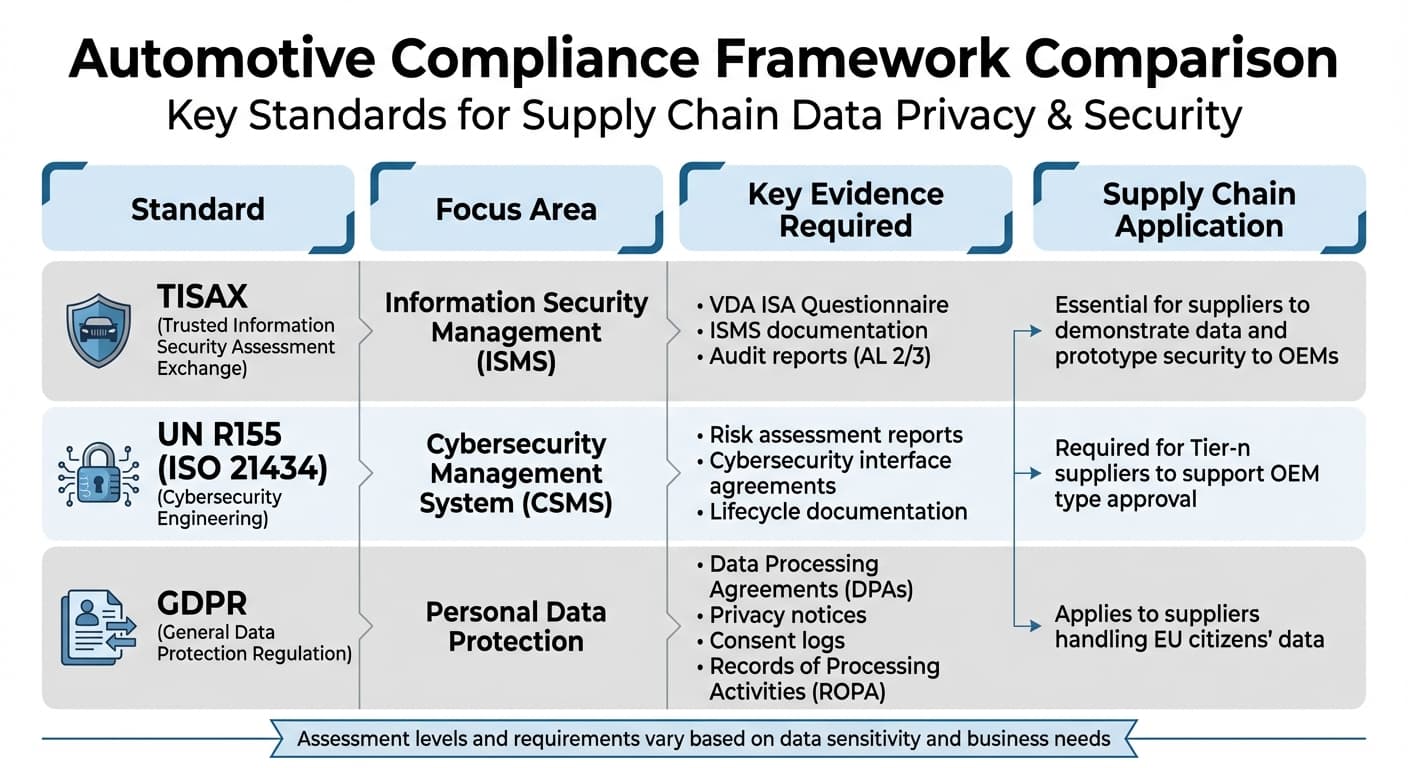
Automotive Data Privacy Compliance Framework Comparison: TISAX vs UN R155 vs GDPR
The automotive supply chain faces unique challenges when it comes to compliance, requiring adherence to specialized frameworks beyond GDPR. These frameworks address the specific risks tied to sensitive automotive data and partnerships with OEMs, ensuring that audit practices align with industry needs.
TISAX (Trusted Information Security Assessment Exchange) serves as the automotive industry's go-to standard for safeguarding sensitive information. Created by the German Association of the Automotive Industry (VDA) and overseen by the ENX Association, TISAX builds on the VDA ISA catalog and aligns with ISO/IEC 27001. It evaluates both data security and prototype protection. Depending on business requirements, companies can achieve up to eight labels. The required assessment level hinges on the sensitivity of the data being managed:
- AL 1: Self-assessment (rarely used for supply chain verification).
- AL 2: Remote auditor interviews, suitable for high protection needs.
- AL 3: On-site audits for scenarios demanding very high protection, such as handling prototype vehicles or managing confidential photoshoots.
On the other hand, UN R155 focuses on the implementation of a Cybersecurity Management System (CSMS) for vehicle manufacturers. Suppliers typically align with this regulation through ISO 21434, which addresses cybersecurity engineering for road vehicles. This standard requires suppliers to provide evidence of component security, including risk assessments, cybersecurity interface agreements, and lifecycle documentation - key elements for OEM type approval.
Comparing Industry Standards
Integrating these frameworks into your compliance strategy requires a clear understanding of their individual roles. Below is a comparison of the primary frameworks:
| Standard | Focus Area | Key Evidence Required | Supply Chain Application |
|---|---|---|---|
| TISAX | Information Security Management (ISMS) | VDA ISA Questionnaire, ISMS documentation, audit reports (AL 2/3) | Essential for suppliers to demonstrate data and prototype security to OEMs |
| UN R155 (ISO 21434) | Cybersecurity Management System (CSMS) | Risk assessment reports, cybersecurity interface agreements, lifecycle documentation | Required for Tier-n suppliers to support OEM type approval |
| GDPR | Personal Data Protection | Data Processing Agreements (DPAs), privacy notices, consent logs, Records of Processing Activities (ROPA) | Applies to suppliers handling EU citizens' data |
When preparing for a TISAX assessment, it’s critical to define the scope of your Information Security Management System (ISMS). This includes identifying all systems, processes, physical locations, and cloud services - such as G-Suite, Salesforce, or Slack - that require protection. Conducting internal VDA ISA audits before the official assessment is also essential. While the assessment itself only spans a few days, preparation time can vary widely, from weeks to years, depending on the organization's security maturity. This targeted compliance approach strengthens supply chain security and complements broader audit strategies discussed earlier.
Conclusion
Ensuring data privacy compliance in automotive supply chains is an ongoing effort that demands attention on multiple levels. Companies need to carry out detailed information audits to identify what personal data they handle, who has access to it, and the reasons for its use. These audits form the backbone of key practices, like maintaining accurate Records of Processing Activities and responding effectively to potential breaches. This proactive approach underscores the importance of safeguarding data and staying aligned with regulations.
Given the intricate nature of automotive supply chains - spanning dealerships, auctions, finance partners, and transportation providers - managing third-party vendors is absolutely essential. Every vendor should have solid Data Processing Agreements (DPAs) that clearly outline responsibilities and data protection measures. As the Information Commissioner's Office puts it, "The greater the risk, the more robust and comprehensive the measures you should put in place". This means carefully evaluating vendors and ensuring they can provide adequate data protection assurances before sharing any sensitive information. These steps are a critical part of the broader compliance strategy outlined earlier.
Additionally, companies should prioritize conducting Data Protection Impact Assessments (DPIAs) for any high-risk data processing activities.
FAQs
What are the essential steps to ensure compliance with automotive data privacy regulations?
To comply with automotive data privacy regulations, start by conducting a data inventory and mapping. This helps identify all personal information within the supply chain - what data is collected, where it’s stored, and who can access it. Make sure you establish a lawful basis for processing this data, and clearly communicate it through privacy notices and contracts. For high-risk activities, like connected vehicle telemetry, perform a Data Protection Impact Assessment (DPIA). Use privacy-by-design principles to limit data collection and ensure techniques like anonymization or pseudonymization are applied wherever feasible.
Strengthen your defenses with robust technical safeguards such as encryption, strict access controls, and regular vulnerability testing. Align these measures with standards like ISO/SAE 21434. Maintain an up-to-date information-security policy, and review it regularly to address new challenges. Designate a Data Protection Officer or a privacy lead to oversee compliance efforts. Build a privacy-compliance program that includes regular audits, staff training, and clear data-protection clauses in contracts with third-party processors. These steps not only help meet U.S. regulatory requirements but also demonstrate a commitment to safeguarding sensitive information.
How can automotive companies manage risks when working with third-party vendors?
To manage third-party vendor risks effectively, automotive companies should begin by mapping how personal data flows throughout their supply chain. This involves conducting a thorough audit to track data exchanges with suppliers, logistics providers, and software partners. Document the type of data being shared, the legal grounds for its processing, and any instances of cross-border transfers. It’s also essential to maintain a detailed vendor register that outlines each third party’s role, security certifications, and contractual obligations. When choosing vendors, prioritize principles like data minimization, purpose limitation, and privacy by design.
Incorporate risk-based controls into contracts by requiring vendors to adopt robust security measures, promptly report any breaches, and agree to audits. For high-risk activities, conduct Data Protection Impact Assessments (DPIAs) and ensure vendors maintain their own DPIA records. Regularly review vendor policies, perform security tests, and establish a clear incident-response plan. Ongoing monitoring of vendor compliance and embedding security requirements into product development processes can further mitigate risks.
Partnering with a logistics provider like CR Express can make compliance easier. CR Express offers GDP-compliant warehousing, customs-bonded facilities, and TSA-approved drivers, ensuring the secure handling of personal data and regulated automotive parts. By working with a trusted partner, you can streamline audits and compliance efforts, keeping third-party risks in check while adhering to U.S. data privacy standards.
What key elements should a Data Processing Agreement (DPA) include for handling automotive data?
A Data Processing Agreement (DPA) for automotive data needs to clearly outline the roles of all involved parties. For example, the automotive manufacturer typically acts as the controller, while logistics or IT providers function as processors. It should also define the purpose and lawful basis for processing the data, such as ensuring vehicle operation, monitoring safety, or managing warranty services.
The agreement should detail the types of data being processed, which might include driver information, location data, telematics, or even biometric details. It must also specify the processing activities, such as data collection, storage, analysis, and sharing with sub-processors.
To ensure compliance with data protection laws, the DPA must address security measures like encryption, access controls, and incident response protocols. It should also provide clear guidelines for managing sub-processors, handling international data transfers, and responding to data-subject requests, such as those for access, correction, or deletion of personal data.
Additionally, the agreement should establish data retention and deletion policies, grant the controller audit rights, and outline breach notification requirements (e.g., notifying breaches within 72 hours). Termination clauses are essential too, ensuring that all data is either returned or securely destroyed when the contract ends. Including these elements helps meet data privacy regulations while addressing the unique challenges of the automotive supply chain.