
Checklist for FTL and LTL Safety Compliance
by CR Express Team, Logistics Team • 14 min read

Checklist for FTL and LTL Safety Compliance
Ensuring safety and compliance in freight shipping is non-negotiable. Whether you're managing Full Truckload (FTL) or Less-Than-Truckload (LTL) operations, following Federal Motor Carrier Safety Administration (FMCSA) regulations is critical to avoid penalties and ensure cargo and public safety.
Here’s what you need to know:
- FTL vs. LTL: FTL shipments dedicate an entire truck to one customer, ideal for large loads, while LTL combines shipments from multiple customers, increasing handling and risk.
- Key Compliance Areas:
- Driver Qualifications: Valid CDL, physical exams, and Driver Qualification Files (DQF) for 3 years.
- Hours of Service (HOS) & ELD: Accurate tracking of driver hours; violations can cost up to $16,000.
- Vehicle Maintenance: Annual inspections, pre/post-trip checks, and proper recordkeeping.
- Load Securement: Ensure tiedowns meet FMCSA standards and the working load limit (WLL) equals at least 50% of the cargo's weight.
- Documentation: Retain key records like Bills of Lading (BOL), ELD data, and hazmat permits for specified durations.
Penalties for Non-Compliance: Fines range from $1,000 to over $186,000 depending on the violation.
FTL offers fewer risks with direct routes, while LTL involves higher exposure due to terminal transfers. Regardless of the method, staying compliant protects your business and ensures safe freight movement.
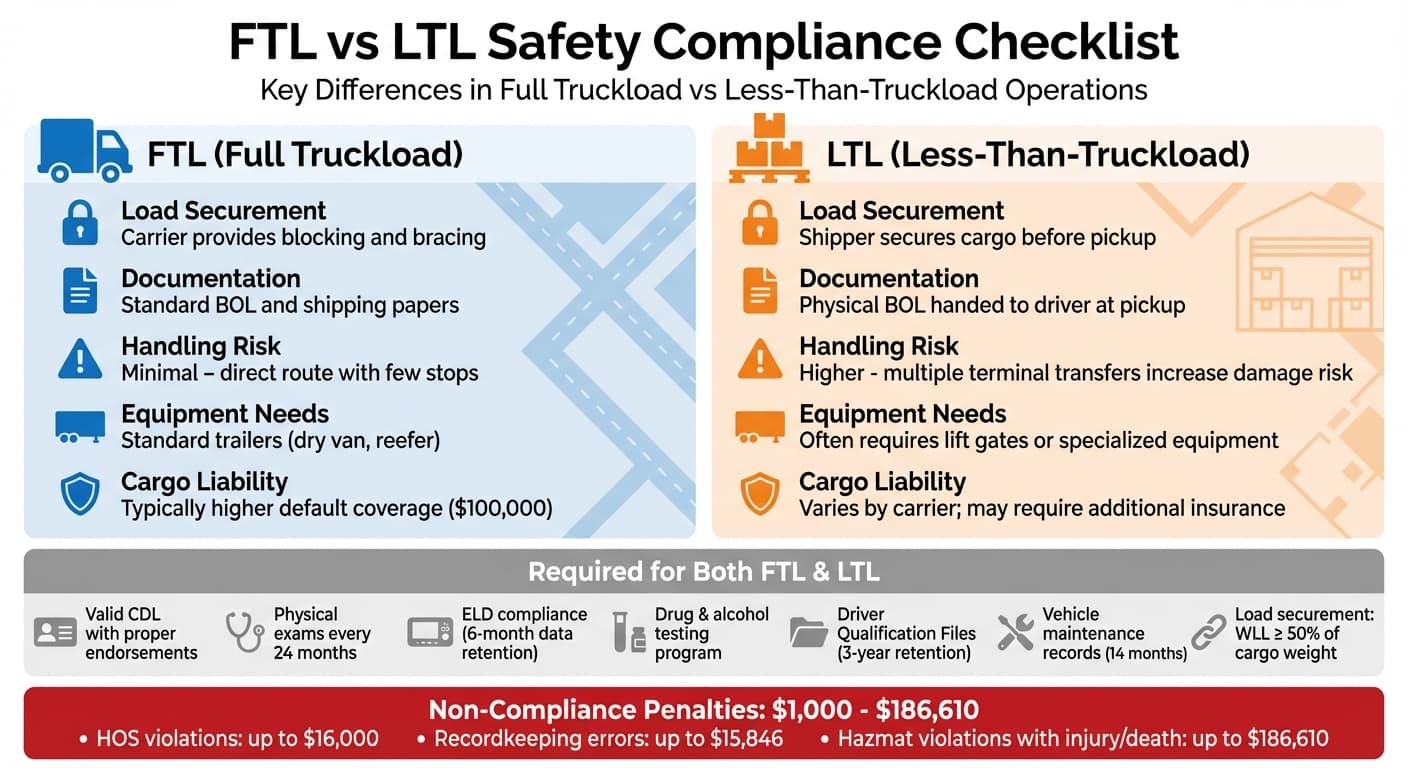
FTL vs LTL Safety Compliance Requirements Comparison Chart
DOT Compliance Binder Checklist
Driver Qualification and Training Checklist
To ensure safety and compliance in both FTL and LTL operations, driver qualifications must adhere to strict standards. Every carrier is required to maintain a Driver Qualification File (DQF) for each driver throughout their employment and for three years after their departure. This file serves as a critical resource during DOT audits and compliance checks. Below, we outline the essential credentials and ongoing training necessary for safe and compliant operations.
Verify Licenses and Certifications
Drivers must hold a valid Commercial Driver's License (CDL) with the appropriate endorsements for the cargo and equipment they handle. This includes endorsements for hazardous materials, tankers, or double/triple trailers, depending on the load requirements.
Additionally, drivers are required to pass a physical exam conducted by a licensed medical examiner listed on the National Registry of Certified Medical Examiners every 24 months. Always verify the examiner's credentials through the registry before accepting the medical certificate. The DQF should also include:
- Employment application
- Road test certificate
- Three-year safety performance history from previous employers
Furthermore, carriers must obtain a Motor Vehicle Record (MVR) from the driver's licensing state at the time of hire and review it annually. Document the review with the reviewer's name and the date in the file. These steps are essential for maintaining driver reliability and ensuring compliance with HOS and ELD regulations.
Hours of Service (HOS) and ELD Compliance
The adoption of Electronic Logging Devices (ELDs) has replaced manual logs, ensuring precise tracking of driver hours. Carriers are required to retain ELD data and secondary backups for a minimum of six months. Non-compliance with ELD recordkeeping can result in penalties ranging from $1,000 to $10,000, while HOS violations may lead to fines of up to $16,000 per incident.
To support compliance, drivers must be trained on HOS limits and proper ELD usage. Supervisors are also required to complete "reasonable suspicion" training to effectively evaluate driver fitness. Regularly monitoring Safety Measurement System (SMS) scores is crucial, as the FMCSA uses this data to identify carriers for audits. Additionally, carriers must keep annual vehicle inspection records for at least 14 months and Driver Vehicle Inspection Reports (DVIRs) for at least 90 days.
Drug and Alcohol Testing Records
Motor carriers must conduct pre-employment, random, reasonable suspicion, and follow-up drug and alcohol testing for all employees involved in safety-sensitive roles, including drivers, dispatchers, mechanics, and warehouse staff. Before hiring, carriers must query the Drug and Alcohol Clearinghouse and verify the candidate's safety performance over the past three years. This process must be completed within 30 days of hiring.
Supervisors overseeing safety-sensitive employees are required to complete "reasonable suspicion" training. While this training is a one-time legal requirement, periodic refreshers are recommended to maintain compliance. Failure to maintain complete drug and alcohol testing records can result in penalties of up to $15,846.
Once these general qualifications are in place, attention should shift to specialized training for high-risk materials.
Hazmat and Specialized Equipment Training
Drivers handling hazardous materials must complete training within 90 days of hire and undergo refresher training every three years. All certifications must be documented in the DQF, including the LCV Driver Training Certificate or Certificate of Grandfathering for those operating longer combination vehicles.
At CR Express, our TSA-approved and hazmat-certified drivers are equipped to handle time-sensitive, regulated cargo. Our training programs ensure compliance with FMCSA standards while prioritizing safety for specialized cargo movements through the Chicago gateway.
Vehicle Maintenance and Inspection Standards
Ensuring vehicle safety is just as important as verifying driver qualifications. Carriers are required to keep annual vehicle inspection records for at least 14 months, while Driver Vehicle Inspection Records (DVIRs) must be retained for a minimum of 90 days.
Pre-Trip and Post-Trip Inspections
Drivers should perform thorough pre-trip and post-trip inspections, recording their findings in DVIRs. These inspections should include a close look at vehicle structures, such as floors, walls, and anchor points, to identify any damage that could jeopardize cargo containment. Any issues must be documented and addressed before the vehicle embarks on its next trip.
Equipment Compliance and Maintenance
All equipment - trailers, tires, brakes, and lights - needs to comply with FMCSA standards. Maintenance logs for all commercial motor vehicle (CMV) equipment should be meticulously kept to prove regular servicing and adherence to regulations. Neglecting this can lead to fines of up to $15,846. At CR Express, we prioritize safety by implementing strict maintenance protocols. Our asset-based fleet undergoes scheduled inspections to ensure every vehicle meets or surpasses FMCSA requirements. This includes rigorous upkeep of our privately owned chassis fleet and a variety of equipment options.
Load Securement Device Checks
Before loading begins, inspect all securement devices for any damage that might reduce their working load limit (WLL). FMCSA standards require that all tiedowns, except steel strapping, be adjustable so drivers can tighten them during transit. Using tiedowns with knots is strictly prohibited. Additionally, edge protection must be applied wherever tiedowns contact cargo to prevent cutting or abrasion. Ensure that dunnage, chocks, cradles, and shoring bars are free from defects, and confirm that the combined WLL of all tiedowns equals at least 50% of the cargo's weight.
Documentation and Recordkeeping Requirements
Once you've confirmed driver qualifications and vehicle maintenance, the next critical step is ensuring proper documentation. Keeping thorough and accurate records isn't just a good practice - it’s essential for staying compliant and avoiding costly fines. The FMCSA mandates that carriers retain specific records for varying lengths of time, and even a single missing document during an audit can lead to penalties as high as $15,846.
Bills of Lading and Insurance Documents
Every shipment starts with a Bill of Lading (BOL), which acts as both a receipt and a contract. For LTL shipments, the BOL must include detailed freight classifications, as these directly impact pricing and weight limits. FTL operations generally use one BOL for the entire truckload, while LTL shipments require separate BOLs for each individual shipment due to multiple stops and transfers at distribution centers. Additionally, it’s crucial to keep a physical or digital copy of the latest FMCSA rules and the MCS-90 form at your main office. These documents are key to ensuring shipment safety and compliance with regulations.
ELD Data and Maintenance Logs
Electronic Logging Device (ELD) data and Hours of Service (HOS) records must be stored for at least six months, including backups. Annual vehicle inspection records should be kept for 14 months, while Driver Vehicle Inspection Reports (DVIRs) need to be retained for 90 days. Since DOT audits can occur without prior notice - often triggered by low Safety Measurement System scores or public complaints - organizing your records is crucial. Group them into clear categories such as Driver Qualifications, HOS/ELD Compliance, Vehicle Maintenance, and Hazmat/Permits. This makes it easier to locate necessary documents quickly during an audit.
Hazmat and Overweight Permits
For carriers handling hazardous materials, documentation requirements are even stricter. Hazmat shipping papers must be kept for one year and must include a precise description sequence: proper shipping name, hazard class, identification number, and packaging group. Ensure that the emergency response number listed connects to someone with the technical knowledge to assist in case of an incident. Additionally, for FTL shipments exceeding 45,000 pounds, you’ll need overweight permits. Be aware that hazmat violations can result in steep penalties, starting at $79,976 and climbing to $186,610 if the violation leads to serious injury or death.
| Record Type | Minimum Retention Period |
|---|---|
| Driver Qualification Files (DQF) | 3 Years |
| ELD Data and Backups | 6 Months |
| Annual Vehicle Inspection Records | 14 Months |
| Driver Vehicle Inspection Records | 90 Days |
| Hazmat Shipping Papers | 1 Year |
sbb-itb-c0b8770
Load Securement and Cargo Handling Protocols
Beyond meeting vehicle and equipment standards, proper cargo securement is critical for ensuring safety and compliance during transit.
Securing cargo appropriately helps prevent accidents, violations, and damage. Federal regulations require adherence to specific load securement standards.
FMCSA Securement Rules
The FMCSA requires that cargo securement systems in commercial motor vehicles withstand specific forces: 0.8 g deceleration forward, 0.5 g acceleration backward, and 0.5 g acceleration laterally. While most loaded vehicles don’t exceed 0.6 g deceleration, these higher benchmarks account for situations involving empty or lightly-loaded vehicles during braking.
The aggregate working load limit (WLL) of all tiedowns must equal at least 50% of the cargo’s weight. The number of tiedowns depends on the cargo’s size and weight:
- For items 5 feet or shorter:
- Use one tiedown if the cargo weighs 1,100 pounds or less.
- Use two tiedowns if the cargo weighs more than 1,100 pounds.
- For items between 5 and 10 feet: Two tiedowns are required, regardless of weight.
- For items longer than 10 feet: Use two tiedowns for the first 10 feet, adding one additional tiedown for every 10 feet (or fraction thereof) beyond that.
Protect edges where tiedowns make contact with the cargo to prevent abrasion. Rolling items, such as drums or machinery, should be secured with chocks, wedges, or cradles that remain firmly in place during transit.
These rules provide the foundation for handling specialized cargo, as explained below.
Temperature-Controlled and High-Value Cargo
For shipments like pharmaceuticals or electronics, which require extra care, follow securement protocols tailored to these sensitive loads. While full truckload (FTL) shipping minimizes handling and enhances security, less-than-truckload (LTL) shipping involves more frequent stops, increasing the risk of damage or theft.
When securing sensitive cargo, ensure tiedowns (excluding steel strapping) allow drivers to adjust them as needed. Use blocking and bracing to immobilize the cargo, and verify that the securement system meets the 0.8 g standard.
Consolidation and Cross-Docking Safety
During consolidation and cross-docking, cargo must be secured using sturdy structures like dunnage, dunnage bags, shoring bars, or tiedowns to prevent shifting. When placing items side by side, ensure they are either in direct contact or secured with transverse tiedowns to eliminate movement.
For items like paper rolls that don’t touch the vehicle walls, fill any gaps with blocking, bracing, or friction mats to prevent lateral movement. If friction mats are the primary securement method, ensure the mat extends in the direction of the securement force.
Personnel involved in cross-docking operations are classified as safety-sensitive employees and must comply with DOT/FMCSA drug and alcohol testing regulations. Additionally, workers handling hazardous materials must complete HAZMAT training within 90 days of employment and undergo refresher training every three years.
Final Pre-Shipment Verification Checklist
Before sending out a shipment, it’s crucial to double-check that everything complies with regulations. This step not only prevents expensive penalties but also ensures safe transportation. Start by confirming that all driver documentation is up-to-date and complete. The vehicle must have a valid annual inspection (conducted within the last 14 months), and the driver should complete a pre-trip Driver Vehicle Inspection Record.
For securing cargo, ensure the total working load limit of all tiedowns equals at least 50% of the cargo's weight. If hazardous materials are involved, verify that the shipping papers include the proper shipping name, hazard class, identification number, packing group, and a 24/7 emergency contact number. Vehicles carrying any amount of Table 1 hazardous materials or more than 1,001 lbs of Table 2 hazardous materials must display placards on all four sides.
Below is a comparison table highlighting the differences between full truckload (FTL) and less-than-truckload (LTL) verification processes.
FTL vs LTL Checklist Comparison
Full truckload (FTL) and less-than-truckload (LTL) shipments require different checks due to how they are handled and routed.
| Checklist Item | FTL Requirements | LTL Requirements |
|---|---|---|
| Load Securement | Carrier provides blocking and bracing | Shipper secures cargo before pickup |
| Documentation | Standard BOL and shipping papers | Physical BOL must be handed to the driver at pickup |
| Handling Risk | Minimal; direct route with few stops | Higher; multiple terminal transfers increase damage risk |
| Equipment Needs | Standard trailers (dry van, reefer) | Often requires lift gates or specialized equipment |
| Cargo Liability | Typically higher default coverage ($100,000) | Varies by carrier; may require additional insurance |
Final Safety Audit and Records Retention
After reviewing the shipment type, complete a final safety audit to ensure all records comply with FMCSA standards. This step pulls together all the earlier compliance checks, verifying that both documentation and equipment meet the necessary requirements. A designated expert should sign the shipping certification.
Keep the following records for the specified durations:
- ELD data: 6 months
- DVIRs: 90 days
- Annual vehicle inspection records: 14 months
- Hazmat shipping papers: 1 year
- Driver Qualification Files: 3 years
Non-compliance can result in hefty fines. Hours of Service violations can cost up to $16,000 per violation, recordkeeping errors may incur fines of up to $15,846, and hazardous materials violations involving death or serious injury can reach $186,610. Keeping accurate records and performing thorough pre-shipment audits not only avoids these penalties but also ensures your freight moves safely and in compliance with regulations.
Conclusion
Staying compliant with FTL and LTL safety regulations not only shields your business from hefty fines but also ensures the secure delivery of your cargo. Keeping accurate records is a critical part of avoiding penalties and potential operational disruptions.
The key takeaway? Your compliance strategy should align with your shipping method. FTL shipments, with their direct routes and minimal handling, naturally reduce the risk of damage. On the other hand, LTL freight, which often involves multiple terminal transfers, faces greater exposure to potential issues. No matter the shipping method, meeting cargo securement standards is non-negotiable for safe and reliable operations.
At CR Express, we bring decades of experience to every shipment. With real-time tracking, continuous monitoring, and comprehensive certifications, we ensure your freight is in good hands. Our asset-based fleet - ranked among the top 1-2% of U.S. carriers by size - operates through GDP-compliant warehouses and temperature-controlled facilities. Whether it’s hazmat-certified handling or navigating customs requirements, we’re equipped to manage even the most complex regulatory demands.
FAQs
What are the key compliance differences between FTL and LTL shipping?
Full-truckload (FTL) shipping means a single shipper uses the entire trailer. This type of shipping demands attention to load-specific documentation, staying within weight and size regulations, and ensuring proper load securement as outlined by the Federal Motor Carrier Safety Regulations (FMCSR). If the cargo includes hazardous materials (hazmat), the shipment must comply with strict rules for labeling, placarding, and paperwork. FTL shipments generally need higher-value insurance coverage and a single bill of lading that details the truck’s full contents.
Less-than-truckload (LTL) shipping, on the other hand, involves combining freight from multiple shippers, which adds layers of compliance. Each shipper is responsible for providing individual packaging, labeling, and documentation for their cargo, including meeting hazmat standards if applicable. Carriers must ensure load segregation to avoid contamination and follow stricter securement protocols due to frequent stops and handling. LTL shipments also require carrier liability insurance that covers the total value of all combined shipments.
CR Express handles both FTL and LTL shipping with ease, offering TSA-approved drivers, GDP-compliant warehousing, and professional hazmat handling. These services ensure your cargo meets all regulatory and safety standards.
What steps can I take to ensure my drivers meet FMCSA qualifications and avoid penalties?
To keep your drivers compliant with FMCSA regulations, it's crucial to maintain a Driver Qualification File (DQF) for each driver. Here's what should be included:
- An annual Motor Vehicle Record (MVR) check from the state licensing agency, along with a documented review to confirm adherence to FMCSA rules.
- An annual certification of traffic violations provided by the driver, accompanied by a dated note from the reviewer.
- A valid Medical Examiner’s Certificate, issued by a certified medical examiner, updated every 24 months. Ensure the examiner is listed on the National Registry.
- Copies of the driver’s Commercial Driver’s License (CDL), initial application, and other required forms, retained for the specified time periods.
Conducting regular audits of these files is essential to catch any missing or outdated documents before an inspection. Overlooking items like an expired medical certificate or an outdated MVR could result in penalties, out-of-service orders, or fines.
At CR Express, we prioritize compliance by maintaining up-to-date driver files with thorough annual reviews and all necessary documentation. This ensures safe and compliant FTL and LTL shipments every time.
What are the key steps to properly secure cargo according to FMCSA standards?
Securing cargo properly under FMCSA standards starts with a thorough pre-trip inspection. Before loading, check the vehicle’s anchor points, tie-downs, and any blocking or bracing for signs of damage or wear. If any equipment is defective, replace it immediately. The number of tie-downs you’ll need depends on the cargo’s weight, size, and type. As a general rule, you’ll require one tie-down for every 10,000 pounds of cargo or one tie-down for every 5 feet of length, whichever results in more restraints. For heavier or irregularly shaped loads, additional tie-downs may be necessary. When securing intermodal chassis, ensure all four corners are locked down, and make sure the front and rear of the load are independently restrained to prevent shifting during transit.
Tie-downs must meet the required load rating, be attached to approved anchor points, and be spaced no more than 4 feet apart. Straps, chains, or other securing devices should be tightened to remove slack while allowing minimal movement during the journey. Once the cargo is loaded, confirm it is evenly distributed with no overhanging items. Additionally, check that all doors and latches are securely locked. After driving a short distance, perform a final walk-around to verify everything is still secure, and document the inspection in the vehicle’s safety checklist.
At CR Express, we follow these FMCSA guidelines rigorously for both FTL and LTL shipments. Our trained drivers and dedicated fleet ensure that cargo remains secure from pickup to delivery.