

FMVSS Testing Trends in 2025
Big changes are reshaping vehicle safety standards in 2025. The National Highway Traffic Safety Administration (NHTSA) is modernizing Federal Motor Vehicle Safety Standards (FMVSS) to address advanced technologies like automated driving systems (ADS) and automatic emergency braking (AEB). Key updates include:
- FMVSS No. 102: Removing outdated transmission controls for autonomous vehicles.
- FMVSS No. 108: Allowing adaptive lighting systems for better visibility.
- FMVSS No. 127: Mandating AEB systems on all light vehicles by September 2029, with a proposed extension to 2031.
These updates shift the focus from design-specific rules to performance-based testing, creating new challenges for automakers and suppliers. Enhanced testing methods, stricter data reporting, and logistical support are now critical to meet evolving compliance requirements. As the automotive industry adapts, collaboration with research institutions like Virginia Tech and logistics partners is key to navigating these changes effectively.
The Next 15 Months Will Define Autonomous Vehicle Policy in America
Major FMVSS Regulation Changes for 2025
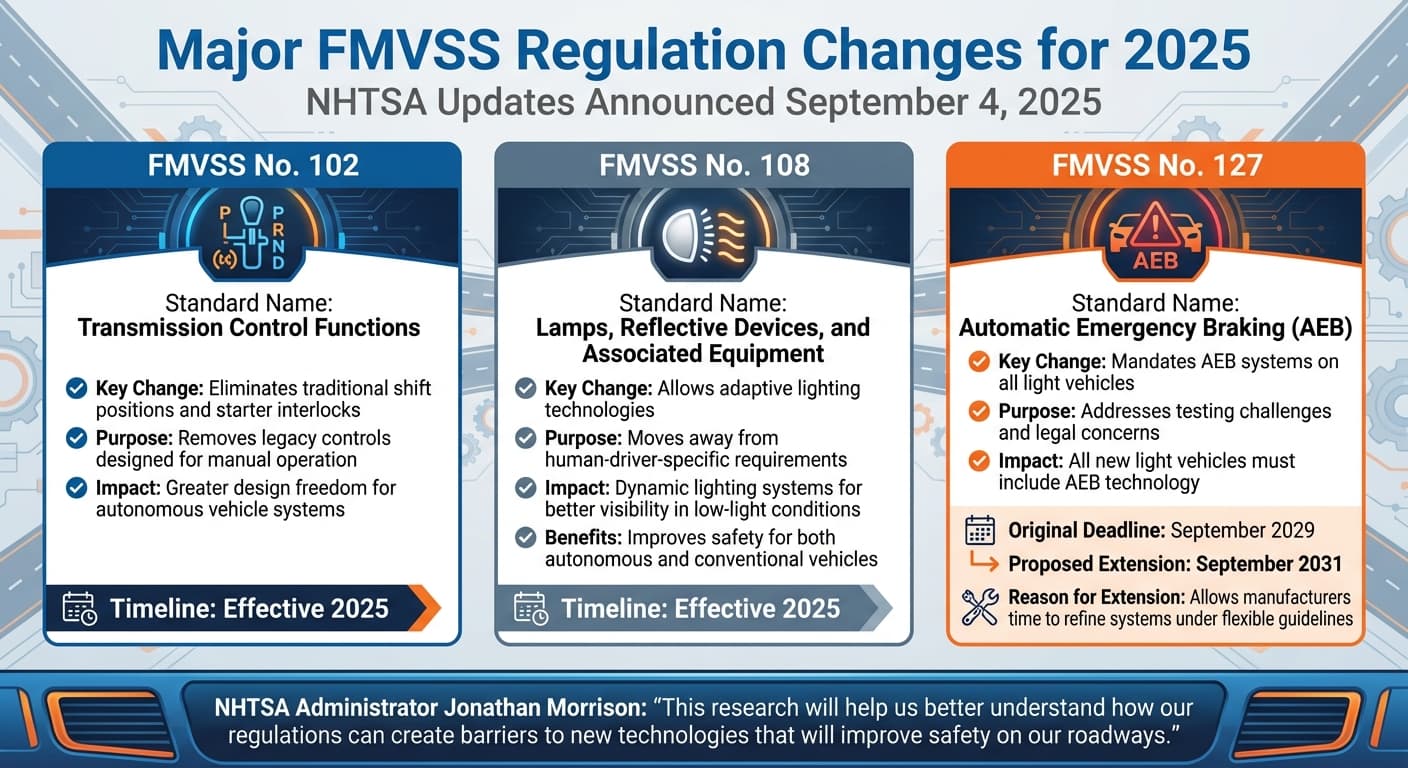
2025 FMVSS Key Regulation Updates: Standards 102, 108, and 127
In a significant move, the NHTSA announced on September 4, 2025, updates to three key FMVSS standards. These updates aim to remove outdated requirements tied to human driving, setting the stage for autonomous vehicles while maintaining essential safety standards. The changes are expected to not only modernize vehicle design but also reshape industry practices in validation and compliance.
FMVSS No. 102: Transmission Control Adaptations for Autonomy
The update to FMVSS No. 102 (Transmission Control Functions) eliminates traditional features like shift positions and starter interlocks that assume manual operation. This builds on earlier NHTSA rules, such as the 2022 crashworthiness updates, which addressed vehicles without steering wheels or driver’s seats. By removing these legacy controls, manufacturers gain more freedom to design autonomous systems that meet safety goals without unnecessary constraints.
FMVSS No. 108: Adaptive Lighting System Standards
Changes to FMVSS No. 108 (Lamps, Reflective Devices, and Associated Equipment) emphasize adaptive lighting technologies for better performance in low-visibility conditions. The revised standard moves away from requirements tailored to human drivers, allowing advanced systems that adjust dynamically to varying driving environments. These updates benefit both autonomous and conventional vehicles by improving visibility and overall safety.
FMVSS No. 127: Automatic Emergency Braking (AEB) Adjustments
Under FMVSS No. 127, all light vehicles must feature Automatic Emergency Braking (AEB) systems. However, the NHTSA has proposed extending the compliance deadline from September 2029 to September 2031. This extension addresses challenges in testing and legal concerns following the 2024 final rule. It provides manufacturers additional time to refine AEB systems under neutral and flexible guidelines. NHTSA Administrator Jonathan Morrison highlighted the importance of this ongoing work:
This research will do just that by helping us better understand how our regulations can create barriers to new technologies that will improve safety on our roadways
.
New Testing Standards for Automated Driving Systems
The development of automated vehicles requires updated testing standards to ensure safety and eliminate barriers to innovation. A multi-year study by the National Highway Traffic Safety Administration (NHTSA) examined all 81 Federal Motor Vehicle Safety Standards (FMVSS). Research from Virginia Tech has proposed adjustments that maintain safety while addressing the unique needs of driverless systems, setting the stage for updated testing protocols across both light and heavy vehicles.
Virginia Tech Research on Autonomous Vehicle Safety Standards
The Virginia Tech Transportation Institute has published a series of reports titled "FMVSS Considerations for Vehicles With Automated Driving Systems" between April 2020 and July 2025. These reports provide detailed recommendations for modifying various FMVSS to align with the requirements of autonomous vehicles. The standards addressed include:
- Crash avoidance standards: Nos. 102, 108, 114, 118, 138, 141
- Crashworthiness standards: Nos. 201, 202a, 203, 204, 205, 206
- Windshield controls: Nos. 103, 104
- Critical systems: Braking (Nos. 105, 121, 135) and electronic stability control (Nos. 126, 136).
These reports introduce "technical translation options" that allow vehicles equipped with Automated Driving Systems (ADS) to comply with safety standards even without traditional components like steering wheels or driver’s seats. This work directly informs the development of testing standards that accommodate the unique features of autonomous technology.
NHTSA-FMCSA Joint Rules for Heavy Vehicle Automation
Building on these advancements for light vehicles, NHTSA and the Federal Motor Carrier Safety Administration (FMCSA) are extending similar performance-based testing approaches to heavy trucks. In 2023, the agencies proposed new Automatic Emergency Braking (AEB) requirements for heavy trucks. By spring 2025, they plan to issue a supplemental notice of proposed rulemaking (SNPRM) to refine the original proposal, which is still pending finalization.
The proposed rule relies on performance-based track testing to evaluate how automated systems perceive and respond to obstacles. These tests measure the effectiveness of AEB systems during dynamic driving tasks, ensuring they can detect and react to potential hazards in real-world scenarios.
sbb-itb-c0b8770
How FMVSS Updates Affect the Automotive Supply Chain
As the FMVSS standards continue to evolve, efficient supply chain operations are becoming increasingly critical to meet stricter testing schedules. The 2025 FMVSS modernization initiative is reshaping how original equipment manufacturers (OEMs), Tier 1–3 suppliers, and test laboratories handle sourcing, inventory, and transportation of components. With the National Highway Traffic Safety Administration (NHTSA) focusing on "accounting for autonomous vehicles" and expanding exemptions for research fleets, there’s been a noticeable increase in the movement of prototype and exempt vehicles between R&D centers, proving grounds, and specialized facilities. For example, the introduction of FMVSS No. 127 - mandating automatic emergency braking (AEB) on nearly all new light vehicles by September 1, 2029 - along with joint heavy-vehicle AEB requirements from NHTSA and FMCSA, has significantly boosted the demand for timely delivery of sensors, test dummies, and instrumented targets to dedicated track testing sites.
Additionally, NHTSA’s 2025 enforcement strategy requires more comprehensive and timely reporting, recall data, and field information collection. This pushes OEMs and suppliers to enhance traceability of parts and test batches throughout their logistics processes. For development fleets headed to the U.S. and imported test components, customs-compliant logistics have become essential. These ensure noncertified vehicles and specialized equipment are properly managed during FMVSS testing and exemption procedures. Meanwhile, research from the Virginia Tech Transportation Institute on "technical translation options" for automated vehicles without traditional driver controls highlights how test configurations, fixtures, and instrumentation are becoming more varied. This complexity underscores the need for strong logistics support to keep testing timelines on track.
How Logistics Providers Support FMVSS Compliance
Logistics providers play a critical role in preventing shipment delays, damage, or compliance issues that could disrupt FMVSS testing schedules. For instance, CR Express - ranked among the top 1–2% of U.S. fleets - offers a fleet equipped with reefer, flatbed, and roller bed options, ensuring nationwide full truckload service with real-time GPS tracking. Their services are particularly well-suited for rush deliveries of AEB sensors and autonomous lighting prototypes under the tight deadlines of 2025 testing requirements. Certified drivers and airport access allow for secure and timely air freight of high-value components, while their intermodal drayage services - operating 7 days a week - ensure smooth transport of FMVSS No. 108 lighting and No. 127 braking parts. With over 500 container parking spots near key Chicago rail hubs, including Elwood/Joliet, Harvey/City, and North rails, CR Express ensures efficient logistics for critical automotive components.
Located strategically near Chicago’s major transportation hubs, CR Express is well-positioned to handle expedited regional and national deliveries. This capability is vital for transporting FMVSS No. 127 AEB components to U.S. testing labs, especially under extended deadlines for heavy vehicles. Their hub-and-spoke model supports cross-docking, enabling just-in-time delivery of advanced driver system parts. This approach not only reduces inventory costs but also ensures that components are readily available for NHTSA’s track-testing protocols.
Customs-Bonded Warehousing for Automotive Testing Components
Customs-bonded warehousing is another essential piece of the puzzle for managing test component inventories. CR Express operates a 280,000-square-foot customs-bonded facility that offers deferred storage and transloading for imported FMVSS testing parts. Whether it’s advanced lighting modules for FMVSS No. 108 or AEB hardware for No. 127, these facilities provide efficient sorting by SKU and OS&D (over, short, and damaged) management before compliance release. With GDP-compliant, temperature-controlled storage spaces, 24/7 operations, and CCTV-secured docks, these facilities ensure a secure chain-of-custody for sensitive prototypes amid the regulatory changes coming in 2025.
Manufacturers also benefit from the ability to store imported components duty-free for up to five years while awaiting or undergoing FMVSS compliance testing. This approach minimizes both customs risks and duty expenses, offering a cost-effective solution for managing prototype and exempt vehicles during this transitional period.
Conclusion
The 2025 FMVSS landscape is set to reshape how the automotive industry approaches safety testing and compliance. NHTSA’s partnership with Virginia Tech to evaluate 81 FMVSS and propose technical adaptations for vehicles with automated systems, along with the phased implementation of FMVSS No. 127 AEB requirements (potentially extending to 2031 for light vehicles), highlights the scale of transformation ahead. As NHTSA Administrator Jonathan Morrison stated, these updates aim to "enhance safety and support American innovation" by clearing obstacles to adopting advanced technologies. This evolving regulatory framework demands immediate attention from all stakeholders.
For OEMs, suppliers, and test laboratories, engaging proactively in NHTSA’s rulemaking process is no longer optional - it’s critical. Monitoring updates from Virginia Tech and providing feedback on proposed changes to standards like Nos. 102, 108, and 127 will be vital. Building strong regulatory affairs teams to navigate new test procedures and data requirements will also be essential as NHTSA intensifies its analytical and enforcement efforts. Preparedness must go beyond technical compliance, extending into operational logistics.
The supply chain presents its own challenges. Extended testing timelines and the movement of prototypes between R&D centers, proving grounds, and specialized facilities require logistics partners with expertise in customs compliance, bonded warehousing, and just-in-time delivery. Ensuring the timely and traceable delivery of high-value components is now more critical than ever to maintain testing schedules and meet regulatory deadlines.
Looking ahead, Q2 2026 marks a pivotal point as manufacturers align their testing protocols with confirmed deadlines and anticipated extensions. Automotive stakeholders must refine testing strategies, secure dependable logistics partners, and adjust their roadmaps to meet both the September 2029 AEB deadline and any future updates. The integration of automated vehicle technologies, advanced driver-assistance systems, and traditional FMVSS into a unified regulatory structure underscores the need for ongoing adaptability.
FAQs
What impact will the 2025 FMVSS updates have on autonomous vehicle development?
The upcoming 2025 updates to FMVSS standards are set to be a major step forward for autonomous vehicle development. These revisions will bring in stricter safety testing and validation protocols, particularly for essential components like sensors and control algorithms. With these tighter regulations, manufacturers will have clearer guidelines for incorporating autonomous technologies into their vehicles.
By establishing these rules, the updates aim to strike a balance between encouraging technological progress and prioritizing consumer safety. This clarity in regulation is expected to increase trust among both manufacturers and consumers, potentially speeding up the adoption of autonomous vehicles in the market.
What challenges do automakers face with the new FMVSS performance-based testing requirements?
Automakers are facing a host of challenges with the updated FMVSS performance-based testing requirements. One major hurdle is the increased complexity of testing protocols, which now call for more detailed and precise evaluations to meet stricter safety standards.
Another pressing issue is the rising cost of compliance. Meeting these new requirements often involves investing in advanced simulation tools, specialized testing equipment, and cutting-edge technologies. On top of that, the constantly shifting regulatory landscape forces manufacturers to pour significant resources into research and development just to keep up.
These shifts highlight the need for smarter, more efficient testing processes. They also underscore the value of working closely with dependable logistics and supply chain partners to handle the growing demands of the industry.
What does the extended AEB compliance deadline mean for manufacturers?
The extended deadline for meeting autonomous emergency braking (AEB) requirements offers manufacturers a bit of breathing room to adjust to the updated standards. This added time helps ease immediate financial pressures and avoids major disruptions to daily operations.
With this extension, manufacturers can dedicate more resources to properly integrating and testing AEB systems. The goal is to ensure these systems not only meet safety regulations but also maintain production efficiency. This adjustment period allows the automotive industry to adapt more smoothly as it continues to advance and refine its technologies.