

Securing Automotive Supply Chains with ISO/SAE 21434
by CR Express Team, Logistics Team • 14 min read

Securing Automotive Supply Chains with ISO/SAE 21434
Cybersecurity in automotive supply chains is no longer optional. With vehicles acting as "computers on wheels", featuring up to 100 million lines of code - and projections of 300 million by 2030 - cyber risks are escalating. The ISO/SAE 21434 standard provides a structured approach to managing these risks across a vehicle's lifecycle, from design to decommissioning.
Key takeaways:
- ISO/SAE 21434 focuses on cybersecurity for automotive electronic systems, emphasizing processes over specific technologies.
- It supports compliance with global regulations like UNECE WP.29 (R155), requiring automakers and suppliers to implement Cybersecurity Management Systems (CSMS).
- Suppliers at all levels (Tier 1, 2, and 3) must address risks within their components and collaborate with OEMs.
- Threat Analysis and Risk Assessment (TARA) is central to identifying vulnerabilities early in development.
- Physical logistics, including secure handling and transport of components, is as critical as digital safeguards.
Adopting ISO/SAE 21434 ensures a unified framework for securing every link in the automotive supply chain. This article explains how to implement it effectively and why it matters.
Implementing Automotive Cybersecurity Management Systems based on ISO/SAE 21434 and UNECE R155
What Is ISO/SAE 21434?
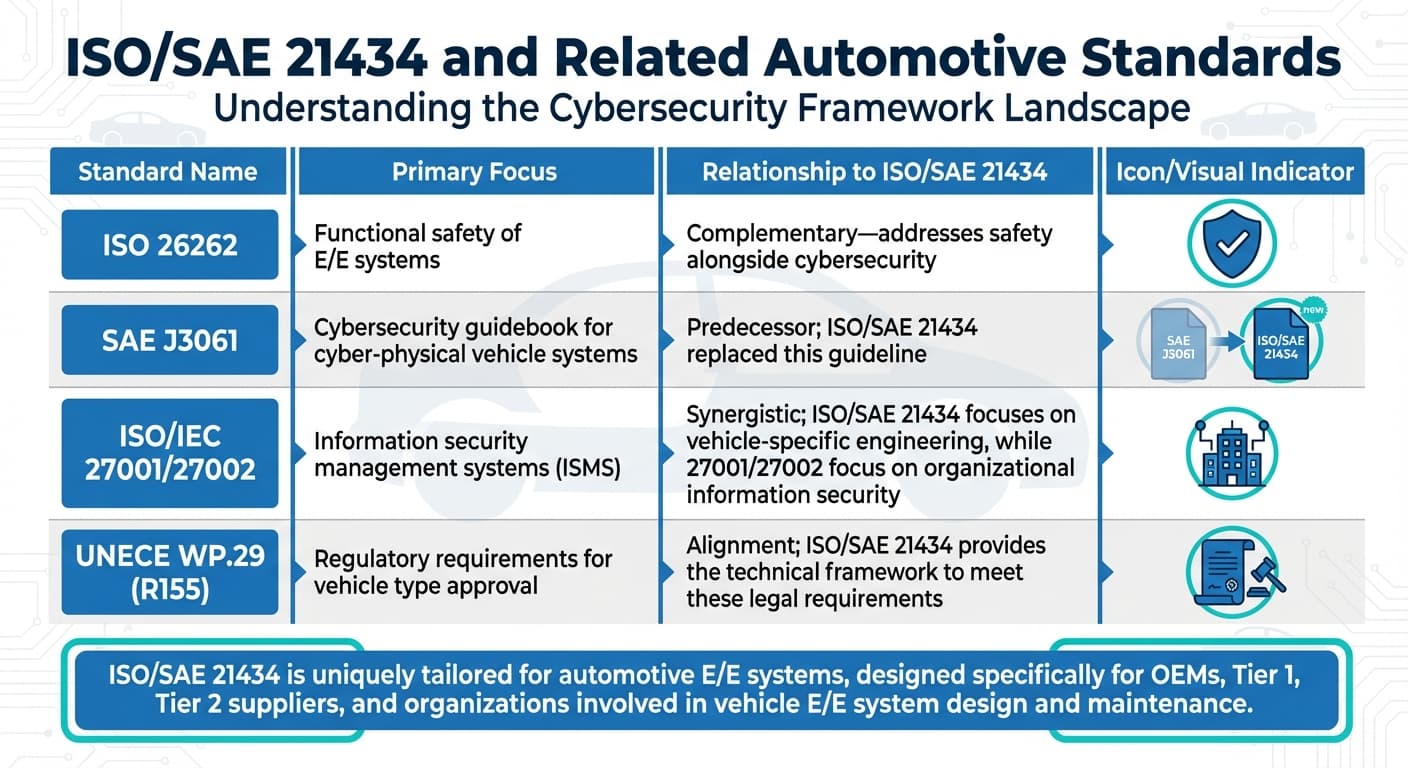
ISO/SAE 21434 vs Other Automotive Standards Comparison
ISO/SAE 21434 establishes cybersecurity risk management requirements for automotive E/E systems. Introduced in August 2021, this 81-page standard replaced SAE J3061, moving from a voluntary guideline to an official international standard.
This standard spans the entire lifecycle of a vehicle - starting from the initial concept and product development phases, through production, operation, and maintenance, all the way to decommissioning. Its goal is to maintain cybersecurity throughout the vehicle’s lifespan.
ISO/SAE 21434 doesn’t prescribe specific technologies; instead, it emphasizes processes and risk management. This approach allows manufacturers and suppliers to tailor their security measures to their operations while still meeting the standard’s requirements.
For the automotive supply chain, the standard provides a shared framework that helps OEMs and suppliers collaboratively manage cybersecurity risks. While compliance with ISO/SAE 21434 isn’t a legal requirement on its own, it’s widely recognized as the main way to meet international regulations like UNECE WP.29 R155. These regulations mandate that vehicle manufacturers establish a Cybersecurity Management System (CSMS).
With this foundation, ISO/SAE 21434’s goals and its relationship to other standards become more apparent.
Main Goals of ISO/SAE 21434
The standard’s overarching aim is to manage cybersecurity risks across the automotive product lifecycle, ensuring all entities in the supply chain take responsibility for security. This includes Tier 1, Tier 2, and Tier 3 suppliers, who must now implement their own CSMS to secure the components they deliver.
A key feature of ISO/SAE 21434 is its use of Threat Analysis and Risk Assessment (TARA). This method helps identify and assess cybersecurity risks early in the development process. By addressing vulnerabilities upfront, organizations can avoid costly issues in production vehicles.
The framework also tackles four critical areas: risk assessment, threat mitigation, secure software deployment, and incident response. For incident response, the standard specifies requirements for "Event and Incident Response", ensuring organizations can detect and address security incidents in a timely manner. Before implementing these measures, businesses are advised to conduct a gap analysis of their current cybersecurity practices. This helps pinpoint areas needing improvement, define the scope of their CSMS, and assign clear roles and responsibilities to their teams.
How ISO/SAE 21434 Compares to Other Standards
ISO/SAE 21434 works alongside other automotive standards, each addressing different aspects of vehicle safety and security. ISO 26262 focuses on functional safety (preventing risks from system failures), while ISO/SAE 21434 targets cybersecurity (protecting against malicious attacks). These two standards complement each other, often being implemented together to cover both safety and security concerns.
| Standard | Primary Focus | Relationship to ISO/SAE 21434 |
|---|---|---|
| ISO 26262 | Functional safety of E/E systems | Complementary - addresses safety alongside cybersecurity |
| SAE J3061 | Cybersecurity guidebook for cyber-physical vehicle systems | Predecessor; ISO/SAE 21434 replaced this guideline |
| ISO/IEC 27001/27002 | Information security management systems (ISMS) | Synergistic; ISO/SAE 21434 focuses on vehicle-specific engineering, while 27001/27002 focus on organizational information security |
| UNECE WP.29 | Regulatory requirements for vehicle type approval | Alignment; ISO/SAE 21434 provides the technical framework to meet these legal requirements |
The key takeaway is that ISO/SAE 21434 is uniquely tailored for automotive E/E systems, making it far more specific than general information security standards like ISO/IEC 27001. It’s designed for automotive OEMs, Tier 1 and Tier 2 suppliers, and any organization involved in the design or upkeep of vehicle E/E systems.
How to Implement ISO/SAE 21434 in Your Supply Chain
Implementing ISO/SAE 21434 involves integrating cybersecurity measures across your entire supply chain. Start by establishing a Cybersecurity Management System (CSMS) that spans the complete product lifecycle. Conduct a thorough gap analysis to pinpoint weaknesses in your current cybersecurity practices, and assign clear roles so every team member knows their responsibilities.
It’s also a good idea to create an independent cybersecurity assurance team. This team, separate from product development, ensures that security reviews are not rushed or overlooked due to production deadlines.
ISO/SAE 21434 applies to every level of the supply chain. Each tier - whether it’s Tier 1 suppliers managing complex systems like ADAS or infotainment, Tier 2 suppliers producing subcomponents, or Tier 3 suppliers providing raw materials or chips - must implement its own CSMS. This layered approach ensures that cybersecurity is embedded from the smallest parts to the final vehicle. By connecting design security with supply chain practices, you create a consistent, system-wide framework.
Conducting Threat Analysis and Risk Assessment (TARA)
TARA is a critical method for identifying and addressing cybersecurity risks in automotive systems. This process examines four key elements: threat scenarios, impact, attack paths, and feasibility. By combining the potential damage (threat scenario and impact) with the likelihood of occurrence (attack path and feasibility), you can calculate risk scores to guide your security decisions.
"The risk score is used to make an informed decision about how the risk needs to be treated." - Ron DiGiuseppe, Synopsys
To be effective, TARA activities should begin early - ideally during the concept phase - so vulnerabilities are addressed well before production. Document threats methodically and implement mitigation strategies. Keep in mind that TARA isn’t a one-and-done task. Regularly monitor vulnerability databases and security disclosures throughout the lifecycle of your product to stay ahead of emerging risks.
Adding Cybersecurity Requirements to Supplier Contracts
Supplier contracts must include explicit cybersecurity expectations, starting with "security by design" principles. These requirements ensure that cybersecurity is embedded from the concept phase through to decommissioning. Contracts should also mandate that suppliers demonstrate due diligence by implementing safeguards and testing both software and hardware components rigorously.
One essential requirement is a Software Bill of Materials (SBOM) for every component. SBOMs help identify vulnerabilities in third-party and open-source software. Additionally, contracts should reference specific coding standards, such as MISRA C:2023, AUTOSAR C++14, CERT, or CWE, and outline clear expectations for incident response. For example, include patch Service Level Agreements (SLAs) that specify how quickly updates must be delivered. Using Application Lifecycle Management (ALM) solutions can ensure full traceability between cybersecurity requirements, source code, and testing.
"ISO 21434 requires OEMs and suppliers to address cybersecurity measures across the entire supply chain, with the ultimate responsibility resting on the manufacturer." - PTC
While contracts set the foundation, embedding security into the development process is equally important.
Securing Software Development and Deployment
Adopt a Secure Software Development Lifecycle (SSDLC) to integrate cybersecurity into every stage of the V-model, from defining requirements and design to implementation, testing, and operations. ISO/SAE 21434 aligns with this V-model, offering guidance for each phase.
Focus on early and frequent testing, including vulnerability analysis and penetration testing, for both individual components and the entire vehicle system. This ensures that security measures remain effective throughout the development process.
As over-the-air (OTA) updates become more common, implement strict controls for software deployment. Ensure your update management system complies with UNECE R156, which complements the R155 CSMS requirements. These secure update mechanisms allow for timely patches without compromising the integrity of the system.
sbb-itb-c0b8770
How Logistics Providers Support Secure Supply Chains
When it comes to automotive cybersecurity, securing the physical supply chain is just as critical as implementing digital safeguards. While ISO/SAE 21434 focuses on cybersecurity within vehicle systems, it also emphasizes the importance of protecting the supply chain. Logistics providers play a key role in the "Distributed cybersecurity activities" outlined in Clause 7 of the standard, where responsibilities are shared between manufacturers and service providers. Protecting automotive components, particularly electronic control units (ECUs), from both physical and cyber threats during transit is essential to maintaining overall security.
Every automotive component in transit represents a potential vulnerability. If intercepted, tampered with, or diverted, these components could compromise the entire system. Logistics providers mitigate risks such as package tampering, unauthorized access to firmware-signing keys, and supply chain attacks.
"ISO/SAE 21434 addresses intentional and malicious threats to vehicle systems... [it] is not just a technical requirement, it's a strategic imperative for automotive businesses."
– High Integrity Systems
Clause 12 of ISO/SAE 21434 highlights the need for secure practices during manufacturing and assembly, extending these measures throughout the supply chain up to vehicle integration. This focus continues into operations and maintenance, where logistics providers transport sensitive replacement parts or software updates, ensuring security at every stage.
Secure Handling of High-Value Automotive Components
Physical security is the backbone of cybersecurity in automotive logistics. Specialized logistics providers implement rigorous measures, such as using TSA-approved drivers and SIDA-badged personnel for air cargo operations. These protocols ensure that only thoroughly vetted individuals handle sensitive automotive components during plane-side pickups and deliveries, protecting both prototypes and high-value parts.
Facilities certified as Customs Bonded Warehouse (CBW) Class 3 offer secure, climate-controlled storage with 24/7 surveillance and customs compliance. These warehouses allow automotive manufacturers to store components duty-free for up to five years while adhering to strict security protocols. For instance, CR Express operates 280,000 square feet of secure, monitored warehouse space, providing essential protection against theft or tampering.
The Trusted Information Security Assessment Exchange (TISAX) certification further strengthens security. Logistics providers with TISAX certification align with ISO/SAE 21434 standards, ensuring a consistent level of information security across manufacturers, suppliers, and service providers. Additionally, white-glove delivery services safeguard not only the physical components but also the sensitive designs and cybersecurity elements they carry.
Real-Time Tracking and Shipment Monitoring
Continuous tracking is vital for maintaining supply chain integrity. Real-time GPS tracking ensures every stage of transit is monitored, helping to prevent unauthorized access or tampering with hardware loaded with sensitive software. This visibility supports the Just-In-Time (JIT) delivery models commonly used in automotive manufacturing, where timing and security must work seamlessly together.
Integrated tracking systems verify that components remain within secure channels during transit. These systems combine real-time GPS monitoring with proof-of-delivery protocols, supporting the cybersecurity lifecycle outlined in ISO/SAE 21434. CR Express, a top-tier U.S. carrier, offers nationwide coverage with real-time tracking for both full truckload (FTL) and less-than-truckload (LTL) shipments, ensuring secure and efficient delivery.
Customs and Regulatory Compliance Support
Managing international regulations while upholding cybersecurity standards requires specialized expertise. Logistics providers assist manufacturers in complying with ISO/SAE 21434 and related regulations like UNECE R155, which mandates managing supplier-related risks to vehicle and component security.
Customs bonded warehouse operations ensure secure chain-of-custody documentation for Tier 1, 2, and 3 suppliers, tracking components throughout their journey. In-house export documentation services, such as Permit to Transfer (PTT) creation, streamline regulatory compliance for manufacturers.
"CR Express has been instrumental in streamlining our supply chain operations. Their bonded warehouse services and seamless customs handling have reduced our logistics costs by 30% while improving delivery times."
– Sarah Johnson, Supply Chain Director
The ENX Vehicle Cybersecurity (ENX VCS) audit scheme offers an industry-standard framework for evaluating supply chain cybersecurity management systems. Logistics providers participating in these audits demonstrate their commitment to maintaining robust security standards, reinforcing the end-to-end cybersecurity framework required by ISO/SAE 21434.
| Service Feature | Security/Compliance Benefit |
|---|---|
| CBW Class 3 Warehouse | 24/7 surveillance, customs compliance, and duty-free storage |
| TSA-Approved Operations | Secure air freight handling with SIDA-badged personnel |
| Real-Time GPS Tracking | Constant visibility and theft prevention for shipments |
| Bonded Drayage Drivers | Secure container transport from rail yards and ports |
| GDP Compliance | Specialized handling for sensitive electronic components |
Maintaining Security Through Monitoring and Incident Response
Cybersecurity isn’t just a one-and-done effort - it’s a continuous process that spans a product's entire lifecycle, from its initial operation to eventual decommissioning. This ongoing vigilance is critical to staying ahead of ever-evolving threats. As Ron DiGiuseppe, Senior Automotive IP Segment Manager at Synopsys, puts it:
"The assumption is that cybersecurity will be compromised at some point in the future".
After a product hits the market, two key activities take center stage: vulnerability management and incident response. Vulnerability management involves keeping a close eye on public databases and disclosures to identify potential threats to products already in use. On the other hand, incident response focuses on assessing and addressing vulnerabilities as they’re discovered, ensuring that risks are quickly detected and mitigated.
Given the complexity of modern vehicles and their interconnected systems, this level of vigilance isn’t optional - it’s essential. To make continuous threat management a reality, many organizations rely on dedicated monitoring centers.
Setting Up a Vehicle Security Operations Center (vSOC)
A Vehicle Security Operations Center, or vSOC, plays a pivotal role in real-time threat detection and response across the automotive supply chain. According to ISO/SAE 21434, having an independent cybersecurity assurance team is vital to ensure that security measures are not compromised by production pressures.
At its core, a vSOC is designed to monitor an organization’s entire product portfolio. This includes tracking vulnerability databases, analyzing threat intelligence, and coordinating swift incident responses. A crucial element of any vSOC is the implementation of secure reporting channels, which safeguard sensitive vulnerability information. DiGiuseppe emphasizes this point:
"The Incident Response team must provide a mechanism to report the incidents securely since an unsecure reporting mechanism could provide a channel to malicious entities accessing organizations' reported vulnerabilities".
To further protect sensitive data, access to vulnerability information is strictly controlled, ensuring only authorized personnel can view it.
| vSOC Component | Function Under ISO/SAE 21434 |
|---|---|
| Vulnerability Monitoring | Tracks databases and public disclosures for emerging threats. |
| Secure Reporting | Ensures safe disclosure channels to prevent data interception. |
| Impact Analysis | Assesses how vulnerabilities affect specific product architectures. |
| Access Control | Restricts access to sensitive vulnerability details. |
| Remediation Response | Implements fixes or mitigations for confirmed vulnerabilities. |
While managing immediate incidents is critical, it’s equally important to evaluate the overall effectiveness of the cybersecurity program to maintain long-term resilience.
Measuring Your Cybersecurity Program's Performance
To demonstrate continuous protection, cybersecurity programs must provide measurable evidence of their effectiveness. ISO/SAE 21434 requires organizations to document their efforts during both the design and post-production phases, ensuring they can prove compliance during audits or certifications.
Key metrics include reports generated by automated tools, such as static code analysis, security design reviews, and privacy design reviews. These tools help confirm that cybersecurity has been a priority from the very beginning of the product lifecycle. For example, the Applus+ Laboratories certification program highlights the importance of these metrics:
"The Certificate for ISO/SAE 21434 Conformity guarantees that suppliers can manage their product cyber risks during the entire life cycle... This includes detecting and answering security incidents in a reasonable period".
Regular gap analyses also play a crucial role in identifying areas where monitoring efforts could be improved. This allows organizations to focus their investments on tools, training, and processes that will have the greatest impact. By relying on data-driven insights, companies can strengthen their cybersecurity frameworks and ensure that every link in the automotive supply chain remains secure.
Conclusion
In today’s world of connected vehicles, safeguarding automotive supply chains against cyber threats is no longer optional - it’s a necessity. The ISO/SAE 21434 standard offers a solid framework for managing cybersecurity risks throughout the product lifecycle. By adopting structured methods like Threat Analysis and Risk Assessment (TARA), defining clear supplier responsibilities, and employing continuous monitoring through Vehicle Security Operations Centers, manufacturers can establish defenses capable of adapting to ever-changing threats.
But cybersecurity isn’t just about software. The secure transport and storage of critical automotive components are just as important. Aligning cybersecurity measures with physical logistics ensures a comprehensive approach to supply chain security.
CR Express plays a vital role in this space, offering CBW Class 3 bonded warehouses equipped with 24/7 surveillance, real-time GPS tracking, and TSA-approved operations. Their 280,000 square feet of secure warehouse space, located just minutes from Chicago O’Hare International Airport, provides the controlled environment needed to protect sensitive components. With specialized "white glove" services for prototypes and concept products, CR Express helps manufacturers maintain strict confidentiality during early development phases.
As vehicles are projected to reach 300 million lines of code by 2030, integrating strong cybersecurity practices with secure logistics solutions becomes even more critical. Companies that embed cybersecurity into their engineering workflows and collaborate with logistics providers who understand the specific needs of automotive supply chains will be better positioned to meet regulatory expectations and earn consumer trust.
The journey toward robust automotive cybersecurity doesn’t stop with certification. It demands ongoing effort, continuous improvements, and partnerships that extend security principles across every link in the supply chain. By combining effective risk management strategies with secure logistics solutions, manufacturers can confidently navigate the complexities of modern automotive cybersecurity. This commitment to continuous improvement and strategic collaboration remains the foundation for securing the future of the automotive industry.
FAQs
What are the benefits of using ISO/SAE 21434 to secure the automotive supply chain?
Adopting ISO/SAE 21434 enables automotive manufacturers and suppliers to tackle cybersecurity risks effectively throughout a vehicle's entire lifecycle - from initial design to its eventual decommissioning. This standard lays out a clear framework for identifying and addressing threats to electronic systems, which is essential as modern vehicles increasingly depend on intricate software and electronics.
Here’s why ISO/SAE 21434 matters:
- Stronger risk management: Proactively dealing with cybersecurity threats helps reduce the chances of costly incidents while improving overall safety.
- Easier regulatory alignment: The standard aligns with UNECE WP.29 requirements, helping companies meet global cybersecurity regulations more efficiently.
- Simplified processes: A unified framework minimizes confusion and duplication within the supply chain, boosting efficiency and cutting costs.
- Increased confidence: Following an internationally recognized standard fosters trust among customers, regulators, and industry partners.
By embracing ISO/SAE 21434, companies can secure their supply chains more effectively, safeguard critical systems, and support advancements in connected and autonomous vehicle technologies.
How does ISO/SAE 21434 work alongside ISO 26262 in the automotive industry?
ISO/SAE 21434 and ISO 26262 work hand in hand, covering two critical aspects of vehicle safety. ISO/SAE 21434 zeroes in on cybersecurity risk management throughout a vehicle's lifecycle, aiming to guard against cyber threats. On the other hand, ISO 26262 focuses on functional safety, tackling risks that arise from system malfunctions.
By combining these standards, manufacturers gain a solid framework to address both safety and security concerns. This dual approach helps ensure vehicles are not only safe to operate but also equipped to withstand potential cyber risks, creating a more secure and reliable driving experience.
How do logistics providers contribute to securing the automotive supply chain under ISO/SAE 21434?
ISO/SAE 21434 establishes a cybersecurity risk management framework that spans a vehicle's entire lifecycle, including every link in the supply chain. Logistics providers play a critical role in this process by ensuring components are stored, handled, and transported securely. This involves safeguarding against unauthorized access and maintaining a fully documented chain of custody.
Logistics services that include bonded warehouses, TSA-approved drivers, real-time shipment tracking, and strict adherence to customs regulations are instrumental in meeting the standard’s requirements. For example, CR Express contributes to these efforts with secure, climate-controlled storage facilities, 24/7 surveillance, and specialized transportation solutions tailored for sensitive and high-value components. These practices help manufacturers align their supply chain management with the cybersecurity expectations outlined in ISO/SAE 21434.