New Hazmat Labeling Rules in 2025
by CR Express Team, Logistics Team • 14 min read
New Hazmat Labeling Rules in 2025
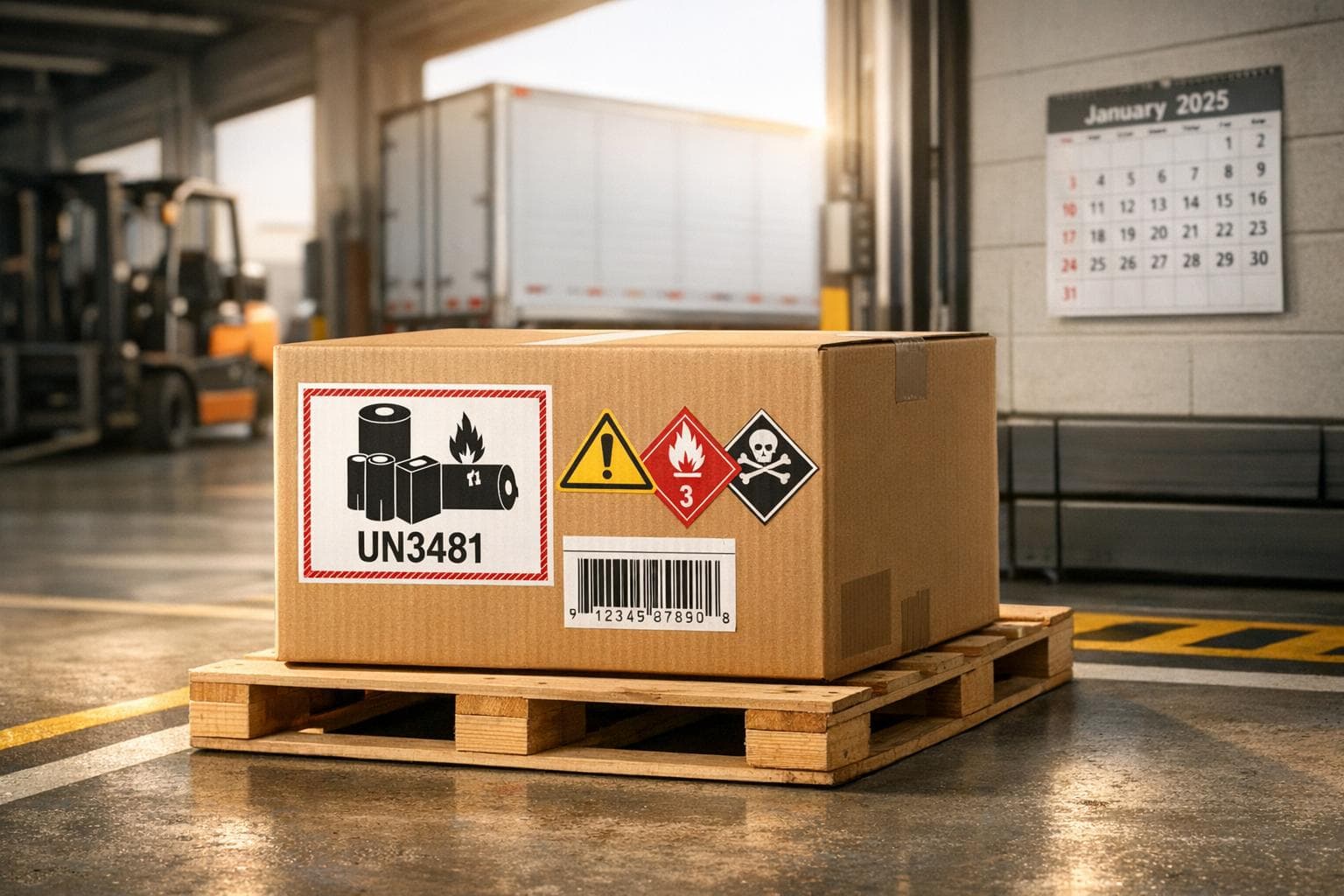
Starting January 2025, new hazmat labeling regulations will affect businesses handling hazardous materials globally. These updates aim to improve safety, align international standards, and address climate-related risks. Here's what you need to know:
-
Key Changes:
- New classifications for sodium-ion batteries and vehicles powered by lithium or sodium-ion batteries.
- Introduction of a unified "Battery Mark" for simplified labeling.
- Revised penalties: up to $165,514 for serious OSHA violations and $102,348 per day for DOT labeling errors.
- Mandatory compliance deadlines across regions, including U.S. OSHA updates by 2026 and IMDG Code changes by 2026.
- Industries Affected: Automotive, energy, logistics, chemical manufacturing, and retail must reclassify products, update labels, and meet stricter documentation requirements.
- Global Standards Update: GHS Revision 11, ADR 2025, and IMDG Code 42-24 introduce consistent rules for labeling, transport, and packaging, including criteria for global warming potential and non-animal testing methods.
-
Compliance Deadlines:
- U.S. OSHA: Substances by January 19, 2026; mixtures by July 19, 2027.
- IMDG Code: Mandatory by January 1, 2026.
- Canada: Dual-language labels required by December 15, 2025.
To avoid costly penalties and disruptions, businesses must act immediately to update labels, train employees, and align with these new regulations.
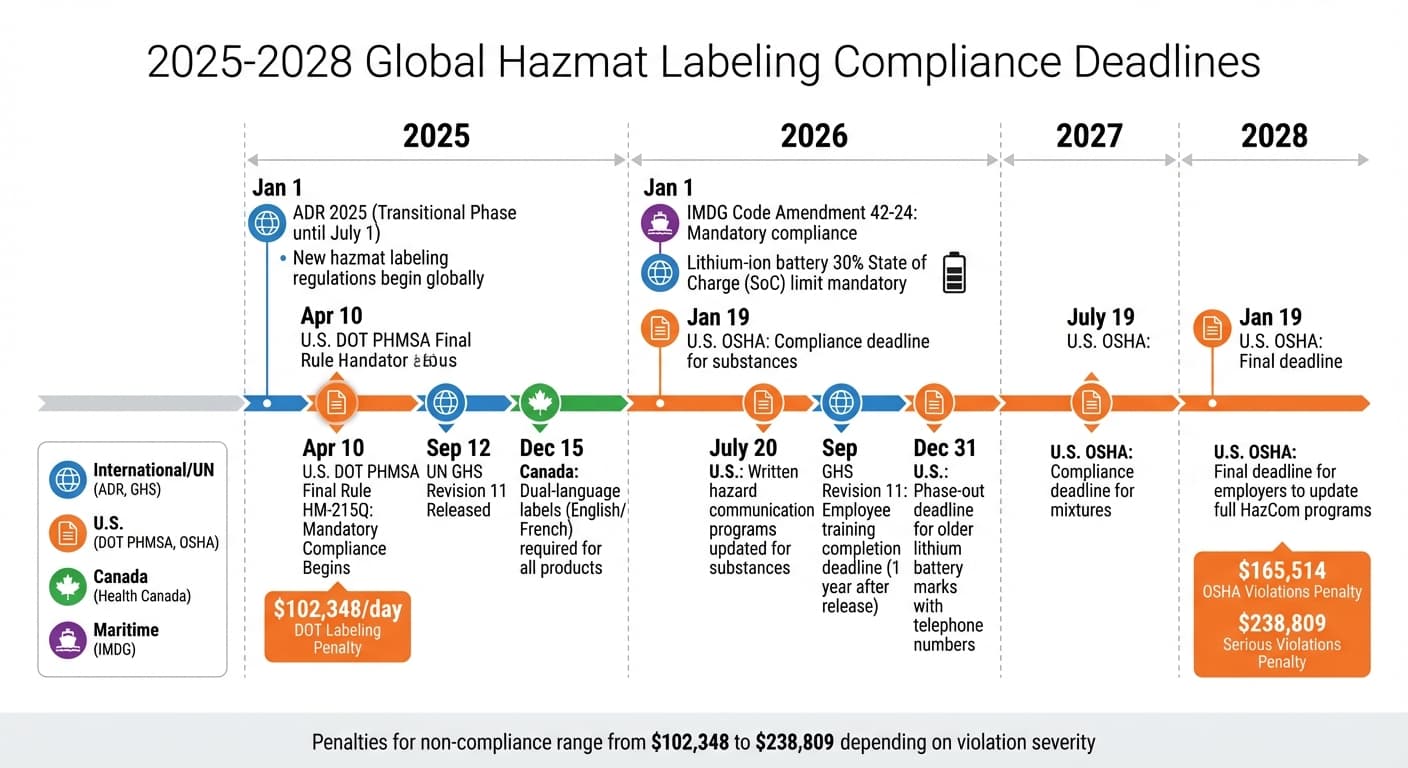
2025-2028 Hazmat Labeling Compliance Deadlines by Region
What is new in the 2025 IATA Dangerous Goods Manual (DGR) ed.66?
sbb-itb-c0b8770
Maritime Hazmat Labeling Updates (IMDG Code)
The IMDG Code Amendment 42-24, which becomes optional in 2025 and mandatory by January 1, 2026, introduces critical updates for maritime shipments. Companies shipping hazardous materials by sea must familiarize themselves with these changes to avoid severe penalties. Labeling violations can result in fines of up to $102,348 per day, and errors causing injury or property damage could lead to penalties as high as $238,809. Below is an overview of the key updates, including revised label designs and documentation requirements.
Label Design and Specification Changes
One notable update is the consolidation of battery labeling. A single "battery mark" now applies to both lithium-ion and sodium-ion batteries. Additionally, the Class 9 lithium battery hazard label has been renamed the "lithium battery and sodium ion battery hazard label". Andrew Ely, DGSA at Hibiscus Plc, elaborates:
"The 'lithium ion battery mark' now covers sodium-ion batteries and has been renamed as the 'battery mark' for all modes of transport".
For substances that produce smoke, maritime shippers are required to use improved labels that emphasize the potential for corrosive or toxic inhalation hazards, specifically within maritime settings. Furthermore, all labels must adhere to BS5609 standards, ensuring they remain intact and legible even after exposure to saltwater and the challenging conditions at sea.
Documentation Requirements
New documentation rules mandate that all charcoal shipments be classified as Dangerous Goods. Shippers must provide documentation confirming that the material was kept below 104°F (40°C) during packing. This requirement addresses the risk of spontaneous combustion, a serious concern given the roughly 1,500 incidents annually involving undeclared or improperly labeled hazardous materials during transport.
Additionally, the amendment introduces over 60 revisions to the Dangerous Goods List (DGL). This includes new UN numbers for emerging technologies, such as UN 3551 and UN 3552 for sodium-ion batteries, and UN 3556, UN 3557, and UN 3558 for various battery-powered vehicles. By January 2026, shippers must ensure their transport documents reflect these updated classifications.
Old vs. New Standards Comparison
The table below highlights the differences between the previous standards and the updates introduced by Amendment 42-24.
| Feature | Previous Standard | Amendment 42-24 |
|---|---|---|
| Battery Mark Name | Lithium ion battery mark | Battery mark (includes sodium-ion) |
| Class 9 Label Title | Lithium battery hazard label | Lithium battery and sodium ion battery hazard label |
| Charcoal Status | Often non-regulated depending on treatment | Mandatory Dangerous Goods declaration |
| Sodium-Ion Batteries | Not specifically classified | Assigned UN 3551 and UN 3552 |
| Smoke-Producing Substances | Standard hazard labeling | Enhanced labels for corrosive/toxic inhalation risks |
These updates underscore the importance of staying compliant with the latest regulations to ensure safe and penalty-free shipping practices.
U.S. DOT Hazmat Labeling Regulation Changes
The U.S. Department of Transportation's Pipeline and Hazardous Materials Safety Administration (PHMSA) introduced Final Rule HM-215Q to bring U.S. regulations in line with international hazardous materials standards. While companies have had the option to adopt these standards voluntarily since January 1, 2023, mandatory compliance begins on April 10, 2025. This move is expected to save the industry up to $130 million in shipping costs while enhancing safety throughout the supply chain. The rule also ensures that U.S. regulations align with maritime standards, creating consistency between domestic and international practices. These updates include stricter design and documentation requirements, which are outlined below.
Labeling Requirements by Hazard Class
DOT hazmat labels must meet specific design criteria, including a diamond-shaped "square-on-point" layout with each side measuring at least 3.9 inches (100 mm). A solid inner border must be positioned 0.2 to 0.25 inches from the edge. The class number must appear in a font size of at least 0.25 inches, while any accompanying text must be in a font size of at least 0.3 inches. To ensure durability during transportation, labels must be made from weather-resistant materials like vinyl or coated paper.
For Class 9 materials, the updated rules eliminate the requirement for a telephone number on the battery mark. Additionally, test summary documents are no longer needed for button cell batteries installed in equipment. For Class 8 corrosive materials, shippers can now use the "Test No. 439, In Vitro Skin Irritation: Reconstructed Human Epidermis Test Method" for classification, offering an alternative to traditional testing methods. Non-bulk packages must display labels on two opposing sides, but smaller packages may instead label the top and one side.
Compliance Deadlines and Penalties
The PHMSA has also increased penalties for non-compliance, reflecting the importance of adhering to these updated labeling standards. Violations of DOT-specific labeling rules can result in fines of up to $102,348 per day. If a violation leads to death, serious illness, severe injury, or significant property damage, penalties can rise to $238,809. Michael Atkinson, Editor of Hazardous Materials Transportation at J. J. Keller & Associates, emphasizes the timeline:
"Mandatory compliance for the final rule is April 10, 2025, with voluntary compliance retroactive to January 1, 2023".
For companies handling lithium batteries, the deadline to phase out older battery marks with telephone numbers is December 31, 2026.
Exceptions and Special Provisions
The updated regulations include several notable exceptions to accommodate specific scenarios. For instance, the formaldehyde de minimis exception explicitly applies to formaldehyde solutions used for packing specimens. Vehicles equipped with sodium-ion batteries (UN 3551, UN 3552) may qualify for exemptions under Special Provision 404 if the batteries are verified as short-circuited. Additionally, the phase-out date for polymerizing substances has been removed, allowing continued use of existing transport provisions.
For limited-quantity and excepted-quantity packages, businesses can use modified labeling options, such as alternate marks or hang-tags, instead of the standard 4-inch diamond labels. Companies should refer to 49 CFR §172.101 Column 7 for details on special provisions that may apply to their materials. These exceptions aim to balance strict safety standards with practical compliance options.
Global Harmonization under GHS Revision 11
On September 12, 2025, the United Nations released GHS Revision 11, marking a step forward in standardizing hazardous material labeling worldwide. While the U.S. is currently transitioning to Revision 7 under OSHA's 2024 Hazard Communication final rule, this latest revision lays the groundwork for future international alignment. As Chemwatch aptly puts it:
"GHS is more than a standard - it is a cornerstone of risk management".
These updates build on earlier maritime and U.S. DOT labeling reforms, pushing for a more unified global approach.
New Hazard Classifications and Labels
Revision 11 introduces several updates to hazard classifications, including a new "Contributing to Global Warming" subcategory under the expanded "Hazardous to the Atmospheric System" class. This subcategory uses Global Warming Potential (GWP) to compare substances to CO₂. Companies dealing with fluorinated gases or other high-GWP substances must assess their products against Chapter 4.2 standards and adjust their labels to reflect this. Additionally, Annex 11 offers formal guidance on identifying simple asphyxiants like nitrogen, methane, and CO₂, requiring labels to include warnings such as "May displace oxygen and be fatal".
Another key change is the emphasis on non-animal testing methods for skin sensitization. Detailed guidelines for in vitro assays and computational models align with EU REACH and OECD standards, reflecting a shift toward ethical testing and quicker regulatory decisions. Revision 11 also revises Chapter 2.3, drawing a clear line between aerosols and chemicals under pressure. This update ensures companies reclassify pressurized formulations for better clarity during transport.
Cross-Jurisdiction Alignment
GHS Revision 11 enhances consistency across various regulatory frameworks, including IMDG (maritime), DOT (U.S. domestic transport), and IATA (air freight). Updates to precautionary statements in Annex 3 standardize language and sector requirements, easing the compliance process for companies operating in multiple regions. For instance, new precautionary codes P322 and P323 now mandate specific treatment details to be prominently displayed on Safety Data Sheets (SDS).
The revision also addresses the distinction between transport labels and GHS workplace labels for combination packaging. By aligning with UN Model Regulations (Special Provisions 63 and 362), it ensures hazard communication remains consistent whether materials are in transit or at a facility. To maintain compliance, companies must ensure that the "Product Identifier" matches exactly between the label and the SDS. These updates streamline cross-border operations and reduce the risk of regulatory conflicts.
Regional Implementation Timelines
Because GHS is implemented at the national level, adoption timelines differ across regions. For example, while the U.S. is transitioning to Revision 7, other regions will implement Revision 11 at varying speeds. Companies should plan to provide updated employee training on GHS changes within one year of their region's adoption. For those preparing for Revision 11, this means completing training by September 2026.
Although the global rollout of GHS Revision 11 began in September 2025, businesses must track specific transition dates for each market they operate in. Some regions may adopt only parts of the revision, adding complexity for multinational companies. According to EHS Support:
"These GHS 11 changes are relatively incremental yet still significant as companies increasingly try to reduce compliance risk and take a more proactive approach to safe and sustainable chemical management".
To stay ahead, businesses should develop structured change-management plans, monitor regional timelines, and update internal records to include data on ozone-depleting substances and global warming potentials for all products. These steps are critical for keeping compliance strategies up to date.
Business Compliance Requirements
Businesses dealing with hazardous materials need to act quickly to meet the upcoming 2025 labeling mandates. Starting January 2025, OSHA's maximum penalty for "Willful or Repeat" violations will hit $165,514, while PHMSA fines for mislabeling could reach $102,348 per day - or $238,809 if the violation leads to injury or property damage.
Label Production and Supply Chain Updates
Now is the time to review chemical inventories to align with the updated hazard classifications. For example, items previously labeled as aerosols might now fall under "Chemicals Under Pressure", requiring new hazard statements and pictograms. It's also crucial that each label's product identifier matches the information in Section 1 of the Safety Data Sheet (SDS).
For businesses operating in Canada, compliance takes on an additional layer of complexity. By December 15, 2025, all six required label elements must appear in both English and French. Importers, considered "suppliers" under the rules, must relabel foreign products to meet domestic standards before distribution. Additionally, labels must be updated within 180 days of discovering "significant new data" that alters a product's hazard classification.
| Compliance Deadline | Jurisdiction | Affected Products |
|---|---|---|
| December 15, 2025 | Canada (Health Canada) | Full compliance for all substances and mixtures |
| January 19, 2026 | United States (OSHA) | Compliance deadline for substances |
| July 19, 2027 | United States (OSHA) | Compliance deadline for mixtures |
| January 19, 2028 | United States (OSHA) | Deadline for employers to update full HazCom programs |
In challenging environments like warehouses or outdoor storage, labels can fade or become unreadable. To counter this, consider using etched or embossed identification alongside secondary tags to maintain compliance over time. In high-risk settings such as childcare facilities or food service areas, ensure labels are placed at eye level near cleaning stations and are made from durable, weather-resistant materials. As Probe IT emphasizes:
"WHMIS labels are not just stickers but legal tools that can prevent workplace accidents and protect everyone on site."
These updates are designed to align with broader regulatory frameworks, helping businesses maintain smooth supply chain operations across different regions.
Employee Training Requirements
Meeting these updated labeling standards also means upgrading employee training programs. Training must be rolled out within a year of regulatory changes and should cover new hazard classes like "Contributing to Global Warming" and simple asphyxiants. These now require warnings such as "May displace oxygen and be fatal". Label authors and Health, Safety, and Environmental (HSE) teams will need specialized training on technical updates, including new classification criteria for aerosols and non-animal testing methods for skin sensitization. Employees should also be trained to interpret labels by focusing on signal words, pictograms, and hazard statements. Emphasis should be placed on "Prevention" precautionary statements (P2XX series) to reduce risks before incidents occur.
According to EHS Support:
"Training should reinforce how to recognize revised hazard statements, understand new climate or asphyxiation risks, and apply safe-handling procedures tied to the updated classifications."
U.S. employers must update their written hazard communication programs by July 20, 2026, for substances and by January 19, 2028, for mixtures. Regular refresher training ensures employees stay informed about evolving regulations and site-specific safety measures. Sharing these updates with supply chain partners can also promote consistent hazard communication across the entire network.
Compliance Monitoring and Risk Management
Staying compliant requires more than just updating labels and training employees - it calls for a proactive monitoring strategy. Key steps include:
- Developing a structured change-management plan to update labels and SDS as jurisdictions adopt GHS Revision 11.
- Auditing product lines for reclassified substances, including those with climate-related hazards or updated aerosol criteria.
- Tracking local implementation timelines, as GHS standards are adopted differently across regions.
Using centralized SDS management software and AI-powered regulatory tools can simplify compliance. These tools provide live updates from over 150 jurisdictions, helping companies stay ahead of varying adoption schedules. As Chemwatch puts it:
"A structured change-management plan will help ensure timely updates and consistent documentation."
Employers should also inspect incoming shipments for updated labels. If labels are missing or damaged, workplace labels must be created immediately. Maintaining a 24-hour emergency response number connected to someone knowledgeable about hazardous materials can further reduce liability and improve safety outcomes. For businesses managing complex supply chains, partnering with a logistics provider like CR Express - offering hazmat-certified handling and end-to-end solutions - can simplify compliance from import to delivery.
Conclusion
Summary of Regulatory Changes
The hazmat labeling regulations for 2025 bring a host of updates across various frameworks. In September 2025, the United Nations released GHS Revision 11, which introduced climate-related hazard classifications based on Global Warming Potential (GWP) and approved non-animal testing methods for skin sensitization. Transportation rules have also shifted: ADR 2025 came into effect on January 1, 2025, with a transitional phase ending July 1, 2025. Meanwhile, the IMDG Code Amendment 42-24 will become mandatory starting January 1, 2026. These changes include new UN numbers for sodium-ion batteries and clarified distinctions between aerosols and pressurized chemicals. In the U.S., OSHA's updated Hazard Communication Standard sets compliance deadlines for substances by January 19, 2026, and for mixtures by July 19, 2027.
Steps for Achieving Compliance
To meet these new requirements, businesses should:
- Audit chemical inventories to identify substances with high GWP or asphyxiants like nitrogen and methane.
- Update Safety Data Sheets (SDS) and labels to include the latest precautionary statements, such as P322, P323, and P502.
- Ensure lithium-ion battery shipping protocols comply with the mandatory 30% State of Charge (SoC) limit by January 1, 2026.
- Verify that drivers transporting "Limited Quantities" under ADR hold the newly required training certificates under ADR 8.2.3.
- Review and adjust packaging to align with updated label formats.
For companies managing complex supply chains, particularly those involving hazmat shipments through major hubs, working with a logistics provider experienced in hazmat-certified handling can simplify compliance. CR Express, for example, offers integrated solutions that cover everything from customs handling to final delivery, helping businesses stay on top of these evolving requirements.
By implementing these steps, companies can ensure they are ready for the current changes and better equipped for future updates.
Future Hazmat Regulation Trends
Looking ahead, the integration of climate metrics into chemical classifications signals a broader push toward Environmental, Social, and Governance (ESG) reporting. This shift means businesses will need to assess chemicals not only for toxicity but also for long-term environmental effects, such as their contribution to global warming.
As Chemwatch explains:
"The recognition of climate-relevant hazards under GHS revision 11 expands the system beyond acute and chronic toxicology to include long‑term environmental impacts."
Digital tools are also shaping the future of compliance. Electronic labeling systems and AI-driven regulatory platforms are expected to make global updates more manageable. Additionally, New Approach Methodologies (NAMs), such as in vitro testing and computational models, will gain traction as regulators move away from animal testing. Stricter oversight of substances like PFAS, with limits such as Taiwan's 50 ng/L for surface water, is another emerging priority.
Battery logistics are evolving too, with new rules supporting diverse energy storage technologies. Special Provision 404 now allows for the transport of dangerous goods using electric and hydrogen-powered vehicles, reflecting infrastructure advancements. Staying ahead of these trends will require businesses to closely monitor regional regulations and maintain adaptable compliance systems ready for future shifts.
FAQs
Do these rules apply to workplace labels, shipping labels, or both?
Starting December 15, 2025, updated WHMIS requirements will require all labels and Safety Data Sheets (SDS) to fully comply with the new regulations. These updates cover hazard classification and labeling standards, ensuring consistency for hazardous materials in both workplace settings and shipping processes.
What do I need to change if I ship lithium-ion or sodium-ion batteries?
If you're involved in shipping lithium-ion or sodium-ion batteries, it's essential to prepare for the updated 2025 WHMIS standards. These updates require reclassifying batteries, updating labels, and revising safety data sheets (SDS) to comply with the new regulations set to take effect on December 15, 2025. These adjustments are necessary to meet the revised hazard classification and labeling rules.
What’s the fastest way to check if my labels and SDS match the new requirements?
To ensure your labels and SDS comply with the latest standards, compare them against the updated criteria outlined in GHS Revision 11. Pay close attention to adjustments in hazard classifications, indicators for environmental hazards, and precautionary statements. For more detailed guidance, you can review summaries of the updates or seek advice from a compliance expert. Aligning with these changes is key to meeting the new requirements.