Hazmat Compliance for Cross-Border Logistics
by CR Express Team, Logistics Team • 12 min read
Hazmat Compliance for Cross-Border Logistics
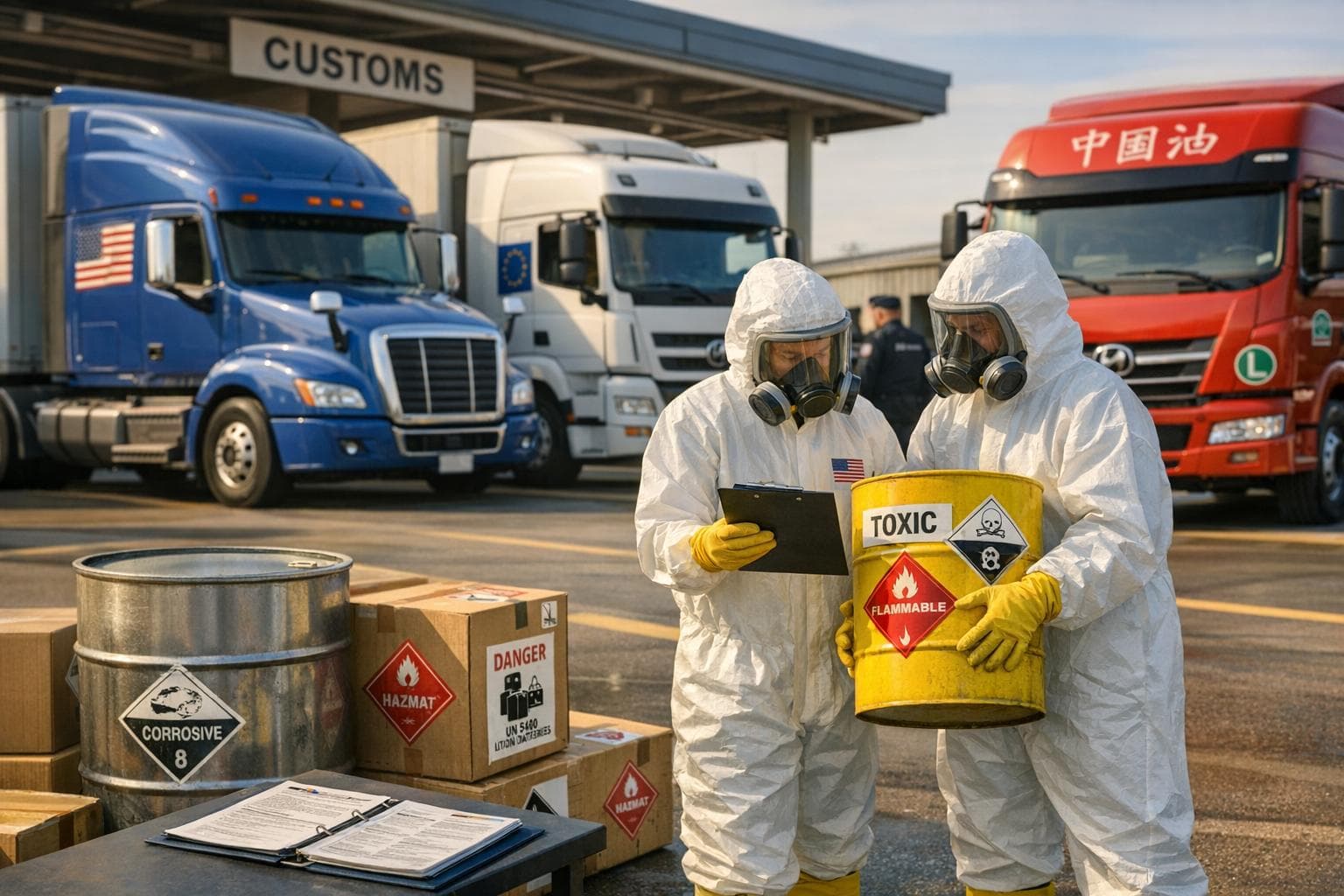
Transporting hazardous materials internationally is complex due to varying regulations across regions. Here's what you need to know:
- United States (HMR): Governed by 49 CFR Parts 100-185, penalties for non-compliance can reach $500,000 or five years in prison. Proper classification, training, and documentation are essential.
- Europe (ADR): Unified rules across 50+ countries simplify cross-border transport but require Dangerous Goods Safety Advisers (DGSA) and regular updates every two years.
- Asia-Pacific: No unified treaty exists, leading to fragmented regulations based on the UN Model. Compliance varies by country, requiring detailed planning and training.
Key takeaway: Compliance depends on understanding regional rules, proper training, and accurate documentation. Partnering with experienced logistics providers like CR Express can help you navigate these challenges safely and efficiently.
1. United States Hazmat Regulations (HMR)
Regulatory Framework
The foundation of the U.S. hazardous materials (hazmat) system lies in the Hazardous Materials Transportation Act (HMTA), which empowers the Secretary of Transportation to oversee the movement of dangerous goods. The Pipeline and Hazardous Materials Safety Administration (PHMSA) is responsible for crafting the regulations, which are detailed in 49 CFR Parts 100-185. Following updates under Docket HM-181, U.S. regulations now align closely with United Nations standards. Sections 171.12 and 171.22 specifically address how shipments are to be handled under Canadian or international rules.
Companies transporting hazardous materials - whether across state lines, within a single state, or internationally - are required to register annually and pay a fee. Additionally, motor carriers, including foreign operators, must secure a Hazardous Materials Safety Permit (HMSP) when transporting high-risk materials such as radioactive substances or certain explosives. Enforcement of these regulations is carried out by multiple agencies, including the FMCSA, FAA, FRA, PHMSA, and the U.S. Coast Guard.
Training and Certification
According to 49 CFR, employers must provide training for every "hazmat employee" in four key areas: general awareness, function-specific training, safety training, and security awareness. Unlike Europe’s ADR system, where drivers need a government-issued vocational certificate, the U.S. relies on an employer-led system. This approach makes companies responsible for training, testing, and maintaining employee training records.
Penalties for violations range widely. Fines for training-related infractions start at $481, while general violations can lead to penalties up to $79,976. In cases of severe outcomes, such as incidents involving fatalities, fines are even higher. Criminal violations can result in corporate penalties reaching as much as $500,000.
Packaging and Labeling
Ensuring proper packaging and labeling is a cornerstone of hazmat safety. The shipper, often referred to as the "offeror", is tasked with accurately classifying materials. This classification determines the required packaging, markings, labels, and placards. The Hazardous Materials Table in 49 CFR 172.101 serves as the go-to resource for verifying shipping names, hazard classes, and authorized packaging.
Hazard information is communicated through multiple layers, including shipping papers, markings, labels, and placards. For bulk packages (1,000 gallons or more), ID numbers must be displayed on all sides. Additionally, shipping papers must include a monitored, 24-hour emergency contact number. These stringent requirements ensure that safety remains a top priority and directly shape operational processes, as discussed in the next section.
Operational Impact
Complying with HMR introduces unique challenges for cross-border logistics. For instance, any shipment of 5,000 lbs or more from a single hazard class requiring placarding triggers registration requirements. High-hazard materials, such as explosives exceeding 55 lbs or Poison-Inhalation Hazard Zone A substances in quantities over 1 liter per package, mandate an HMSP permit.
While the U.S. has harmonized its HMR with international standards like those from ICAO and IMDG, meeting U.S. requirements doesn’t automatically ensure compliance with foreign regulations. Shipping papers must follow a strict format, listing the Identification Number, Proper Shipping Name, Hazard Class, and Packing Group in that exact order.
At CR Express, our hazmat-certified team remains up-to-date with these complex requirements. We ensure that shipments fully comply with U.S. standards while also addressing the additional compliance layers necessary for seamless international transportation.
2. European Hazmat Standards (ADR)
Regulatory Framework
Since 1968, the European Agreement concerning the International Carriage of Dangerous Goods by Road (ADR), overseen by the United Nations Economic Commission for Europe (UNECE), has been the cornerstone of hazmat transportation regulations across Europe. The ADR is divided into two annexes: Annex A, which addresses classification, packaging, labeling, and certification, and Annex B, which focuses on vehicle specifications, tank requirements, and operational rules. To keep pace with advancements in technology and safety, the ADR is revised every two years. The latest version, ADR 2025, has been in effect since January 1, 2025. Additionally, countries can negotiate temporary exceptions through multilateral agreements, allowing specific deviations from standard rules. This harmonized system works in tandem with the U.S. standards mentioned earlier.
Training and Certification
Transporting dangerous goods under ADR rules requires drivers to obtain an ADR Certificate, especially for tank shipments or certain packaged loads. Companies involved in handling hazardous materials must also designate a Dangerous Goods Safety Adviser (DGSA) to ensure compliance with regulations. Vehicles transporting explosives or hazmat in tanks must undergo an annual ADR inspection, which checks critical systems like brakes, lighting, and steering to maintain safety standards.
Packaging and Labeling
Every ADR shipment must include a transport document specifying the classification and packaging details of the substances being moved. Packages must display the appropriate hazard labels and UN identification numbers, except in cases involving "Limited Quantities" or "Excepted Quantities." A unique aspect of ADR compliance is the mandatory "Instructions in Writing", a standardized four-page document provided in languages understood by the vehicle crew.
Operational Impact
One of ADR's key benefits is the facilitation of smoother border crossings, enabling hazardous goods to move freely between member states as long as vehicles, goods, and drivers meet the unified requirements. However, certain high-risk materials may face restrictions at specific inland border facilities. For shipments involving multiple transport modes, such as road and sea under the International Maritime Dangerous Goods (IMDG) Code, meticulous international coordination is essential. Companies like CR Express, with a hazmat-certified team, navigate these complex multi-modal requirements skillfully, ensuring that shipments through European gateways comply with ADR standards while addressing additional layers of international regulations.
3. Asia-Pacific Hazmat Regulations
Regulatory Framework
The Asia-Pacific region operates without a unified treaty for hazardous materials transport, unlike Europe's ADR system. Countries like China, Japan, and Australia structure their regulations around the UN Model Regulations (Revision 24, September 15, 2025). Chemical classification and labeling follow the Globally Harmonized System (GHS), currently at Revision 11. For air transportation across borders, the ICAO Technical Instructions and the IATA Dangerous Goods Regulations (DGR) serve as the guiding frameworks, with updates made regularly to address evolving safety standards. However, the lack of regional standardization means logistics providers must navigate varying national laws, each potentially adopting different versions of international standards. This patchwork of regulations adds complexity to cross-border hazmat shipments, requiring careful planning, specialized training, and precise documentation.
Training and Certification
In the Asia-Pacific region, personnel handling hazardous materials are required to undergo training every two years. This ensures compliance with both the latest UN Model Regulations and specific modal requirements. Lithium battery shipments, a significant category in the region, demand extra attention. For cells or batteries manufactured after June 30, 2003, manufacturers and distributors must provide a test summary as outlined in the UN Manual of Tests and Criteria (Revision 8, 2023, with Amendment 1 effective in 2025). These summaries must be made digitally accessible to streamline compliance.
Packaging and Labeling
Air shipments in the region face stricter packaging standards compared to ground transportation. For instance, liquids transported by air must pass IATA DGR pressure tests. Proper labeling is equally critical, requiring hazard class designations, UN identification numbers, and specific markings. For example, shipments of battery-powered vehicles (UN 3171) must include "Contains Lithium Batteries" markings near the proper shipping name. Tools like WorldShip help streamline compliance by generating accurate documentation, including Dangerous Goods Declarations for IATA-compliant packages. These packaging and labeling requirements directly influence the efficiency of shipping operations.
Operational Impact
The absence of a regional agreement like ADR poses significant challenges for cross-border logistics in Asia-Pacific. Each country may enforce its own version of the UN Model Regulations, requiring meticulous checks of national requirements for every border crossing. Air transportation adds another layer of complexity, as carriers frequently impose rules that exceed government regulations. Staying up-to-date with the latest IATA Operator Variations is crucial for ensuring shipments meet all requirements. Much like the challenges seen under HMR and ADR, navigating the diverse regulatory landscape in Asia-Pacific demands constant adjustments. For services like CR Express, understanding and managing these variations is critical when connecting U.S. origins to destinations across China, Japan, Australia, and other parts of the region.
sbb-itb-c0b8770
Advantages and Disadvantages by Region
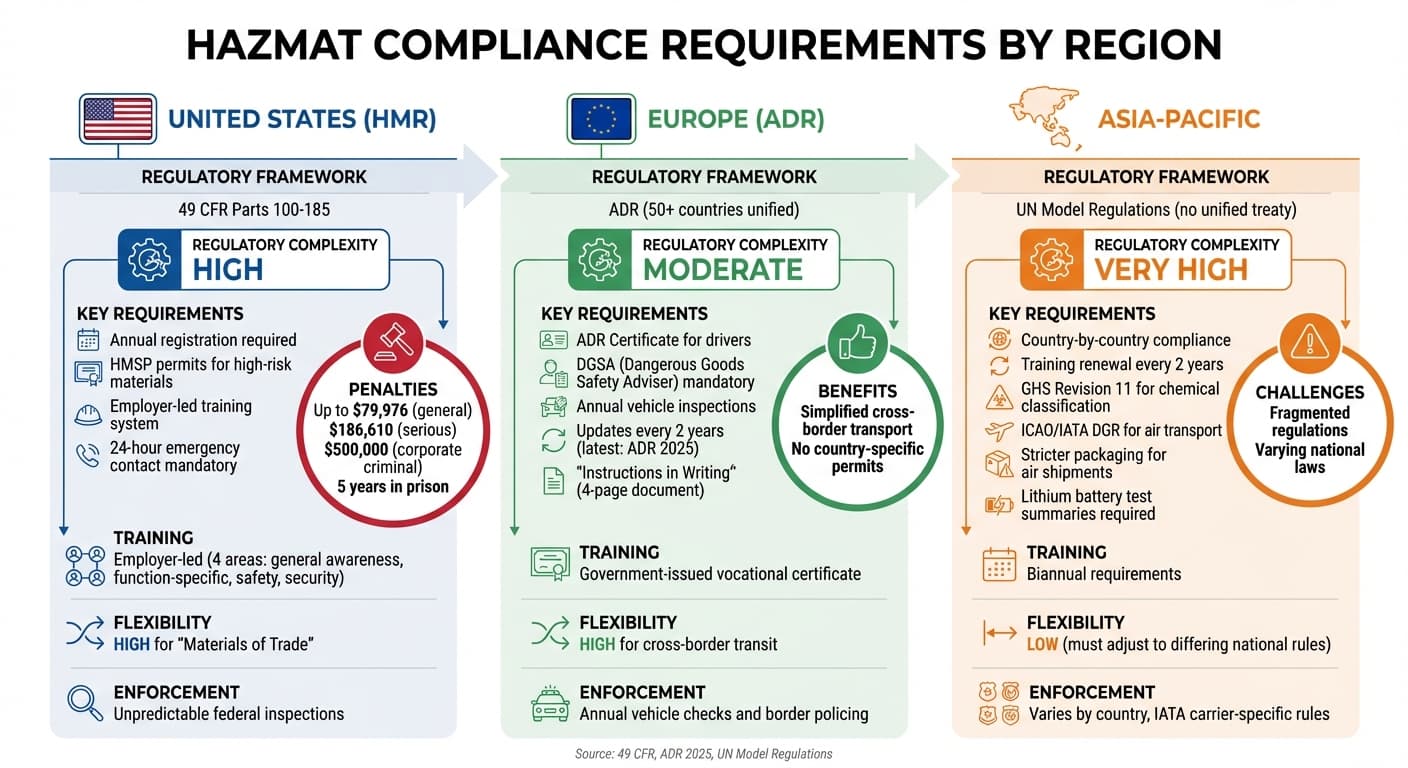
Hazmat Compliance Requirements Comparison: US vs Europe vs Asia-Pacific
When it comes to transporting hazardous materials, the challenges and benefits vary significantly depending on the region. Let’s break down how different parts of the world handle this complex task.
In the United States, regulations like "Materials of Trade" provide some domestic flexibility. However, the stakes are high - violations can result in penalties up to $79,976, or as much as $186,610 if serious consequences occur. Corporations can face fines reaching $500,000, and federal inspections are often unpredictable. These strict rules create a unique balance between flexibility and risk, setting the stage for comparison with international systems.
In Europe, the ADR (European Agreement concerning the International Carriage of Dangerous Goods by Road) simplifies cross-border transport. By unifying rules across more than 50 countries, the ADR removes the need for country-specific permits. However, compliance comes with its own demands, such as appointing Dangerous Goods Safety Advisors (DGSA), annual vehicle inspections, and keeping up with updates every two years. While this system streamlines operations, it requires constant vigilance.
Meanwhile, the Asia-Pacific region presents a different set of challenges. Without a unified treaty like the ADR, countries rely on their own adaptations of the UN Model Regulations. This fragmented approach means logistics providers must navigate varying requirements at every border. Training needs to be refreshed every two years, and air transport adds another layer of complexity, as carriers often impose their own additional rules. For companies operating in this region, understanding these varied regulations is crucial for smooth operations.
| Factor | United States (HMR) | Europe (ADR) | Asia-Pacific |
|---|---|---|---|
| Regulatory Complexity | High; governed by 49 CFR Parts 100-185 with modal variations | Moderate; harmonized across over 50 countries and updated every two years | Very High; no regional treaty and country-by-country compliance |
| Compliance Costs | Includes annual registration, HMSP permits, and steep fines | Requires DGSA appointments and annual vehicle certifications | Biannual training requirements |
| Enforcement Consistency | Unpredictable federal inspections | Enforced through annual vehicle checks and border policing | Varies by country, with IATA carrier-specific rules adding complexity |
| Flexibility | High for "Materials of Trade" and limited quantities | High for cross-border transit | Low; operators must adjust to differing national rules |
For CR Express, navigating these regional differences is key to ensuring safe and efficient cross-border logistics. With hazmat-certified handling capabilities and a strategic location near O'Hare International Airport, CR Express is well-positioned to manage the complexities of HMR in the U.S. while collaborating effectively in ADR-governed Europe and the fragmented Asia-Pacific markets.
Conclusion
This analysis highlights a clear reality: there’s no universal approach to hazardous materials compliance that works across all regions. While U.S. regulations enforce strict penalties, Europe and the Asia-Pacific region each bring their own distinct challenges. For instance, Europe’s ADR framework simplifies cross-border transport with unified standards, but it also requires businesses to appoint a Dangerous Goods Safety Adviser and adapt to biannual regulatory updates. Meanwhile, the Asia-Pacific region is characterized by a fragmented patchwork of country-specific rules, making compliance a more intricate task. Navigating these diverse systems demands expertise at every step.
For businesses shipping hazardous materials internationally, understanding region-specific requirements is critical to avoid delays and legal troubles. Each regulatory framework comes with its own set of rules for documentation, training, and enforcement. As the U.S. Department of Transportation firmly states:
No person may offer or accept a hazardous material for transportation in commerce unless... the hazardous material is properly classed, described, packaged, marked, labeled, and in condition for shipment.
Given these complexities, partnering with specialized logistics providers is often the smartest move. Hazmat-certified providers handle everything from compliance documentation to emergency protocols and vehicle standards. They also stay on top of regulatory updates, such as recent changes impacting air transport.
CR Express stands out as a prime example of expertise in this field. With hazmat-certified handling, customs bonded warehouse facilities (CBW Class 3), and a strategic location near Chicago O'Hare International Airport, they ensure seamless compliance with U.S. HMR while managing international shipments across ADR, IMDG, and IATA frameworks. Their TSA-certified drivers, 24/7 shipment tracking, and in-house export documentation services make them a reliable partner for businesses navigating the challenges of multi-regional hazmat compliance.
Whether you’re shipping automotive components, pharmaceuticals, or industrial chemicals, working with a provider that understands both the regulatory nuances and logistical demands of hazardous materials transport can mean the difference between smooth, efficient operations and costly compliance setbacks.
FAQs
What are the key challenges in transporting hazardous materials across the Asia-Pacific region?
Transporting hazardous materials across the Asia-Pacific region is no small feat. The mix of regulatory variations, aging infrastructure, and environmental challenges creates a logistical puzzle for companies operating in this space. While international standards like the UN Model Regulations, ADR, IMDG, and IATA Dangerous Goods Rules exist, each country interprets them differently. This patchwork of compliance rules makes cross-border shipments a lot trickier to plan and execute.
Infrastructure adds another layer of difficulty. Many rail and highway systems in the region are outdated, with limited hazmat-specific lanes or modern containment features. This increases the risk of accidents during transit. Ports also face challenges, particularly with mis-declared or poorly packed hazardous goods. High-profile incidents, such as explosions caused by volatile materials, underscore the critical need for precise documentation and thorough verification. On top of that, extreme weather - like heat waves - can push container temperatures dangerously high, increasing the flammability of certain substances.
Each mode of transport has its own set of hurdles. Rail systems frequently rely on old equipment, while highways demand strict adherence to rules on labeling, packaging, and driver training. Air cargo, on the other hand, must navigate continuously evolving regulations and specialized training requirements, especially for high-risk items like lithium-ion batteries. All these factors combined make the logistics of hazardous materials in the Asia-Pacific region especially complex and challenging to manage.
How do U.S. hazmat regulations compare to those in Europe and Asia-Pacific?
U.S. hazardous materials (hazmat) regulations are mainly directed by the Department of Transportation's Hazardous Materials Regulations (HMR) and OSHA's Hazard Communication Standard (HCS). These regulations align with GHS Revision 7, but they include some unique hazard classifications like pyrophoric gas, simple asphyxiant, and combustible dust. Notably, they leave out certain categories, such as "hazard to the ozone layer" and "aspiration hazard", which are recognized in other parts of the world. Additionally, U.S. compliance separates responsibilities, with the Pipeline and Hazardous Materials Safety Administration (PHMSA) focusing on transportation enforcement and OSHA handling chemical safety registration.
In Europe, the CLP Regulation works alongside REACH, incorporating GHS Revision 5 with added EU-specific rules. The European approach requires registration for substances exceeding one ton per year and includes hazard categories that the U.S. does not recognize, like flammable-liquid Category 4. European regulations also demand more detailed labeling and risk documentation compared to U.S. standards.
In the Asia-Pacific region, countries such as China, Japan, and South Korea generally follow GHS Revisions 4 or 5 but adapt the framework to align with their national standards. These adaptations often omit some GHS elements, like the aspiration hazard category, and implement country-specific chemical notification or registration systems.
To sum it up, U.S. regulations prioritize transportation safety and adopt later GHS revisions. Europe combines chemical registration with an expanded range of hazard classifications, while Asia-Pacific nations tailor GHS standards to fit localized needs.
Why is it important to work with a specialized logistics provider for hazardous materials compliance?
Partnering with a logistics provider experienced in handling hazardous materials means you’re working with professionals who know the ins and outs of federal and international regulations. They take care of crucial tasks like employee training, proper documentation, and implementing security measures. This helps minimize the chances of non-compliance, costly fines, or delays in shipments.
These providers also create customized solutions to ensure regulated and time-sensitive shipments are handled with care and efficiency. That way, you can stay focused on running your business without worrying about the complexities of hazardous material logistics.