

Why Healthcare Needs Temperature-Controlled Drayage
by CR Express Team, Logistics Team • 9 min read
Why Healthcare Needs Temperature-Controlled Drayage
Temperature-controlled drayage is essential for transporting sensitive healthcare products like vaccines, biologics, and specialty drugs. Unlike standard drayage, which lacks refrigeration, this method ensures strict temperature ranges (e.g., 36°F–46°F) are maintained during short trips between ports, railyards, airports, and warehouses. Here’s why it matters:
- Cold Chain Protection: 85% of pharmaceuticals require precise temperature control to remain effective. Even brief exposure to improper conditions can damage or ruin these products.
- Regulatory Compliance: It meets FDA and Good Distribution Practice (GDP) standards, ensuring safety and traceability.
- Cost Savings: While more expensive upfront, it prevents product spoilage and financial losses, making it a smarter choice for high-value shipments.
Standard drayage may work for non-sensitive goods, but temperature-controlled drayage is critical for safeguarding patient safety and meeting healthcare industry standards.
Shipping Pharmaceuticals: What You Need to Know
1. Standard Drayage
Standard drayage involves moving shipping containers over short distances with non-refrigerated equipment. It focuses on keeping costs low and operations fast, rather than maintaining temperature control. Dry van trucks and basic chassis are typically used, which work well for general freight but leave containers exposed to ambient conditions with little active monitoring.
Cold Chain Challenges
This method does not support cold chain requirements. Without insulation or refrigeration, containers are left vulnerable to external temperatures. For temperature-sensitive items like pharmaceuticals, even a short trip from a railyard to a warehouse can lead to temperature swings that compromise products such as vaccines or biologics. Studies indicate that temperature deviations are 20–30% more common in uncontrolled transit compared to refrigerated options.
Cost vs. Risk
While standard drayage is budget-friendly upfront, the risks it carries can lead to significant financial losses. Temperature excursions during transit often result in spoiled goods, and pharmaceutical companies report losing millions of dollars annually due to damaged products during uncontrolled transport. These risks can easily outweigh the initial savings, especially when factoring in strict regulatory requirements.
Regulatory Gaps
Standard drayage also falls short in meeting key regulatory standards, such as GDP and FDA requirements. These guidelines demand precise temperature monitoring, data logging, and a clear chain-of-custody. Non-compliance can lead to hefty penalties or even shipment rejections.
Limited Flexibility
Without real-time monitoring or adaptable solutions, standard drayage struggles to handle surges in demand for temperature-sensitive goods, like vaccines during emergencies. This lack of scalability increases the risk of delays and compromises the integrity of the cold chain.
2. Temperature-Controlled Drayage
Temperature-controlled drayage relies on refrigerated containers, insulated equipment, and continuous monitoring to safely transport pharmaceuticals, vaccines, and biologics between ports, railyards, airports, and warehouses. Unlike standard drayage, this method ensures products are kept within strict temperature ranges - like 36°F to 46°F for many biologics - throughout the short-haul journey. This system solves the challenges of standard drayage by maintaining precise temperature control every step of the way.
Cold Chain Integrity
Ensuring cold chain integrity involves using pre-conditioned reefer trucks, calibrated sensors, and real-time loggers to monitor temperatures during transit. If any temperature deviations occur, alerts are triggered immediately, allowing drivers or dispatchers to adjust settings, switch to backup systems, or prioritize delivery to prevent product damage. Facilities near major hubs, such as Chicago O'Hare, that comply with Good Distribution Practices (GDP) help minimize risks during handoffs. These setups can handle a wide range of temperatures, from –80°F for cryogenic biologics to controlled room temperature for ambient pharmaceuticals.
Cost Efficiency
While temperature-controlled drayage comes with higher upfront costs due to specialized equipment and monitoring systems, it can save money in the long run by preventing spoilage and expensive product losses. Intermodal solutions, which combine temperature-controlled drayage with rail transport, can reduce linehaul costs by 10–15% compared to using trucks exclusively, offsetting some of the added drayage expenses. Providers with their own reefer fleets, private chassis, and container yards near terminals can further cut costs by avoiding wait fees, improving container turnaround times, and consolidating shipments through cross-docking.
Regulatory Compliance
Temperature-controlled drayage plays a key role in meeting Good Distribution Practice (GDP) and FDA requirements by ensuring medicinal products stay within their labeled temperature ranges during transit. This includes following strict procedures for loading and unloading, using validated monitoring devices, and providing drivers with specialized training in pharmaceutical handling and temperature deviation management. Providers must maintain detailed records, such as time-stamped temperature logs, route data, and corrective action reports, to meet regulatory standards and pass audits. Integrating drayage data with warehouse and long-haul systems - using TSA-approved drivers, SIDA-badged access, customs-bonded facilities, and GDP-compliant warehousing - further simplifies compliance.
Operational Scalability
For healthcare products, scaling temperature-controlled drayage is critical to maintaining quality from hub to destination. Providers achieve scalability by combining their own reefer fleets with flexible warehouse space, multiple temperature zones, and strong partner networks. As demand for biologics and cell therapies grows, scalable solutions require modular storage, rapid equipment repositioning, and adaptive scheduling to handle volume surges without compromising control. Large fleets and 7-day access to railyards allow providers to adjust capacity quickly during peak periods. Advanced technology platforms with real-time GPS tracking, automated alerts, and unified visibility systems enable proactive planning and efficient exception management. Companies like CR Express demonstrate these capabilities by leveraging their strategic location near Chicago O'Hare and offering comprehensive cold chain services tailored to the healthcare industry.
sbb-itb-c0b8770
Advantages and Disadvantages
Standard vs Temperature-Controlled Drayage for Healthcare Products Comparison
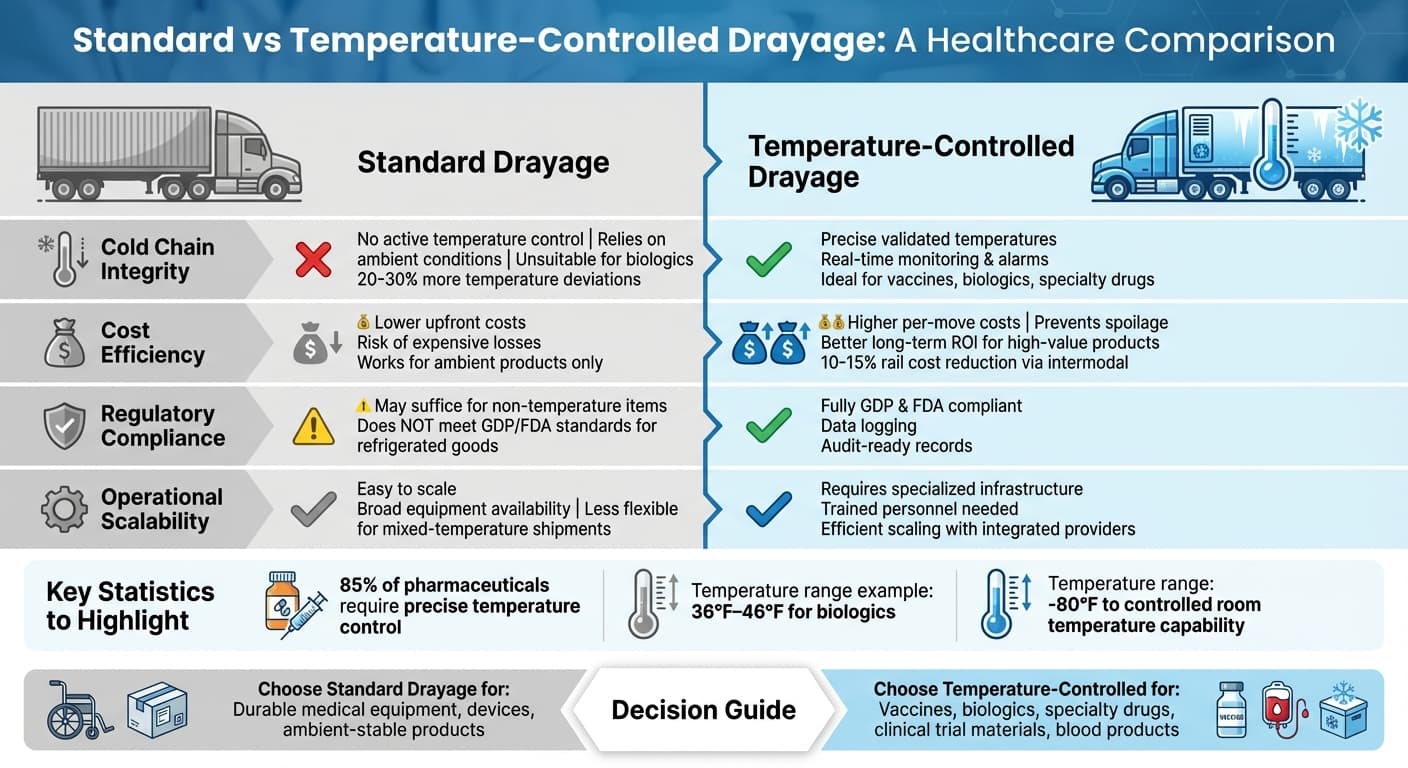
Building on the operational details outlined earlier, let’s break down the pros and cons of the two main drayage models in healthcare: standard drayage and temperature-controlled drayage. Each serves a distinct purpose, with standard drayage focusing on cost savings for ambient products, while temperature-controlled drayage ensures the safety of sensitive medications.
Standard drayage is a cost-effective option for transporting non-temperature-sensitive medical items. It uses non-refrigerated equipment, requires simpler handling, and doesn’t rely on advanced monitoring technology. This makes it ideal for products like durable medical equipment, certain devices, and some over-the-counter items. However, its major drawback is the lack of cold chain integrity. Without active refrigeration or continuous monitoring, shipments are exposed to fluctuating ambient conditions, which can vary widely across seasons and regions in the U.S. This increases the risk of temperature excursions, leading to product spoilage. For example, vaccines can lose potency, and biologics may degrade, posing risks to patient safety and product efficacy. Additionally, using non-compliant equipment can result in regulatory issues, product recalls, and damage to relationships with hospitals and pharmacies.
On the other hand, temperature-controlled drayage provides a robust solution for sensitive shipments. It uses refrigerated containers (reefers), insulated equipment, and active cooling systems to maintain precise temperature ranges - such as 36°F to 46°F - during short-haul moves between ports, rail hubs, or airports. Advanced monitoring tools, like IoT temperature sensors, real-time GPS tracking, and automatic alerts, ensure continuous temperature logging. This is essential for meeting GDP, FDA, and manufacturer requirements, while also simplifying investigations when exceptions arise. While temperature-controlled drayage has higher upfront costs, it prevents spoilage and product losses, often proving more cost-effective for high-value or strictly temperature-sensitive items in the long run.
Scaling temperature-controlled drayage comes with its own challenges. It requires specialized reefer equipment, trained drivers, and temperature-controlled facilities like yards or cross-docks. Providers with asset-based fleets, GDP-compliant warehousing, and proximity to major hubs like Chicago O’Hare or key rail ramps can support a seamless, end-to-end cold chain for healthcare shipments.
Here’s a quick comparison of the two models:
| Dimension | Standard Drayage | Temperature-Controlled Drayage |
|---|---|---|
| Cold Chain Integrity | No active temperature control; relies on ambient conditions and short transit times. Unsuitable for strict cold-chain products like biologics. | Maintains precise, validated temperatures with real-time monitoring and alarms. Ideal for vaccines, biologics, and specialty drugs. |
| Cost Efficiency | Lower upfront transportation costs; works well for ambient products but can lead to expensive losses if temperature-sensitive items are mishandled. | Higher per-move costs, but prevents spoilage and yields better long-term savings for high-value or high-risk products. |
| Regulatory Compliance | May suffice for items without strict temperature needs but doesn’t meet GDP or FDA standards for refrigerated goods. | Fully compliant with GDP and FDA requirements, backed by data logging and audit-ready records. |
| Operational Scalability | Easier to scale due to broad availability of non-specialized equipment, but less flexible for mixed-temperature shipments. | Requires specialized infrastructure and trained personnel, but integrated providers can scale efficiently once established. |
To decide which drayage model to use, healthcare shippers should start with a product-level risk and regulatory assessment. This involves classifying items based on their required temperature range, allowable excursion time, and compliance needs. Products that don’t require specific temperature controls, like many devices or low-risk consumables, are well-suited for standard drayage. However, any item with storage temperature requirements or cold-chain validation must move exclusively via temperature-controlled drayage lanes. Many U.S. healthcare organizations implement lane-specific SOPs and partner with integrated providers - such as CR Express, which offers GDP-compliant operations and temperature-controlled warehousing near Chicago O’Hare - to ensure sensitive products are handled appropriately, while ambient freight is transported cost-effectively.
Conclusion
Deciding between standard and temperature-controlled drayage isn’t just a financial choice - it’s a matter of ensuring patient safety and meeting regulatory standards. While standard drayage works for durable medical equipment and other goods confirmed to be stable at ambient temperatures, most pharmaceutical shipments demand temperature-controlled solutions to maintain their integrity.
If a product’s label specifies storage conditions or if the shipment is particularly valuable or critical, temperature-controlled drayage becomes essential. Items like vaccines, biologics, specialty drugs, clinical trial materials, and blood products require refrigerated containers equipped with active cooling systems, real-time monitoring, and detailed temperature logs. Even minor temperature fluctuations can compromise these products, leading to waste, regulatory issues, and potential risks to patient health.
Though the upfront costs of temperature-controlled drayage are higher, the long-term savings are undeniable. It minimizes the risk of product write-offs, costly recalls, and shipment delays. A straightforward risk assessment - comparing the added drayage cost against the shipment’s total value and potential regulatory risks - often makes the case clear: for sensitive products, temperature control is the smarter choice.
FAQs
What risks do healthcare products face without temperature-controlled drayage?
Transporting temperature-sensitive healthcare products using standard drayage methods comes with significant risks. Without the right temperature controls in place, pharmaceuticals and medical devices can be exposed to fluctuations that may lead to spoilage, reduced effectiveness, or even complete degradation. Such issues not only jeopardize patient safety but can also lead to expensive recalls and shipment delays.
Additionally, standard drayage often lacks the necessary monitoring systems and compliance measures to adhere to Good Distribution Practice (GDP) standards. This gap increases the chances of regulatory violations and product damage. For healthcare logistics, temperature-controlled solutions are essential to protect product integrity and ensure safe, reliable delivery.
How does temperature-controlled drayage help meet FDA and GDP regulations?
Temperature-controlled drayage is essential for maintaining FDA and GDP standards, especially when transporting sensitive healthcare products like pharmaceuticals. By keeping goods within strict temperature ranges, this process helps prevent spoilage, contamination, or degradation during transit.
Following rigorous storage and handling protocols, temperature-controlled drayage not only ensures compliance with regulatory requirements but also safeguards the quality of the products. Facilities that implement GDP-compliant procedures, such as those used by CR Express, add an extra layer of safety and dependability to the entire supply chain.
Why is temperature-controlled drayage a smart investment for healthcare shipments?
Temperature-controlled drayage plays a crucial role in healthcare logistics, especially when transporting temperature-sensitive items like pharmaceuticals and medical supplies. By maintaining the required conditions, it helps prevent spoilage, minimizes waste, and avoids expensive product losses.
This approach also ensures compliance with stringent healthcare regulations, reducing the risk of fines, delivery delays, and operational hiccups. Beyond safeguarding product integrity, it protects the value of high-cost medical goods and supports on-time delivery, offering both cost savings and dependable service in the long run.