
Tariff Mitigation: Bonded Warehouses vs FTZs
by CR Express Team, Logistics Team • 14 min read
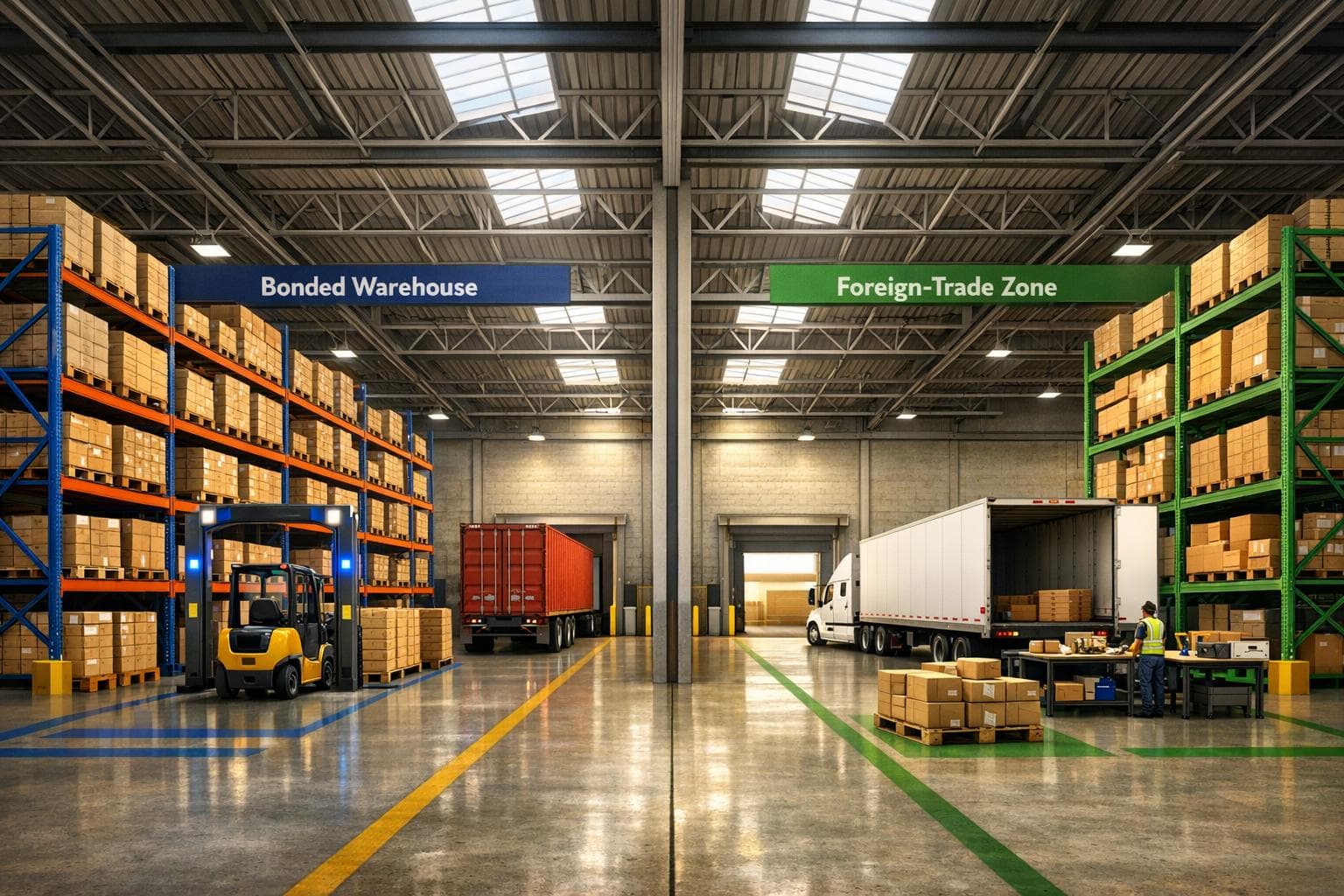
Tariff Mitigation: Bonded Warehouses vs FTZs
Facing high U.S. tariffs? Businesses can reduce costs and improve cash flow with bonded warehouses or Foreign Trade Zones (FTZs). Both options allow you to defer duties, but their features differ significantly.
- Bonded Warehouses: Store imported goods duty-free for up to 5 years. Suitable for short-term needs, seasonal inventory, or if you expect tariffs to drop. Limited to basic operations like sorting or repacking.
- FTZs: Offer indefinite storage and allow manufacturing or assembly. Ideal for high shipment volumes, long-term storage, or taking advantage of inverted tariffs (lower duties on finished goods).
Quick Comparison
| Feature | Bonded Warehouses | FTZs |
|---|---|---|
| Storage Duration | Up to 5 years | Indefinite |
| Operations Allowed | Sorting, repacking | Full manufacturing, assembly |
| Duty Payment | At withdrawal | At withdrawal or admission |
| Setup Time | 90–120 days | 4–8 months |
| Shipment Volume | Fewer than 52 shipments/year | Over 52 shipments/year |
| Inventory Taxes | Subject to state/local taxes | Exempt for goods held for export |
Key Takeaway: Choose bonded warehouses for short-term flexibility and lower setup costs. Opt for FTZs if you need manufacturing capabilities or manage high shipment volumes.
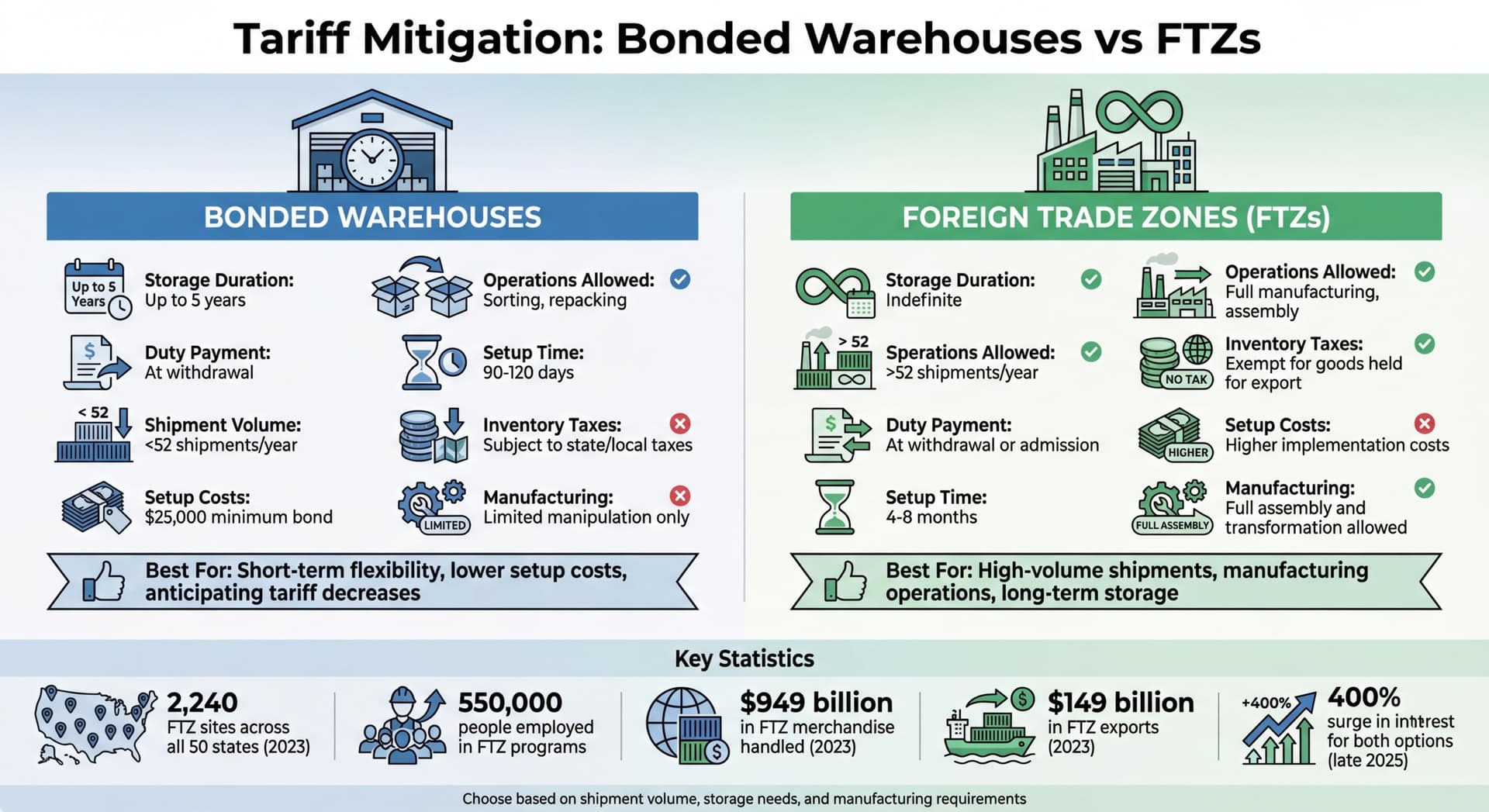
Bonded Warehouses vs Foreign Trade Zones Comparison Chart
What Are Bonded Warehouses?
Definition and Main Features
A customs bonded warehouse is a secure facility authorized by U.S. Customs and Border Protection (CBP) where imported goods can be stored without requiring immediate payment of duties. These warehouses act as a holding area within U.S. Customs territory, allowing businesses to delay tariff payments and better manage their cash flow.
One of their most notable features is the ability to defer duty payments for up to five years from the date the goods arrive. During this time, goods remain under CBP supervision, and businesses can decide when to release them into the U.S. market. To operate a bonded warehouse, the facility must secure a customs bond, with a minimum requirement of $25,000, until the goods are exported, destroyed, or withdrawn for sale.
The U.S. customs system recognizes 11 classes of bonded warehouses. These range from government-operated facilities to public warehouses (Class 3), which are available to any importer.
How Bonded Warehouses Benefit Your Business
The main advantages of bonded warehouses are improved cash flow management and flexibility in tariff rates. Duties are calculated based on the rate in effect when goods are withdrawn, not when they first enter the warehouse.
"Companies can release inventory incrementally and pay tariffs based on current rates instead of higher initial rates."
- Max Levin, Managing Director, Snapl Solutions Inc.
For goods that are re-exported, bonded warehouses offer even more savings. If you ship merchandise directly from the warehouse to a foreign destination, you avoid paying any U.S. customs duties.
While full-scale manufacturing is not allowed in these facilities, certain operations - like cleaning, sorting, repacking, labeling, and testing - can be performed without losing the duty-deferral benefits. Monthly storage fees typically range from $15 to $50 per pallet, with additional handling fees.
These features make bonded warehouses a strategic tool for businesses looking to optimize their operations and reduce costs.
When to Use Bonded Warehouses
Bonded warehouses are particularly useful for short-term storage and managing seasonal inventory. For instance, if you're importing holiday goods in the summer but won't sell them until later in the year, deferring duties during this period can help conserve cash.
They are also a great option if you expect tariff rates to drop. By storing goods and monitoring policy changes, you can time withdrawals to take advantage of lower rates. As Max Levin explains, "many companies are waiting for the dust to settle and are using bonded warehouses as a way to manage their cash flow better".
Businesses involved in exporting large volumes can also benefit. If you're importing components for assembly and then exporting finished products, you can avoid paying U.S. duties on the exported goods.
To get started with a bonded warehouse, you'll need to submit CBP Form 300 along with facility blueprints and fire safety certifications. The approval process typically takes 90–120 days. Annual bond premiums generally range from 1% to 5% of the total bond amount.
sbb-itb-c0b8770
What Are Foreign Trade Zones (FTZs)?
Definition and Main Features
Foreign Trade Zones (FTZs) are a smart alternative to bonded warehouses for managing tariffs. These zones are secure areas located near U.S. Customs and Border Protection (CBP) ports of entry but are considered outside U.S. Customs territory for duty purposes. This means businesses can bring in imported goods without immediately paying customs duties or federal excise taxes.
One of the standout features of FTZs is indefinite storage, unlike the five-year limit imposed on bonded warehouses. As of 2023, there are around 2,240 FTZ sites spread across all 50 states, with 197 active programs employing approximately 550,000 people.
FTZs also allow manufacturing and assembly operations with approval from the FTZ Board. Companies can import components, assemble them into finished goods, and then pay duties based on the classification of the final product instead of the individual components. In 2023 alone, FTZ production operations handled $949 billion in merchandise, marking a 24% rise compared to 2019.
How FTZs Benefit Your Business
FTZs offer several financial advantages, including duty elimination for goods that are re-exported and an inverted tariff benefit. This means businesses can pay the duty rate on the finished product when it enters U.S. commerce, even if that rate is lower than the rates on the imported components. However, certain tariff rules may limit this benefit.
Another significant perk is the ability to consolidate weekly shipments. Instead of filing separate customs entries for every shipment, businesses can file once per week, reducing Merchandise Processing Fees (MPF) and simplifying paperwork.
"FTZs and bonded warehouses essentially frees up a company's cash flow. You don't want to bring in all your goods and spend your cash flow against tariffs that may not be here in, you know, six weeks, six months, if you can defer until the market is ready to consume those goods."
- Jason Strickland, Director of Sales, Givens
In 2023, exports from FTZs reached $149 billion, a 34% increase over five years. Additionally, many states exempt goods stored in FTZs from state and local inventory taxes, further boosting savings for businesses.
These benefits make FTZs particularly advantageous for companies handling high-volume shipments on a regular basis.
When to Use FTZs
FTZs are most effective for businesses managing more than 52 shipments annually, as the savings from weekly entry filings can offset the higher setup and operational costs. They are also ideal for businesses involved in manufacturing, assembly, or processing activities that change a product’s classification.
For example, in May 2025, Pfizer used FTZs to streamline vaccine production. By doing so, they avoided duties on imported components and stored inventory duty-free while waiting for FDA approvals. This highlights the value of FTZs for products requiring regulatory clearance before entering the market.
Additionally, fluctuating tariff conditions in late 2025 led to a 400% surge in interest for FTZs and bonded warehouses as businesses sought to manage the risks of unstable tariffs.
Setting up an FTZ does require careful planning. For operations involving manufacturing, businesses need production authority from the FTZ Board, which can take about 120 days. Moreover, FTZ sites must generally be located within 60 miles or a 90-minute drive from a CBP port of entry.
FTZs, like bonded warehouses, help businesses align tariff payments with market demand, improving supply chain efficiency.
Bonded Warehouses vs FTZs: Main Differences
How They Differ in Operations and Regulations
The key difference between bonded warehouses and Foreign Trade Zones (FTZs) lies in their territorial status. FTZs are legally treated as being outside U.S. Customs territory, while bonded warehouses are fully within it.
Storage terms also vary significantly. Bonded warehouses cap storage time at five years, making them suitable for short-term needs. FTZs, on the other hand, allow indefinite storage, which is perfect for long-term strategies like holding inventory for quota openings or maintaining reserves.
When it comes to operations, FTZs offer much more flexibility. They permit full-scale manufacturing and assembly (with board approval), while bonded warehouses are limited to basic tasks like sorting, cleaning, or repacking. This operational freedom has made FTZs a hub of activity, with merchandise transactions reaching $949 billion in 2023.
Another distinction is how tariff rates are handled. In bonded warehouses, duties are calculated at the time of withdrawal. FTZs, however, provide more options: businesses can lock in duty rates when goods enter the zone or choose to pay based on the rates at withdrawal. Additionally, bonded warehouses require a customs entry for every withdrawal, while FTZs simplify the process by allowing weekly entry consolidations. This feature can lead to significant savings on Merchandise Processing Fees for importers handling large volumes.
Side-by-Side Comparison
| Aspect | Bonded Warehouses | FTZs |
|---|---|---|
| Customs Territory | Inside U.S. Customs territory | Outside U.S. Customs territory |
| Storage Duration | Up to 5 years | Indefinite |
| Eligible Goods | Foreign/dutiable imports only | Foreign and domestic |
| Duty Rate | Determined at withdrawal | Lock in at admission or pay at withdrawal |
| Manufacturing | Limited manipulation (sorting, cleaning, repacking) | Full manufacturing and assembly allowed |
| Entry Filing | Customs entry required per withdrawal | Weekly entry consolidation available |
| Bond Requirements | Minimum $25,000 customs bond | Proprietor and entry bonds required |
| Inventory Taxes | Subject to state/local taxes | Exempt for goods held for export |
Pros and Cons of Each Option
Benefits and Drawbacks
Bonded warehouses are a practical choice for businesses looking to defer tariffs with minimal upfront costs. Setting one up typically takes 90–120 days and requires a customs bond of at least $25,000, with bond costs ranging from 1% to 5% of the bond amount. This makes them a budget-friendly option for smaller operations. One of their standout features is the ability to time withdrawals strategically, which can help optimize duty payments.
"Bonded warehouses allow importers to delay duty and tariff payments until goods are removed for domestic sale, providing valuable cash flow flexibility."
- Jason Price, Senior Director, Cushman & Wakefield
However, they come with some challenges. Storage is capped at five years, and each withdrawal triggers a separate customs entry, each with its own Merchandise Processing Fee (MPF). For businesses handling 52 or more shipments annually, these fees can pile up quickly. Additionally, inventory stored in bonded warehouses is still subject to state and local taxes. Operations are limited to basic activities like sorting or repacking, as manufacturing is generally not allowed.
On the other hand, Foreign Trade Zones (FTZs) offer far more operational flexibility. They allow indefinite storage, manufacturing (including assembling finished products), and the consolidation of multiple weekly shipments into one customs entry. FTZs also provide tax exemptions for goods held for export and can take advantage of inverted tariffs, where the duty rate on finished products is lower than on their components, offering potential cost savings.
That said, FTZs come with higher upfront costs and a setup time of 4–8 months. They also involve more stringent regulatory and compliance requirements. For goods affected by Section 301 tariffs, FTZs may require assigning "Privileged Foreign" status, which locks in duty rates at the time of admission instead of allowing flexibility to defer payments until rates improve. For businesses processing fewer than 52 shipments annually or working with limited budgets, the complexity and cost of FTZs might outweigh their advantages.
The table below provides a quick overview of these differences.
Comparison Table
| Feature | Bonded Warehouses | FTZs |
|---|---|---|
| Cash Flow Impact | Defer duties until withdrawal | No duties until goods leave the FTZ |
| Setup Complexity | Simpler; typically 90–120 days | More complex; typically 4–8 months |
| Setup Costs | Requires a minimum $25,000 customs bond | Higher implementation costs |
| Operational Scope | Limited to tasks like sorting, cleaning, and repacking | Full manufacturing and assembly allowed |
| Storage Duration | Maximum of 5 years | Indefinite |
| Cost Efficiency | Lower startup costs but separate MPF per shipment | Higher startup; consolidated weekly MPF |
| Inventory Taxes | Subject to state/local taxes | Exempt for goods held for export |
| Best For | Fewer than 52 shipments per year; ideal if anticipating tariff decreases | More than 52 shipments per year; suitable for manufacturing operations |
How to Choose Between Bonded Warehouses and FTZs
Factors to Consider
When deciding between bonded warehouses and Foreign Trade Zones (FTZs), several key factors can help guide your choice.
Shipment volume plays a major role. If your business handles more than 52 shipments annually, an FTZ's weekly entry consolidation can significantly reduce Merchandise Processing Fees. On the other hand, if your shipment volume is lower, bonded warehouses are a better choice due to their lower setup costs and faster approval process, which typically takes 90–120 days compared to the 4–8 months required for FTZs.
Storage duration is another crucial consideration. Bonded warehouses limit storage to a maximum of five years from the date of importation. FTZs, however, allow indefinite storage, making them ideal for slow-moving inventory or long-term stockpiling. For businesses dealing with quick inventory turnover or short-term tariff increases, bonded warehouses may be the better fit.
Manufacturing needs can also determine the right option. FTZs allow for full assembly, kitting, and other transformations of goods (with board approval), which can often result in lower duty rates for finished products compared to their raw components. Bonded warehouses, however, restrict operations to simpler tasks like sorting, cleaning, or repacking. If your operations require significant product transformation, FTZs are the better option.
Tariff rate expectations should influence your decision as well. Bonded warehouses apply the duty rate in effect at the time goods are withdrawn, which can be advantageous if you expect tariffs to decrease. FTZs, by contrast, require "Privileged Foreign" status for certain items, locking in the duty rate at the time of admission.
"Choose a Bonded Warehouse if you expect tariff rates to decrease in the foreseeable future, as Bonded Warehouses apply the duty rate in effect at the time of withdrawal."
- Paul Maplesden, Lead Content Strategist, Geodis
These considerations highlight the importance of a logistics partner skilled in managing tariff deferral strategies. CR Express offers solutions tailored to meet these needs.
How CR Express Can Help
CR Express operates a CBW Class 3 bonded warehouse strategically located less than five miles from Chicago O'Hare International Airport. This public storage facility eliminates the need for private warehouse investments while keeping your goods close to a major logistics hub.
With 280,000 square feet of scalable warehouse space, CR Express supports tariff deferral strategies and provides services like container transloading (both floor-loaded and palletized), sorting and segregation by purchase order, SKU, or part number, and seven-day-per-week operations with real-time shipment visibility. Additionally, the facility boasts over 500 container parking spots near key Chicago railyards, ensuring efficient handling of your entire import cycle - from container pickup to customs clearance and final delivery.
For businesses navigating the 17% effective U.S. tariff rate that took effect in 2025, CR Express offers customs clearance and compliance support. This helps defer duty payments until goods enter domestic commerce, providing a valuable cash flow advantage during times of trade uncertainty.
Conclusion
Main Points to Remember
When deciding between bonded warehouses and Foreign-Trade Zones (FTZs), it’s essential to weigh their impact on duty timing, storage duration, and operational flexibility. Bonded warehouses apply the current duty rate when goods are withdrawn, limit storage to five years, and restrict operations to basic tasks like sorting and repacking. On the other hand, FTZs allow indefinite storage, enable full-scale manufacturing, and lock in duty rates at the time of admission.
Given that U.S. tariff rates are at their highest since 1901, finding ways to reduce tariff costs is more critical than ever to maintain cash flow. FTZs offer notable advantages, such as weekly entry consolidation, which reduces Merchandise Processing Fees for businesses handling more than 52 shipments annually, and exemptions from state and local inventory taxes. However, implementing an FTZ takes longer - about 4 to 8 months - compared to the 90 to 120 days required for bonded warehouses.
"Selecting between these options is increasingly important. The differences in how each type of facility determines applicable duty rates... can substantially impact your tariffs, bottom line, and supply chain flexibility."
- Paul Maplesden, Lead Content Strategist, GEODIS
Next Steps
Using these insights, evaluate which option best fits your operational needs. Your choice should align with factors like shipment volume, storage duration, manufacturing requirements, and expected tariff rates. With tariffs remaining high, delaying duty payments until goods enter domestic commerce can be a crucial cash flow strategy during uncertain trade conditions.
Consider CR Express’s CBW Class 3 bonded warehouse near Chicago O'Hare International Airport for implementing these strategies. With 280,000 square feet of scalable space, customs clearance support, and end-to-end services from container pickup to final delivery, CR Express offers the tools and expertise to navigate today’s tariff challenges while protecting your working capital. Carefully assess your shipment volume, storage needs, and manufacturing plans to finalize the tariff mitigation approach that works best for your business.
Tariff Troubles? Consider FTZs and Bonded Warehouses
FAQs
Which option saves more money for my specific imports?
Both bonded warehouses and foreign trade zones (FTZs) can help you cut tariff expenses, but the right option depends on your business needs.
- FTZs: These allow you to defer duties until your goods are sold in the U.S. market. Even better, if you re-export or process the goods, you might not have to pay duties at all.
- Bonded Warehouses: Here, duties are delayed until the goods leave storage. This setup can boost your cash flow by postponing upfront costs.
Choosing between the two comes down to factors like your shipment volume, whether you need to process goods, and how you plan to sell them.
How can I estimate if I exceed 52 shipments a year?
If you want to figure out whether you exceed 52 shipments in a year, start by tracking your shipments over a 12-month period. You can use a shipment log or supply chain software to keep an accurate count. If your shipment volume goes beyond this number, you might be eligible for tariff perks, such as lower Merchandise Processing Fees (MPF) when utilizing Foreign-Trade Zones (FTZs) or bonded warehouses. These benefits can help improve tariff savings and manage cash flow more effectively.
Can I switch from a bonded warehouse to an FTZ later?
Yes, you can move from a bonded warehouse to a Foreign Trade Zone (FTZ), but it’s important to understand the differences between the two. In a bonded warehouse, customs entry and duty payments are required when goods are brought in. On the other hand, FTZs let you store goods without filing customs entry or paying duties until the items are removed for U.S. consumption. Switching involves specific procedural adjustments, so it’s a good idea to work with trade compliance experts to navigate the process effectively.
Related Articles
- How To Cut Import Costs 40% Using Bonded Warehouses During The 2025 Tariff Crisis
- How To Slash Your Import Costs By 40% Using Bonded Warehouses (Step-by-Step Guide)
- 2025 Tariffs Adding $1,200 Per Year To Business Costs – Here's The Bonded Warehouse Loophole
- Customs Clearance Tips for Automotive Parts Importers