
Intermodal Drayage FAQs Answered
by CR Express Team, Logistics Team • 12 min read

Intermodal Drayage FAQs Answered
Intermodal drayage is a critical part of freight logistics, connecting transportation modes like ships, trains, and trucks. It ensures goods move efficiently through the supply chain without being unpacked during transitions. Here's a quick breakdown of the essentials:
- What It Is: Short-distance trucking of shipping containers between ports, rail yards, and warehouses.
- Why It Matters: Saves costs (up to 50% on rail transport), reduces emissions (up to 75%), and adds flexibility to supply chains.
- Key Services:
- Port-to-Rail: Moves containers from coastal ports to rail terminals for long-haul transport.
- Rail-to-Warehouse: Delivers containers from rail hubs to warehouses or distribution centers.
- Door-to-Door: Manages the entire journey from shipper to final delivery point under one provider.
- Cost Factors: Distance, location, container size, chassis type, fuel surcharges, and fees like detention or demurrage.
- Equipment: Chassis types (standard, tri-axle), secure container parking, and yard space are essential for smooth operations.
Choosing the right provider depends on factors like asset ownership, proximity to rail hubs, 24/7 operations, and certifications. CR Express is highlighted for its strong infrastructure, 98%+ on-time delivery rate, and specialized services like bonded warehousing and GPS tracking.
Answering the Most Asked Questions About Drayage
Types of Intermodal Drayage Services
Intermodal drayage adapts to different shipping needs, ensuring smooth transitions within the supply chain. Here are the key service models that keep goods moving efficiently.
Port-to-Rail Drayage
This service bridges coastal seaports and inland rail terminals, an essential step for handling international shipments. For example, it allows shippers to bypass crowded ports like Los Angeles, Long Beach, Savannah, or New York/New Jersey by transferring containers directly to rail for long-haul transport to major hubs such as Chicago. Typically, this involves 20-foot and 40-foot containers arriving from ocean vessels. In some cases, cargo is transloaded into 53-foot domestic containers to maximize rail efficiency. Specialized providers often operate private chassis fleets to prevent delays caused by equipment shortages and monitor railyard releases around the clock.
Rail-to-Warehouse Drayage
Once containers reach inland rail terminals, rail-to-warehouse drayage handles the next leg of the journey, delivering goods to distribution centers, warehouses, or cross-docking facilities. This service often includes "devanning", where goods are unloaded from containers for storage or immediate transfer to outbound trucks. Providers with integrated cross-docking capabilities can transfer containers to outbound trailers within hours, avoiding long-term storage fees. For international shipments, this step may involve bonded warehouses, which allow duty-free storage for up to five years. Additional services like sorting by SKU, palletizing, and labeling are frequently offered to prepare goods for their final destinations.
Door-to-Door Drayage
This all-encompassing service manages the entire shipping process - from the shipper's origin to the final delivery point - under one provider. An Intermodal Marketing Company (IMC) typically oversees the initial drayage to a rail ramp, the rail linehaul, and the final delivery. The advantage here is simplicity: shippers deal with a single point of contact, benefit from predictable "all-in" pricing, and gain full visibility of their shipments. Providers also handle equipment positioning and carrier selection, with asset-based companies offering more control over equipment availability.
What Affects Intermodal Drayage Costs
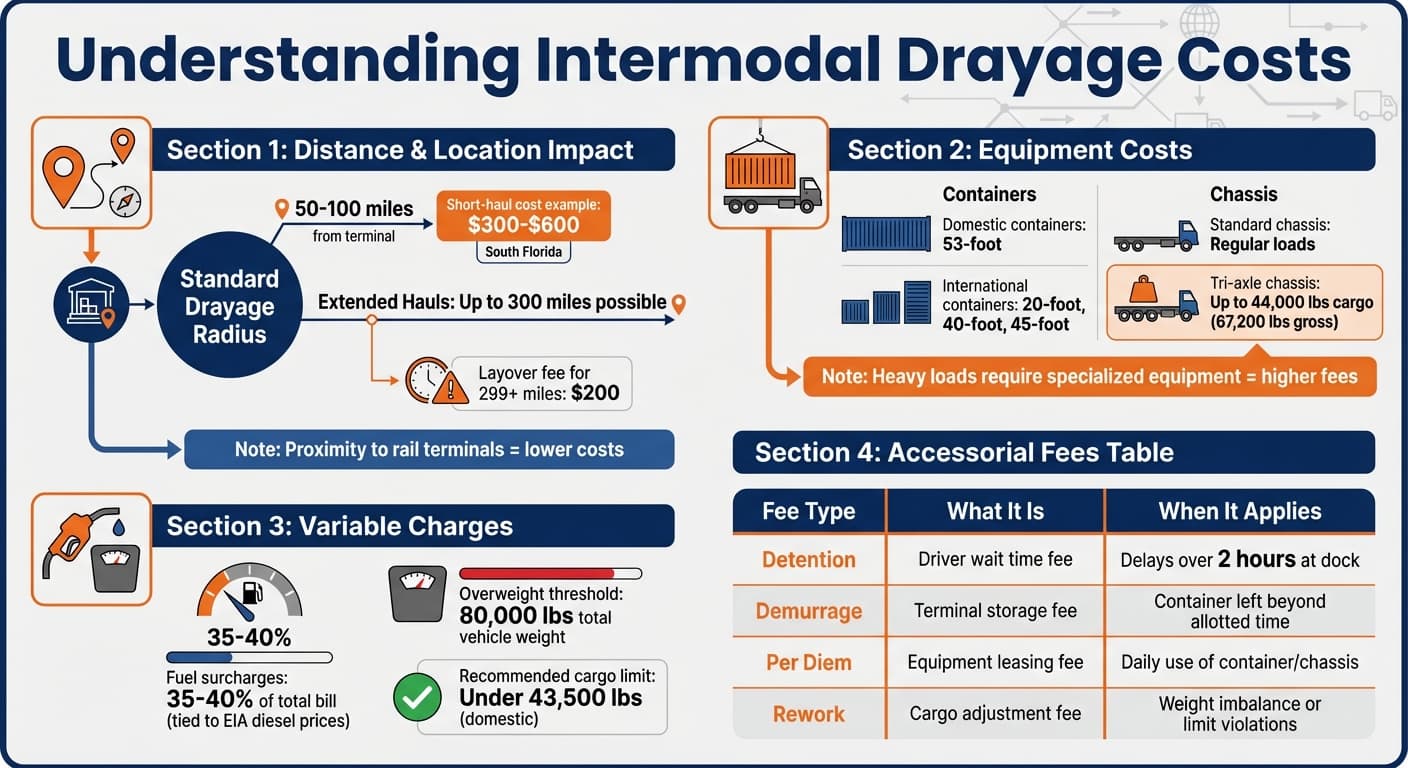
Intermodal Drayage Cost Factors and Accessorial Fees Guide
Getting a handle on intermodal drayage costs is key for shippers looking to budget effectively and avoid surprise fees. Typically, pricing includes a flat linehaul rate and a variable fuel surcharge, but other factors can also play a big role in shaping the final cost.
Distance and Location
Distance is a major cost driver, affecting both travel time and fuel usage. Most drayage trips stay within a 50–100-mile radius of a rail terminal or port, but some carriers will handle hauls stretching up to 300 miles. For example, a short-haul move in South Florida might cost between $300 and $600, while longer trips could incur extra charges, such as a $200 layover fee for hauls over 299 miles.
Location also matters. Businesses closer to major rail terminals or ports typically enjoy lower costs due to reduced fuel surcharges and fewer driver hours. Additionally, routes between major cities with established freight networks tend to be more economical than shorter trips to remote or rural areas.
Container Size and Chassis Type
After distance, the type of equipment needed for the job is another big factor. Domestic shipments usually use 53-foot containers, while international cargo often comes in 20-foot, 40-foot, or 45-foot containers. Each container size requires a specific chassis, which is the wheeled frame used to transport the container.
For heavy loads, specialized equipment like tri-axle chassis is required. These can handle cargo weights up to 44,000 lbs (gross weight up to 67,200 lbs) but come with added costs for permits and legal routing. Standard chassis are fine for most loads, but if you're moving heavy machinery, industrial equipment, or steel, expect higher fees due to the need for special gear and extra administrative work.
Overweight and Fuel Surcharges
Regulations and fuel costs also play a big role in pricing. Overweight fees kick in when a vehicle's total weight exceeds 80,000 pounds, and if cargo shifts and violates axle limits, rework fees can be added. To avoid these charges, it’s best to keep domestic cargo under 43,500 lbs.
Fuel surcharges are another variable cost, often adding 35% to 40% to the total bill. These surcharges are tied to weekly diesel price data from the EIA and adjust frequently, unlike base rates, which many carriers update only once a year.
| Accessorial Fee | Description | Trigger |
|---|---|---|
| Detention | Fee for driver wait time | Delays exceeding 2 hours at the dock |
| Demurrage | Storage fee at rail terminals | Container left beyond the allotted time |
| Per Diem | Daily equipment leasing fee | Use of container or chassis |
| Rework | Fee for adjusting shifted cargo | Weight imbalance or exceeding limits |
Equipment Used in Intermodal Drayage
Having the right equipment is crucial to avoid unnecessary delays. Two key factors - chassis availability and secure container parking - play a major role in ensuring cargo moves efficiently from rail terminals to its final destination.
Privately-Owned Chassis Fleet
A chassis is the wheeled frame used to transport shipping containers. Standard chassis accommodate typical container sizes like 20, 40, and 45 feet. For heavier loads, a tri-axle chassis is essential. These are designed to handle cargo weighing up to 44,000 lbs (gross weight up to 67,200 lbs), making them ideal for transporting heavy machinery, steel, or industrial equipment. Partnering with a provider that owns its chassis fleet can help avoid delays caused by shortages in rental pools or "grey pools". Additionally, secure container storage is just as important for ensuring smooth drayage once containers are released from the rail.
Container Parking and Yard Space
After a container leaves the rail terminal, it often requires a secure storage location before continuing to its destination. Having access to secure yard space is critical. Facilities with ample container parking - offering over 500 spaces in key areas - help reduce demurrage fees and driver wait times. These yards also allow for efficient drop-and-hook operations, which further cuts down on delays. When located near major rail terminals, these facilities provide added benefits like reduced fuel costs and shorter driver hours, ultimately lowering the cost per move.
sbb-itb-c0b8770
CR Express Intermodal Drayage Services
With 26 years of industry experience, CR Express has built a strong reputation by owning its own trucks, chassis, and yard space near Chicago’s major rail hubs. This setup enables the company to maintain an impressive 98%+ on-time delivery rate and secure a position in the top 1-2% of U.S. carriers. These resources allow CR Express to handle a wide range of intermodal services efficiently.
7-Day Railyard Access and Nationwide Coverage
Rail terminals operate seven days a week, and CR Express matches that pace by offering weekend and holiday pickups along with 24/7 dispatch support, helping clients avoid costly demurrage fees. Thanks to its strategic location near Chicago’s key rail terminals, CR Express can provide quick turnarounds: CP Bensenville is just 8 miles away (12 minutes), NS Chicago Rails is 22 miles (30 minutes), CN Harvey Rails is 28 miles (35 minutes), and BNSF Elwood/Joliet is 35 miles (45 minutes). These short distances not only cut down fuel surcharges but also make same-day pickups possible. Beyond Chicago, CR Express extends its services to over 300 cities across all 48 continental U.S. states.
Integrated Warehousing and Cross-Docking Solutions
CR Express operates a 227,000 sq ft CBW Class 3 bonded warehouse located just 5 miles from O’Hare International Airport. This facility supports rapid cross-docking operations and offers duty-free storage for up to 5 years. By expediting the transfer of containers from rail to outbound transport, shipments can move within hours instead of days. Additionally, shippers can delay customs payments until their goods are ready to enter the U.S. market.
Sarah Johnson, Supply Chain Director at a client company, shared: "CR Express has been instrumental in streamlining our supply chain operations. Their bonded warehouse services and seamless customs handling have reduced our logistics costs by 30% while improving delivery times".
Advanced Equipment and Certifications
CR Express goes the extra mile with specialized equipment and certifications to ensure safe and compliant cargo handling. The company’s privately owned tri-axle chassis can handle loads up to 44,000 lbs (67,200 lbs gross weight), making them ideal for heavy cargo. Their team includes TSA-approved and SIDA-badged drivers with direct airport ramp access. For sensitive shipments like pharmaceuticals, CR Express operates under GDP-compliant standards, ensuring proper temperature control and handling. Additional certifications include Hazmat handling and Container Freight Station (CFS) status, enabling the company to manage complex cargo needs under one roof. All equipment is equipped with real-time GPS tracking, geofence alerts, and automated ETA updates, providing clients with complete visibility and peace of mind.
How to Choose an Intermodal Drayage Provider
What to Look for in a Provider
When selecting an intermodal drayage provider, focus on key factors like asset ownership, proximity to major hubs, compliance certifications, operational hours, and storage capacity. Providers that own their trucks, chassis, and container yards have a significant edge - they can better manage equipment availability and costs compared to those who depend on rentals or "grey pool" chassis.
Location matters, too. Providers situated within 20 to 30 miles of major rail hubs can cut down on fuel surcharges, reduce driver hours, and ensure quicker turnaround times. Beyond location and equipment, operational flexibility is critical. Providers with round-the-clock operations minimize downtime, which is especially important for time-sensitive shipments. Compliance credentials are another must-have. For example, TSA approval is necessary for high-value goods, GDP compliance is required for pharmaceuticals needing temperature control, and Hazmat certification is essential for regulated materials. If you're shipping heavy industrial equipment, confirm the provider has the right tools, like tri-axle chassis, to handle your cargo.
Since railroads run seven days a week, choosing a provider with 24/7 dispatch and operations ensures alignment with rail schedules, allowing for faster container recovery. Lastly, storage capacity is a crucial consideration. Providers with space for over 500 containers can offer the flexibility needed to manage loaded imports or reposition empty containers during periods of rail congestion.
Real-Time Tracking and Customer Support
In addition to physical and operational capabilities, advanced tracking and customer support play a major role in service reliability. Real-time GPS tracking offers precise estimated times of arrival (ETAs), helping warehouse teams prepare for incoming shipments and streamline dock scheduling. Providers using cutting-edge tracking systems often achieve on-time delivery rates as high as 98%.
Automated alerts, powered by geofence technology, notify you instantly when containers enter or exit facilities. This not only improves yard management but also eliminates much of the guesswork. Moreover, having access to 24/7 human support ensures that any issues - whether caused by weather, traffic, or rail congestion - are addressed promptly. This combination of automation and responsive customer service keeps you informed and minimizes the risk of costly delays.
| Provider Feature | Operational Impact | Business Benefit |
|---|---|---|
| Asset Ownership | Direct equipment control | Avoids delays with rentals |
| Hub Proximity | Reduced transit time | Cuts fuel surcharges |
| 24/7 Dispatch | Around-the-clock monitoring | Prevents demurrage fees |
| GPS Tracking | Real-time location data | Improves scheduling accuracy |
Conclusion
Intermodal drayage plays a key role in reducing costs, minimizing environmental impact, and providing flexibility in freight operations. Rail transport, for instance, can cut shipping costs by 20% to 50% compared to long-haul trucking while producing up to 75% fewer carbon emissions. On top of that, a single intermodal train can take roughly 280 trucks off the road. For businesses shipping goods over 500 miles, intermodal solutions offer a dependable alternative when driver shortages or highway disruptions threaten delivery timelines.
Selecting the right drayage provider involves considering factors like asset ownership, proximity to rail hubs, operational schedules, and specialized certifications. Providers with their own chassis fleets help avoid equipment shortages, while those located near major rail terminals can cut down on fuel surcharges and improve turnaround times. Features like seven-day railyard access and 24/7 dispatch support ensure smooth coordination with rail schedules, which helps prevent costly demurrage fees.
CR Express stands out with its strong infrastructure and a proven track record of reliability, ensuring smooth and on-time intermodal transfers. These strengths form the backbone of a cost-efficient and resilient supply chain.
Whether you're shipping temperature-sensitive pharmaceuticals requiring GDP compliance, heavy industrial equipment needing tri-axle chassis, or time-critical goods requiring weekend pickups, choosing a provider with the right infrastructure and certifications can transform your supply chain into a flexible, efficient network tailored to your business needs.
FAQs
How does intermodal drayage help reduce its environmental impact?
Intermodal drayage combines the strengths of rail and trucking to create a more eco-friendly transportation solution. Rail transport is far more fuel-efficient than trucking, producing about 75% less CO₂ per ton-mile. By shifting the long-haul portion of freight to rail, fewer diesel trucks are needed on the road. This not only cuts emissions but also eases traffic congestion and reduces wear and tear on highways.
Companies like CR Express further enhance efficiency by using privately-owned chassis fleets. This approach ensures that containers aren't left idle waiting for equipment and avoids unnecessary truck trips, saving fuel and reducing waste. These combined efforts make intermodal drayage a smart choice for businesses looking to align with environmental goals while keeping their logistics operations running smoothly.
What should I look for when choosing an intermodal drayage provider?
When choosing an intermodal drayage provider, focus on reliability and efficiency. Opt for a company that offers 7-day rail yard operations, same-day container pickups, and a well-maintained private chassis fleet, including options for heavy loads. Features like ample container storage near major rail hubs and real-time GPS tracking can also help ensure timely and hassle-free deliveries.
It’s equally important to assess compliance and value-added services. Providers with TSA-approved drivers, customs-bonded warehouses, and GDP-compliant facilities are essential for managing sensitive or high-value cargo, such as pharmaceuticals. Services like cross-docking and container devanning can simplify your supply chain even further. Lastly, consider the provider’s experience in the industry, their proximity to major transportation hubs, and their ability to handle complex, time-sensitive shipments with proven success.
How do fuel surcharges and travel distance impact intermodal drayage costs?
Fuel surcharges are an extra cost added to the base drayage rate, and they’re tied to the current monthly fuel index. Since fuel prices can shift, these surcharges often vary, directly impacting the total shipping expense.
Another key factor in pricing is the distance the container needs to travel. Longer trips mean higher costs for both rail linehaul and drayage at the starting point and destination. To get a clear picture of the overall cost, you’ll need to account for both the fuel adjustments and the mileage involved in the shipment.