
Ergonomic Training: Key to Injury-Free Warehouses
by CR Express Team, Logistics Team • 16 min read
Ergonomic Training: Key to Injury-Free Warehouses
Warehouse injuries are costly, painful, and often avoidable. Workers in warehousing face nearly double the rate of musculoskeletal injuries compared to other industries. Repetitive lifting, bending, and pushing heavy loads are major culprits. These injuries don’t just affect employees - they disrupt operations, increase costs, and lead to higher turnover.
The solution? Ergonomic training. By teaching safe lifting techniques, proper equipment use, and early symptom recognition, companies can reduce injuries, improve productivity, and lower expenses. Key benefits include fewer lost workdays, reduced compensation claims, and happier, healthier employees.
Quick Takeaways:
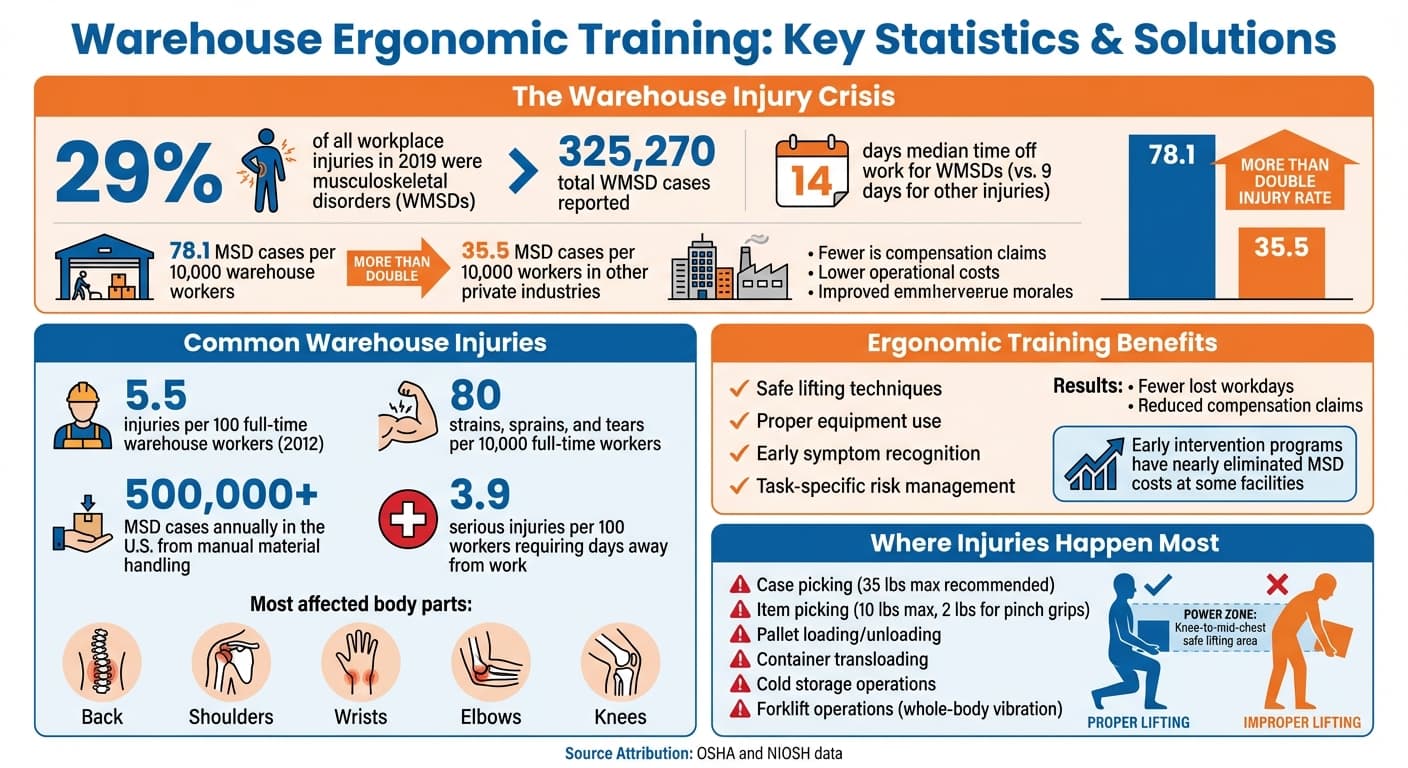
- 29% of workplace injuries in 2019 were musculoskeletal disorders (WMSDs), with a median of 14 days off work.
- Warehousing workers face 78.1 MSD cases per 10,000 employees, compared to 35.5 in other private industries.
- Ergonomic training focuses on reshaping tasks to fit workers’ physical limits, preventing strain and injury.
- Practical tools like hoists, scissor lifts, and anti-fatigue mats further reduce risks.
Bottom line: Investing in ergonomic training isn’t just about safety - it’s about creating a more efficient and sustainable workplace.
Warehouse Ergonomic Training Statistics and Injury Prevention Data
Common Warehouse Injuries and Their Impact
Types of Common Injuries
Musculoskeletal disorders (MSDs) are among the most frequent injuries reported in warehouse environments. These injuries primarily affect areas like the back, shoulders, wrists, elbows, and knees - essentially the body parts most engaged in repetitive and strenuous tasks. Common examples include strains, sprains, tears, carpal tunnel syndrome, tendinitis, rotator cuff injuries, tennis elbow (epicondylitis), and trigger finger .
In 2012, the warehousing and storage industry reported 5.5 injuries per 100 full-time workers. Strains, sprains, and tears alone occurred at a rate of 80 per 10,000 full-time workers, emphasizing just how prevalent these injuries are in the field. Manual material handling is a major contributor, accounting for a significant share of the 500,000+ MSD cases reported annually in the United States. These statistics highlight the need for better safety measures, particularly ergonomic solutions, to reduce risks.
Root Causes of Warehouse Injuries
Many warehouse injuries arise from overexertion during manual material handling. Workers often lift heavy boxes, reach for items on high shelves, bend to pick up products from floor-level pallets, and push or pull loaded carts. These repetitive and physically demanding activities create a high-risk environment for injuries.
Environmental conditions also play a key role. For example, whole-body vibration from operating forklifts, "dock shock" caused by uneven transitions between loading docks and trailers, and working in cold storage areas all increase the likelihood of injury. Cold temperatures, in particular, make muscles stiffer and more prone to strain while requiring workers to exert extra force to grip and handle objects. Additionally, fast-paced work environments and constant performance monitoring add to physical and mental stress, further elevating injury risks. These factors not only endanger workers but also lead to operational disruptions and financial burdens.
Operational and Financial Impact
The effects of warehouse injuries extend far beyond the physical pain experienced by workers. When employees are injured, it creates a ripple effect - reduced labor capacity, lower productivity, increased absenteeism, and higher turnover rates.
"WMSDs are costly and can significantly reduce worker productivity and morale. Workers suffering from WMSDs have difficulty meeting the demands of their jobs." – NIOSH
One major logistics company faced rising MSD-related costs across multiple sites and decided to act. They introduced a strategy centered on early intervention, ergonomic training, and actively engaging their workforce. By encouraging employees to report discomfort early and offering ongoing monitoring, the company saw significant improvements. Some sites nearly eliminated MSD-related expenses altogether, while employees reported fewer injuries, better morale, and greater job satisfaction.
Beyond the human toll, these injuries also lead to higher workers' compensation premiums, medical bills, and the expense of training replacements. Serious injuries requiring days away from work, job restrictions, or transfers occurred at a rate of 3.9 per 100 workers in the warehousing sector. These numbers underscore the importance of proactive measures to safeguard both workers and the bottom line.
Benefits of Ergonomic Training
How Ergonomic Training Improves Safety
Ergonomic training equips workers with the knowledge to spot and address risk factors - like awkward postures, excessive force, and repetitive tasks - before they lead to injuries. By learning proper body mechanics, employees can avoid unnecessary twisting and strain during their daily tasks.
The training also emphasizes the correct use of tools such as hoists, pallet jacks, and conveyors to minimize physical strain. Workers are encouraged to report symptoms of musculoskeletal disorders early, preventing minor discomfort from escalating into serious, long-term issues. For example, understanding how to lift items between knee and shoulder height or how to avoid twisting motions significantly reduces exposure to common warehouse hazards. This foundational knowledge not only enhances individual safety but also sets the stage for broader operational improvements.
Operational Benefits of Ergonomic Programs
The advantages of ergonomic training go far beyond reducing injuries. By lowering the incidence of work-related musculoskeletal disorders (WMSDs), warehouses experience fewer lost workdays. For context, the median time off for a WMSD is 14 days, compared to just 9 days for other injuries. This reduction directly impacts costs, with lower workers' compensation premiums and decreased medical expenses.
Ergonomic training encourages both managers and workers to rethink how tasks are performed, focusing on efficiency. For instance, placing high-demand items closer to packing areas or at waist height cuts down on walking distances and physical exertion, saving time and reducing fatigue. Additionally, when employees see that their well-being is a priority, it boosts morale, job satisfaction, and retention. These operational improvements naturally extend to specific tasks throughout the supply chain.
Application in Logistics Operations
Ergonomic training also plays a critical role in streamlining logistics tasks, helping to align safety measures with operational goals. In logistics environments - where workers handle tasks like container unloading, pallet loading, and transloading - training addresses the unique physical demands of each activity. For example, workers handling unit loads are taught to use cameras for storage and retrieval, reducing neck strain from repeatedly looking up or back. During case picking, training ensures that case weights are limited to 35 pounds or less, and pallets are raised to reduce bending.
At facilities like those run by CR Express, where workers manage container transloading, sorting by PO/SKU, and cross-docking operations, ergonomic training is indispensable. Employees learn techniques such as positioning products to eliminate twisting, maintaining neutral postures, and using conveyors or roller tables to minimize carrying during packing tasks. For high-volume item picking, the training focuses on placing frequently used items at elbow height and using anti-fatigue mats to alleviate strain. These practical strategies ensure ergonomic principles are effectively applied, improving safety and efficiency across diverse warehouse workflows.
High-Risk Areas in Warehouse Workflows
High-Risk Tasks and Workflows
Certain tasks in warehouse operations come with a higher risk of injury, particularly those involving repetitive lifting and movement. Case picking and high-volume item picking are prime examples. These activities often strain the back, shoulders, and wrists as workers handle items weighing anywhere from a few pounds to over 100 pounds. Even operating equipment like pallet jack throttles or manually stretch wrapping can lead to wrist strain. The risk increases significantly when items are stored outside the "power zone" - the area between the knees and mid-chest, where lifting is safest.
Here's a sobering statistic: workers in the warehousing and storage sector experience musculoskeletal injuries at nearly double the rate of those in other private industries - 78.1 per 10,000 workers compared to 35.5 per 10,000.
Other tasks, such as receiving, shipping, and breaking down pallets, also pose unique risks. Workers face vibrations, dock shock, and neck strain from awkward viewing angles. Loading docks present additional hazards, including falls from unprotected edges (4 feet or higher) and injuries caused by unsecured dockboards.
While these task-specific dangers are concerning, environmental conditions often amplify these risks.
Environmental and Seasonal Risks
Environmental factors can make already demanding tasks even more hazardous. Cold storage operations, for instance, present unique challenges. Low temperatures make it harder to grip, lift, and carry objects, requiring workers to exert more force. As OSHA highlights:
"Cold temperatures in combination with any one of the [ergonomic] risk factors may also increase the potential for MSDs to develop".
Recovery periods become essential to help workers regain muscle function and mitigate the effects of cold on their physical performance.
Floor conditions and vibration add another layer of risk. Uneven surfaces can cause whole-body vibration for those operating powered industrial trucks, while hand-arm vibration from tools may damage capillaries and reduce sensation, forcing workers to grip harder. Poor lighting near conveyors and transition points makes it harder to spot hazards like jammed materials or uneven flooring. Meanwhile, slippery floors - caused by high humidity, water, or ice - significantly increase the chances of slips, trips, and falls.
Seasonal challenges also play a role. During summer, heat stress becomes a major concern, compounding fatigue and increasing the risk of ergonomic injuries.
Understanding these high-risk tasks and environmental challenges is a critical step toward implementing effective ergonomic training and reducing workplace injuries.
Designing an Effective Ergonomic Training Program
Core Training Components
An ergonomic training program should focus on reducing injury risks and addressing workplace challenges. The foundation includes teaching ergonomic basics, proper use of equipment, safe lifting techniques, and recognizing early signs of musculoskeletal disorders (MSDs). By tailoring tasks to fit the worker, you can ease muscle strain, boost productivity, and cut down on both the frequency and severity of work-related MSDs.
Beyond general principles, the training must tackle task-specific risks that workers encounter daily. For instance:
- Receiving operations: Address whole-body vibration and dock shock.
- Case picking: Demonstrate safe pallet jack use and proper handling of loads up to 35 pounds.
- Item picking: Stress keeping weights under 10 pounds (or 2 pounds for pinch grips) and placing high-frequency items at elbow height.
Another critical element is early reporting procedures. Workers need to understand how and why to report MSD symptoms immediately. Early reporting not only benefits their health but also prompts workplace assessments that can prevent injuries for others. Training should cover OSHA's reporting guidelines under 29 CFR Part 1904, emphasizing that early action can stop minor symptoms from escalating into serious, long-term issues.
Workers should also learn about the hierarchy of controls, which prioritizes mechanical solutions over less effective measures. For example, tools like hoists and conveyors are more impactful than job rotation or personal protective equipment. This understanding empowers workers to advocate for better solutions rather than enduring discomfort.
Once these fundamentals are in place, the focus shifts to how the training is delivered and reinforced.
Delivery Methods and Reinforcement
The success of ergonomic training hinges on clear and relatable delivery methods. OSHA mandates that training be provided in a language and vocabulary workers understand, using trainers with industry experience. This means going beyond mere translation - it's about using examples and terminology that align with workers' daily tasks.
On-the-job coaching is particularly effective, allowing workers to apply ergonomic techniques as they perform their duties. Pair this with toolbox talks, which are short, focused discussions at the start of shifts. These talks can reinforce concepts like maintaining neutral posture or proper body alignment when retrieving items.
Before rolling out the program fully, conduct pilot testing. Trial new ergonomic solutions in a small area, gather worker feedback, and adjust the approach based on their experiences. This participatory method makes the training more practical and relevant.
Regular retraining is also essential. OSHA advises refresher sessions whenever workplace conditions change, new equipment is introduced, or gaps in skills are identified. Additionally, consider guided stretching sessions led by professionals, treating workers like "industrial athletes" who need warm-ups before engaging in physical work.
Measuring Success
To gauge the effectiveness of your program, look at a mix of metrics rather than just injury rates. Start with the basics: track the frequency and severity of MSDs using OSHA logs and internal medical records. For context, in 2019, work-related MSDs made up 29% (325,270 cases) of all nonfatal occupational injuries involving days away from work, with a median of 14 days away - higher than the 9-day median for other injuries.
Financial and operational metrics can provide additional insights. Compare training and equipment costs against savings from lower workers' compensation premiums and reduced injury-related expenses. Monitor operational efficiency with data like units picked per hour and error rates in packing.
Worker feedback is another valuable indicator. If employees report early MSD symptoms, that’s a positive sign - they’re catching issues before they worsen. Keep an eye on how well new ergonomic tools are being used, and follow up periodically to ensure the solutions remain effective.
Lastly, review human resources data. Metrics like absenteeism, employee turnover, and modified duty assignments can reflect whether the program is improving morale and physical well-being. When workers feel supported, they’re more likely to show up consistently and remain with the organization.
| Metric Category | Specific Data Points to Track |
|---|---|
| Health & Safety | Incidence rate of MSDs, severity of injuries, near misses |
| Operational | Units picked per hour, packing error rates, equipment downtime |
| Human Resources | Absenteeism rates, employee turnover, median days away per injury |
| Financial | Workers' compensation costs, insurance premium changes, cost of modified duty |
sbb-itb-c0b8770
Integrating Ergonomic Training into Logistics Operations
Coordinating Across Workflows
To truly make an impact, ergonomic training needs to become part of everyday operations - not treated as a one-off initiative. OSHA highlights that "an ergonomic process uses the principles of a safety and health program to address MSD hazards. Such a process should be viewed as an ongoing function that is incorporated into the daily operations, rather than as an individual project". This is especially important for logistics providers managing a wide range of tasks, from warehousing and transloading to last-mile delivery. Each operation comes with its own physical challenges, so training must be customized to fit those specific demands. For example, CR Express has successfully woven ergonomic training into daily routines, boosting both safety and efficiency across its workflows.
Take receiving operations - targeted training here can address issues like vibration, dock shock, and neck strain. For case picking and packing, where overexertion injuries are common, workers benefit from guidance on keeping case weights under 35 pounds, using mechanical stretch wrappers, and arranging items to avoid twisting. In item picking, where repetitive hand and wrist movements dominate, training should focus on placing frequently picked items at elbow height to minimize strain.
A participatory approach to ergonomics is essential across all workflows. By involving workers directly in assessing worksites and designing solutions, the training becomes more relevant to the actual hazards they face daily. This hands-on approach can also uncover overlooked issues - like poorly maintained pallet jack wheels, which can require excessive force to maneuver loads.
Handling temperature-sensitive goods adds another layer of complexity. In refrigerated warehouses, where workers often need extra grip force, mechanical assists and proper warm-up routines become even more critical to prevent injuries.
Technology can further enhance these ergonomic practices when thoughtfully integrated.
Using Technology to Support Ergonomics
Digital tools and mechanical aids are game-changers for reducing physical strain in logistics. According to the hierarchy of controls, engineering solutions - like hoists, conveyors, and automated equipment - are far more effective than administrative measures such as job rotation or personal protective equipment. For logistics companies, investing in technology that minimizes manual labor is a proactive way to safeguard workers.
Certain mechanical assist devices are must-haves in high-risk areas. For example, vacuum hoists and overhead lifts are ideal for handling heavy or awkward items in receiving operations. Pallet lifts and scissor lifts help maintain work at an ergonomic knuckle-to-elbow height during case picking. Automated stretch wrappers can reduce wrist strain during packing, while rolling conveyors eliminate the need to carry items manually between workstations. In forklift-heavy operations, vibration-dampening seats and adjustable lumbar support can significantly reduce whole-body vibration and prevent chronic back issues.
Visual technology also plays a role in addressing ergonomic challenges. Cameras mounted on forklifts, for instance, allow operators to retrieve items from high shelves without straining their necks and enable forward driving, which helps avoid the discomfort of prolonged reverse maneuvers.
Digital training platforms offer another layer of support. Online courses provide consistent ergonomic training across all shifts, making it easier for facilities operating round-the-clock - like railyards or 24/7 air freight hubs - to ensure every worker gets the instruction they need without disrupting operations.
However, technology must be used wisely. OSHA cautions that "stress and fatigue associated with a fast work pace and/or the use of continuous performance monitoring systems can exacerbate MSDs". While tools like GPS tracking and real-time visibility platforms enhance efficiency, they should not create unrealistic pace expectations that push workers to take unsafe shortcuts. The aim should always be to ease physical demands, not to add to them.
| Technology/Tool | Ergonomic Benefit | Application Area |
|---|---|---|
| Cameras on Forklifts | Reduces neck/back strain from looking up or backward | Receiving & High-Level Storage |
| Mechanical Stretch Wrappers | Prevents wrist strain and awkward postures | Packing & Shipping |
| Pallet Lifts/Scissor Lifts | Keeps work at a neutral knuckle-to-elbow height | Case Picking & Palletizing |
| Vibration-Dampening Seats | Minimizes whole-body vibration and back issues | Forklift/PIT Operations |
| Conveyors & Roller Tables | Eliminates manual carrying and lifting | Packing & Internal Transport |
| Anti-Fatigue Mats | Reduces leg and back fatigue from prolonged standing | Item Picking & Packing |
Warehouse Ergonomics Webinar
Conclusion
Investing in ergonomic training isn't just about compliance - it's about creating a safer, more efficient workplace that benefits both employees and the bottom line. Consider this: in 2019, work-related musculoskeletal disorders (MSDs) made up 29% (325,270 cases) of all nonfatal workplace injuries requiring time off. For the warehousing and storage industry, the numbers are even more alarming, with 78.1 MSD cases per 10,000 workers - more than double the rate seen in general private industry, which stands at 35.5 per 10,000 workers. These figures make it clear: proactive steps are not optional - they're essential.
The good news? These injuries are preventable. As OSHA points out:
"Ergonomics - fitting a job to a person - helps lessen muscle fatigue, increases productivity and reduces the number and severity of work-related MSDs".
When companies adopt well-rounded ergonomic programs, they often see a cascade of benefits: lower workers' compensation costs, reduced absenteeism, higher employee morale, and more efficient operations. And the results are even better when ergonomic training becomes a regular part of daily workflows instead of a one-off initiative.
Take DB Schenker Logistics as an example. By treating their workforce as "industrial athletes" and focusing on early intervention and training, they nearly eliminated MSD-related expenses at some locations. At the same time, they boosted employee well-being and client satisfaction. Their success shows how impactful an ongoing commitment to ergonomics can be.
For large-scale logistics operations, such as CR Express with its 280,000-square-foot warehouse and continuous drayage, air freight, and transloading activities, ergonomic practices are a game-changer. Whether it’s handling container transloading at railyards or managing temperature-controlled pharmaceutical storage, proper lifting techniques, early MSD symptom recognition, and the use of mechanical aids make a tangible difference. These strategies align with the approaches taken by companies like DB Schenker, proving that ergonomic programs can drive measurable improvements across diverse logistics environments.
Making ergonomic training a priority, involving employees in identifying risks, and providing the right tools and technology create a safer, more productive warehouse. The result? A thriving work environment where employees feel supported, and operations run more smoothly.
FAQs
How does ergonomic training help prevent injuries in warehouse environments?
Ergonomic training plays a key role in preventing workplace injuries by showing employees how to use correct body mechanics, safe lifting methods, and assistive tools. These techniques help ease the strain on muscles and joints, cutting down the risk of common injuries like sprains and strains.
By addressing the physical demands of various tasks, ergonomic training not only helps reduce the chances of musculoskeletal issues but also enhances workplace safety and productivity. This forward-thinking approach ensures employees can work more comfortably and for longer periods without unnecessary discomfort or risk.
What makes an ergonomic training program effective for warehouse safety?
An ergonomic training program aims to create a safer workplace by addressing factors that help reduce injuries and boost efficiency. At the heart of any successful program is management support - leaders need to prioritize safety, allocate the necessary resources, and set clear goals for ergonomic practices. Equally important is employee involvement, as workers play a key role in spotting risks and contributing to practical, real-world solutions.
The training itself should cover the basics, such as proper lifting techniques, maintaining good posture, and correctly using tools like pallet jacks and conveyors. Including hands-on demonstrations and job-specific practice makes the sessions more engaging and helps workers apply what they’ve learned directly to their tasks. Regular refresher sessions are also essential to keep everyone aligned, especially as equipment or processes change over time.
Another critical element is teaching employees how to identify and report ergonomic risks. Having a system in place to track incidents, collect feedback, and continuously improve ensures the program stays effective. Combined, these efforts build a workplace culture centered on safety, reducing injuries while improving overall productivity in the warehouse.
How can warehouses use technology to improve ergonomic safety?
Technology is reshaping warehouse ergonomics by making work environments safer and more efficient. Tools like e-learning modules, interactive videos, and virtual reality simulations give workers the chance to practice safe lifting techniques, proper reaching, and equipment handling before they even step onto the floor. On top of that, wearable sensors and mobile apps track posture and force in real time. These devices can alert workers to unsafe movements and help supervisors pinpoint high-risk tasks that might need adjustments.
Automation and assistive equipment also play a huge role in reducing physical strain. Motorized pallet jacks, conveyor systems, and even exoskeletons take on heavy or repetitive tasks, sparing workers from unnecessary wear and tear. Pairing these tools with a structured process - like assessing risks, planning solutions, implementing changes, and reviewing results - creates a cycle of constant safety and efficiency improvements.
At CR Express, smart technologies are woven into the operations of its vast 280,000 sq. ft. warehouse. By doing so, the company not only boosts worker safety but also upholds its commitment to efficient, GDP-compliant processes in an environment designed to minimize injuries.