
PPE Requirements for Hazardous Waste Operations
by CR Express Team, Logistics Team • 14 min read
PPE Requirements for Hazardous Waste Operations
When dealing with hazardous waste, personal protective equipment (PPE) is your last line of defense against serious health risks. OSHA’s HAZWOPER standard (29 CFR 1910.120) lays out clear rules for selecting, using, and maintaining PPE to protect workers in high-risk situations like chemical spills or toxic exposure. Here's what you need to know:
- Why PPE Matters: It shields workers from immediate injuries and long-term harm in unpredictable environments, such as chemical spills or container leaks.
- OSHA’s Standards: Employers must evaluate the site, identify hazards, and select the right PPE. Four levels of protection (A, B, C, D) range from full-body suits with SCBAs to basic safety gear.
- Key Requirements: PPE must be inspected, maintained, and documented. Training is mandatory to ensure workers know how to use and care for equipment.
- Roles in Logistics: Drivers, warehouse workers, and emergency responders face different risks and need tailored PPE, from gloves and respirators to full protective suits.
Proper PPE use isn’t just about compliance - it’s about keeping workers safe and preventing accidents during hazardous waste operations. Read on for a breakdown of OSHA’s guidelines and practical tips for logistics and transportation.
Essential PPE Tips for HAZWOPER Safety From SafetyVideos.com
OSHA's HAZWOPER Standards for PPE
OSHA HAZWOPER PPE Protection Levels A through D for Hazardous Waste Operations
PPE Requirements Under 29 CFR 1910.120
OSHA requires employers to use a combination of engineering controls, work practices, and personal protective equipment (PPE) to keep hazardous exposure levels below permissible exposure limits (PELs). When engineering controls alone aren't enough, PPE becomes essential.
Employers must choose PPE based on a thorough site characterization and hazard analysis. This involves identifying all hazardous substances on-site, understanding how workers might be exposed (inhalation, skin contact, ingestion), and evaluating specific tasks, including their duration and physical demands. For chemicals without established PELs, employers should consult Safety Data Sheets (SDSs) and relevant exposure studies to determine the appropriate level of protection. At the start of operations, PPE must be selected to address all potential exposure risks.
In situations where exposure could lead to immediate danger, OSHA mandates the use of the highest level of protection. For example, positive-pressure self-contained breathing apparatuses (SCBAs) are required when exposure could result in severe illness, death, or impair a worker’s ability to escape. Similarly, totally encapsulating chemical protective suits are necessary if skin absorption alone poses life-threatening risks. These guidelines apply across various roles, such as warehouse employees managing leaking drums, drivers dealing with tanker spills, or emergency responders entering contaminated zones.
Employers are also required to document procedures for PPE maintenance, storage, inspection, decontamination, and disposal as part of their Health and Safety Plan. For logistics operations, this means keeping detailed inspection logs and ensuring spill kits at loading docks or on transport vehicles include PPE suited to the hazardous materials being handled.
These foundational requirements lay the groundwork for understanding the four PPE levels defined under HAZWOPER.
HAZWOPER PPE Levels: A, B, C, and D
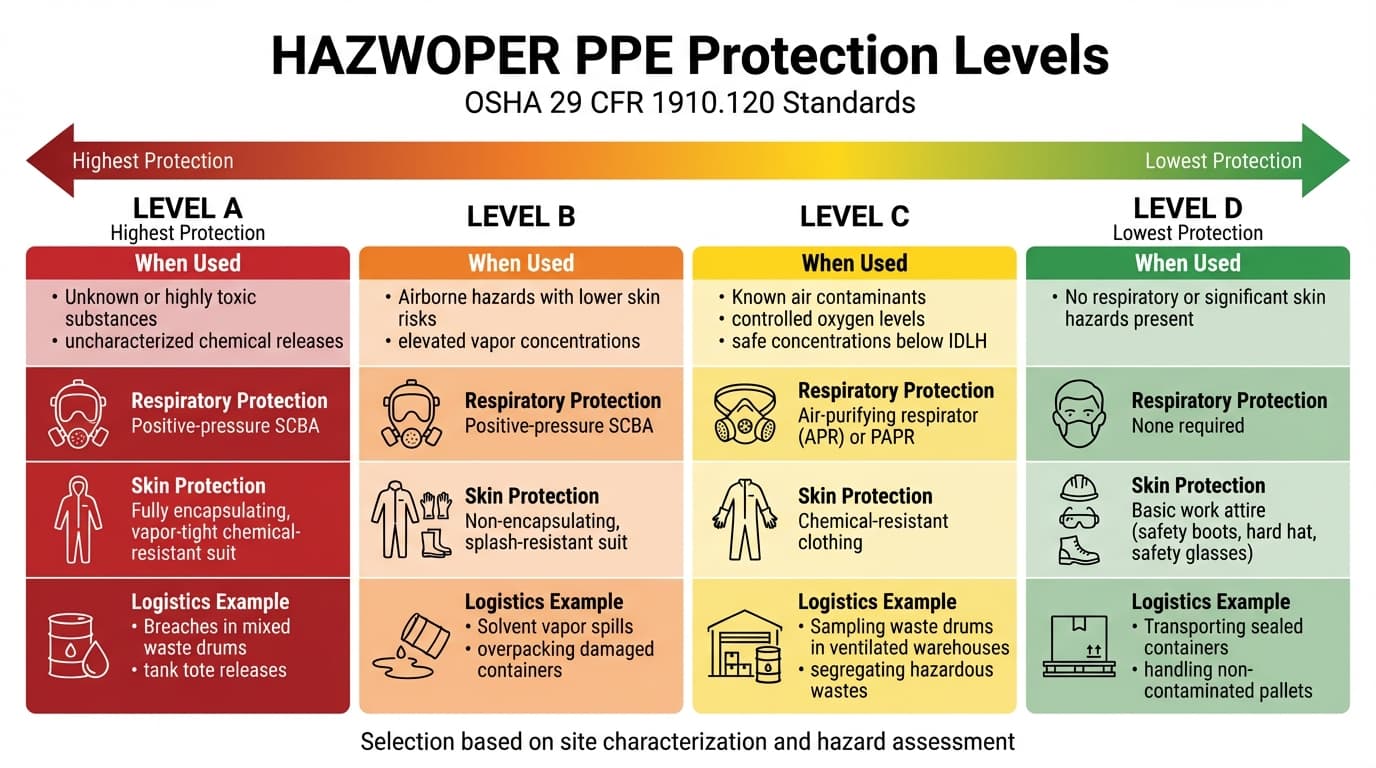
HAZWOPER outlines four distinct PPE levels to address varying degrees of hazard severity. Each level is tailored to specific risks, ensuring workers have the right protection for their environment.
Level A offers the highest level of protection for both respiratory and skin exposure. It includes a fully encapsulating, vapor-tight chemical-resistant suit paired with a positive-pressure SCBA. This level is used in situations involving unknown or highly toxic substances. In logistics, Level A might be necessary during uncharacterized chemical releases, such as breaches in mixed waste drums or tank totes.
Level B provides the same high respiratory protection as Level A, using a positive-pressure SCBA, but uses a non-encapsulating, splash-resistant suit. This level is suited for airborne hazards where skin risks are lower. For example, warehouse teams might use Level B when containing solvent vapor spills from multiple leaking drums or when overpacking damaged hazardous waste containers in areas with elevated vapor concentrations.
Level C involves an air-purifying respirator (APR) or powered air-purifying respirator (PAPR) along with chemical-resistant clothing. This level is appropriate when air contaminants and oxygen levels are known and controlled, and when specific cartridges can effectively filter the hazards. In logistics, Level C is commonly used for routine tasks like sampling waste drums in ventilated warehouses, segregating compatible hazardous wastes, or inspecting containers where air monitoring confirms safe concentrations below immediately dangerous to life or health (IDLH) thresholds.
Level D provides the least protection and consists of basic work attire, including safety boots, hard hats, and safety glasses. This level is only suitable when there are no respiratory or significant skin hazards. In logistics, Level D is typical for truck drivers transporting sealed waste containers, forklift operators handling verified non-contaminated pallets, or support staff working outside of contamination zones.
PPE Compliance for Multiple Employers
PPE compliance becomes more complex when multiple employers operate on the same site. Hazardous waste operations in logistics often involve several parties - such as generators, carriers, warehouse operators, and emergency response teams - all working together. OSHA’s HAZWOPER standards address this by requiring a unified site safety and health plan to ensure consistent protection for all workers, regardless of their employer.
The host or controlling employer typically takes the lead in creating this plan. They identify shared hazards, specify PPE requirements for different zones, and establish protocols for communication and decontamination. Third-party logistics providers, carriers, and warehouse operators must ensure their employees are trained to the appropriate HAZWOPER level, understand the PPE guidelines outlined in the site’s safety plan, and have access to the necessary equipment, especially when working in exclusion or contamination reduction zones like "hot zones" after a spill.
Each employer is responsible for developing their own written safety programs that outline PPE responsibilities, hazard assessments, and emergency procedures. These programs must include site-specific safety plans, PPE protocols, and medical monitoring systems that comply with HAZWOPER standards. Employers must also maintain their own PPE inventories and ensure subcontractors handling hazardous materials follow the required PPE guidelines.
Coordination becomes even more critical during transportation emergencies governed by 29 CFR 1910.120(q). In these cases, carriers, warehouse staff, and emergency responders must collaborate efficiently under tight time constraints to manage the situation safely.
PPE Selection and Performance: Research Findings
Site Characterization and Hazard Assessments
Conducting a thorough hazard assessment is essential for identifying hazardous substances, exposure routes, and risks in the environment. Under 29 CFR 1910.120(c), this process involves examining the site's history, analyzing chemical and physical properties of substances, evaluating potential dispersion pathways, and assessing emergency response capabilities.
For logistics operations, on-site surveys are crucial to pinpoint risks such as chemical exposures, extreme temperatures, falling objects, and traffic hazards. Safety managers rely on Safety Data Sheets (SDSs) to classify substances as gases, vapors, liquids, or solids, while also assessing their volatility, reactivity, and potential to create immediately dangerous to life or health (IDLH) conditions.
The hazard assessment directly influences PPE decisions. For instance, a tank truck rollover involving unknown volatile organics might necessitate Level A protection initially, while handling well-characterized corrosives in a ventilated warehouse may only require Level C or D ensembles with specific eye, face, and hand protection. This documentation must be updated whenever there are changes to operations, materials, or routes. Such assessments are fundamental to ensuring worker safety and selecting the right PPE for hazardous waste operations.
PPE Effectiveness and Limitations
A clear understanding of PPE performance and its limitations is key to improving safety practices. When properly selected, fitted, and maintained, PPE can significantly reduce exposures and prevent acute injuries. However, most failures arise from incorrect selection, improper fit, issues with putting on and removing PPE, or inadequate maintenance, rather than defects in the equipment itself.
Studies have identified common issues, such as chemical breakthrough, respiratory overexposure in oxygen-deficient or IDLH conditions when using air-purifying respirators, and dermal exposures at the interfaces of gloves, sleeves, boots, and pants.
Higher-level PPE, such as fully encapsulating suits and self-contained breathing apparatuses (SCBAs), presents additional challenges. These suits can increase the metabolic heat load by 10–20% or more, with core body temperatures rising 1.5–2.0 °F within 30–60 minutes of moderate activity in warm environments. PPE can also limit dexterity, reduce the field of view, and impair speech, complicating tasks like waste handling or managing emergency transport incidents.
Over-protection can sometimes create its own hazards. For example, using Level A protection unnecessarily can lead to heat stress and fatigue, which may compromise safety and task performance. OSHA and NIOSH highlight heat-related illnesses as a frequent issue during extended work in chemical PPE.
Adjusting PPE Levels During Operations
PPE selection should begin with a preliminary evaluation, but adjustments are often necessary as monitoring provides more accurate hazard data. Organizations should clearly outline criteria for modifying PPE levels in their site safety and health plans.
Upgrade PPE when monitoring detects IDLH conditions, unknown contaminants, rising airborne concentrations near or above permissible exposure limits (PELs), new splash or skin-contact hazards, degraded control measures, or wind patterns that increase vapor exposure in work zones. Downgrade PPE when consistent monitoring shows contaminant levels are below action limits, confirms the absence of IDLH conditions, validates successful spill containment, and ensures contaminant levels are stable and controlled.
Adjustments must always be based on documented monitoring data and evaluations by a competent person. For example, during tanker off-loading, operations might begin with Level B protection until air monitoring results are available. If contaminant levels remain well below limits, the PPE can be downgraded to Level C or D for repetitive tasks like coupling and decoupling.
sbb-itb-c0b8770
PPE in Logistics and Transportation Operations
PPE for Drivers, Warehouse Workers, and Emergency Responders
In logistics, personal protective equipment (PPE) requirements vary greatly depending on the worker's role and exposure risks. For example, drivers operating in low-risk environments typically use Level D PPE. This includes safety boots, high-visibility vests, work gloves, safety glasses, and hard hats. However, if they encounter a leak or a damaged container, they must step up their protection with chemical-resistant gloves, goggles or face shields, disposable coveralls, and appropriate respirators.
Warehouse workers, on the other hand, often find themselves in closer contact with hazardous materials, especially at loading docks, transfer points, or storage areas. For routine tasks, a Level C PPE setup is essential. This might include chemical-resistant gloves, protective footwear, eye protection, chemical splash suits, and air-purifying respirators. In situations with higher risks - like dealing with leaking containers - workers may need to switch to Level B PPE, which includes supplied-air respirators for enhanced protection.
Emergency responders in logistics face the most unpredictable challenges. When a major spill, vapor release in a confined area, or an unknown chemical incident occurs, they rely on Level B or higher PPE. This setup can be adjusted based on air monitoring and the specific conditions at the site. Decontamination equipment is also vital to ensure safe handling of contaminated zones and gear. This tailored approach ensures that each role is equipped with the right level of protection for hazardous materials handling and transportation.
PPE in Hazardous Materials Handling and Transport
When it comes to handling hazardous materials, task-specific PPE is critical. The OSHA HAZWOPER standard (29 CFR 1910.120) lays out clear guidelines for logistics and transportation operations, especially when employees handle hazardous waste or respond to accidental spills. Paragraph 1910.120(q) specifically addresses emergency response operations, such as managing overturned trucks carrying hazardous materials or spills at warehouses, railyards, or airports.
Employers must combine engineering controls, safe work practices, and PPE to keep worker exposure within safe limits. Routine tasks like loading and unloading materials call for chemical-resistant gloves, eye protection, and protective footwear. For higher-risk operations, such as transferring chemicals from tank containers, workers must use chemical suits and respiratory gear. In emergencies, drivers are trained to assess hazards from a safe distance and only use emergency escape PPE when absolutely necessary, leaving the mitigation and cleanup to trained responders.
How CR Express Applies PPE Standards
CR Express has integrated these PPE standards into every aspect of its operations as part of its commitment to hazardous waste safety. Across its intermodal drayage, air freight, and warehousing services, CR Express enforces strict PPE protocols. All personnel are trained in OSHA-compliant PPE usage, ensuring their safety during both routine activities and emergencies. By maintaining these robust safety measures, CR Express prioritizes worker protection while ensuring smooth and secure operations.
PPE Training, Maintenance, and Program Management
PPE Training for Hazardous Waste Operations
According to OSHA's 29 CFR 1910.120, workers involved in hazardous waste operations must undergo both initial training and annual refresher courses. These sessions cover essential topics like selecting the right PPE, understanding its limitations, proper usage, maintenance, and emergency procedures. Hands-on practice is a critical part of this training, ensuring workers can confidently put on and remove PPE, use respirators correctly, follow decontamination steps, and respond effectively during emergencies. It's equally important for workers to understand the limitations of their equipment - such as how long chemical suits can withstand exposure, the risks of heat stress, and how PPE may impact visibility or dexterity.
For logistics operations, training should address hazards specific to the worksite, as identified in detailed hazard assessments. Workers like drivers, warehouse personnel, and emergency responders should participate in practical scenarios. Examples include handling a leaking drum on a loading dock, managing a hazmat spill in a trailer, or responding to a container breach during intermodal transfers. Documenting all training sessions is essential to demonstrate compliance. Additionally, routine PPE maintenance and inspections ensure that training translates into effective protection.
Maintaining PPE Effectiveness
To provide reliable protection, PPE must be maintained in top condition. Respirator fit testing is essential - conducted initially, annually, or whenever there are changes in facial structure or new respirator models are introduced. Regular inspections should identify any defects, and detailed logs should track equipment conditions. If any PPE is found to be defective, it should be tagged and removed from use immediately.
Storage plays a vital role in maintaining PPE effectiveness. Equipment should be stored in clean, dry, and temperature-controlled environments, away from direct sunlight and harmful chemicals. Standard operating procedures should outline proper cleaning methods and criteria for reusing or disposing of PPE. A well-structured maintenance plan, paired with training, ensures that safety protocols are consistently met.
Building a PPE Program
A strong PPE program begins with a comprehensive written plan. This document should detail hazard assessments, PPE selection processes, replacement and issuance protocols, training schedules, medical surveillance requirements, and inspection and decontamination procedures. Clear roles and responsibilities should be assigned to ensure daily compliance and ongoing safety management. The program should be reviewed annually and updated as needed - whether due to new chemicals, incidents, equipment updates, or changes in processes.
Take CR Express as an example. Their approach integrates PPE requirements directly into driver manuals, warehouse work instructions, and collaborative efforts with rail yards, airports, and bonded facilities. By centralizing the tracking of PPE inventories, inspections, and training records across all locations, they ensure consistent safety performance and regulatory compliance throughout their supply chain.
Conclusion: PPE and Logistics Safety
Personal Protective Equipment (PPE) is not just a regulatory requirement under OSHA's 29 CFR 1910.120 - it’s a frontline measure for safeguarding workers from chemical, biological, and physical hazards. Ensuring proper compliance begins with detailed site evaluations and hazard assessments to identify the right protection levels, adjusting as conditions change. This isn’t just essential at cleanup sites but also throughout the logistics chain.
In logistics and transportation, HAZWOPER regulations come into play whenever hazardous materials or waste move through the supply chain. Whether it’s loading drums at a dock, responding to a trailer spill, or handling a container breach during intermodal transfers, companies must ensure workers are equipped with the right PPE and the knowledge to use it. Trucking firms, warehouses, drayage providers, and cross-dock facilities have a responsibility to provide drivers, dockworkers, and yard personnel with access to proper PPE, along with training on its use and limitations. For instance, CR Express incorporates PPE standards across its operations - from air freight to warehousing and cross-dock facilities - ensuring both regulatory compliance and operational safety.
Beyond meeting legal requirements, effective PPE programs reduce regulatory risks, cut down on lost-time incidents, and strengthen a company’s ability to handle emergencies. These benefits translate to smoother operations, fewer disruptions, and increased customer confidence. Many companies that adhere to OSHA’s PPE and HAZWOPER guidelines report fewer accidents, more reliable operations, and better emergency preparedness.
To stay ahead, logistics managers should regularly review PPE protocols, update hazard assessments, and address any gaps by improving PPE selection, training, and overall program management. Partnering with safety experts or HAZWOPER consultants can help validate PPE standards and ensure readiness for handling spills or hazardous releases during transit or at transfer points. Treat PPE as more than a compliance checkbox - it’s a strategic tool for managing risks, ensuring operational continuity, and driving long-term improvement in safety practices.
FAQs
What are the differences between PPE Levels A, B, C, and D in hazardous waste operations?
PPE levels (A, B, C, and D) are safety classifications defined by OSHA under 29 CFR 1910.120. These levels outline the type of protective gear workers need based on the risks they face during hazardous waste operations.
- Level A: This is the highest level of protection. It includes a fully encapsulated suit paired with a self-contained breathing apparatus (SCBA). Workers use this gear when there’s a high risk of exposure to toxic substances through both inhalation and skin contact.
- Level B: While similar to Level A, this level offers less skin protection. It still includes SCBA but is used when respiratory hazards are the primary concern, and skin exposure risks are lower.
- Level C: This level requires air-purifying respirators (APRs) and chemical-resistant clothing. It’s suitable when air quality is known and skin exposure risks are minimal.
- Level D: Providing the most basic protection, this level involves coveralls, gloves, and safety glasses. It’s used in settings where there are no respiratory or skin hazards.
Choosing the right PPE level starts with a thorough site risk assessment to identify specific hazards. Following OSHA guidelines and ensuring workers are properly trained are key steps in maintaining safety.
What steps should companies take to ensure PPE compliance when multiple employers are working on the same site?
To meet OSHA's 29 CFR 1910.120 standards for PPE compliance at multi-employer worksites, clear coordination and open communication are key. Each employer should have clearly defined responsibilities when it comes to PPE, ensuring that all workers are trained to use their equipment correctly and understand its limitations.
Employers are responsible for supplying the necessary PPE, conducting regular inspections, maintaining the equipment, and monitoring its use to mitigate potential risks. By fostering open dialogue among all involved parties, companies can help create a safer and fully compliant workplace.
What are the challenges and limitations of using advanced PPE in hazardous waste operations?
Using advanced personal protective equipment (PPE) in hazardous waste operations is crucial for keeping workers safe, but it does come with its share of challenges. For starters, high-level PPE can be bulky and limit mobility, making physical tasks more tiring, especially over long shifts. In hot conditions, wearing such gear for extended periods can lead to heat stress, fatigue, and general discomfort.
Another hurdle is ensuring workers are properly trained to use the equipment. Without adequate training, even the best PPE won't provide the protection it’s designed for. On top of that, maintaining and replacing PPE can be both expensive and time-consuming. Regular inspections are a must to ensure the equipment remains effective.
Even with these obstacles, choosing the right PPE is non-negotiable when it comes to shielding workers from hazardous exposures. Safety always comes first.