

What Are Shipping Alliances and How Do They Work?
by CR Express Team, Logistics Team • 12 min read
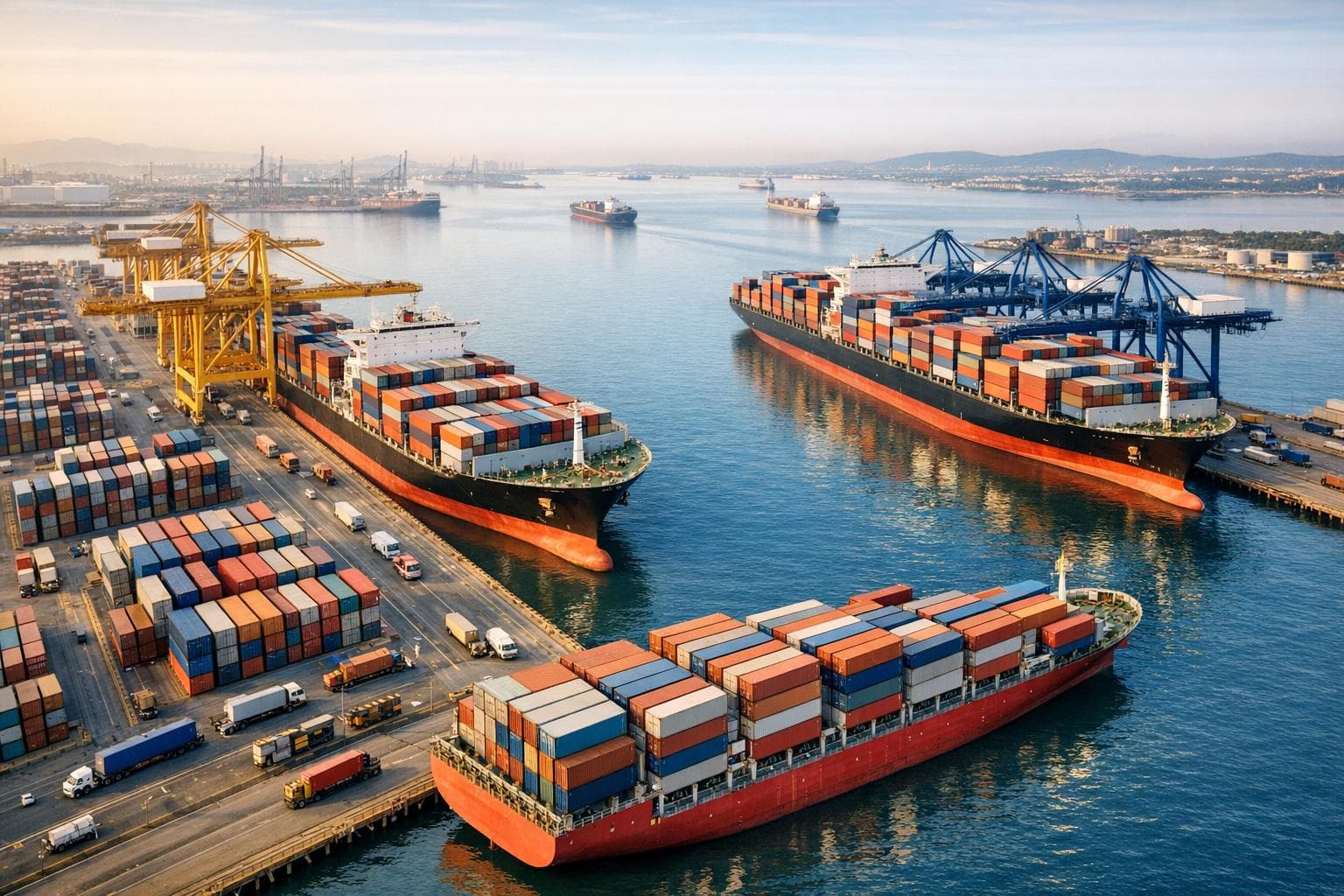
What Are Shipping Alliances and How Do They Work?
Shipping alliances are partnerships between ocean carriers that share vessel fleets under Vessel-Sharing Agreements (VSAs). These agreements allow carriers to operate more efficiently by pooling resources, expanding route coverage, and reducing costs, all while maintaining independence in pricing and sales strategies.
Here’s the quick breakdown:
- Purpose: Share resources to reduce costs and increase route coverage.
- How it works: Carriers share ship space, coordinate schedules, and optimize port operations.
- Key players: Ocean Alliance, Gemini Cooperation, Premier Alliance, and MSC.
- Benefits: Lower shipping costs, expanded coverage, and improved efficiency.
- Challenges: Port congestion, service commoditization, and market concentration.
Shipping alliances now manage over 80% of global container capacity, reshaping global trade by enabling smaller carriers to compete and carriers to operate mega-vessels at full capacity. However, they also introduce complexities in port operations and service differentiation.
“Navigating the Giants: The Dominance of Shipping Alliances in Global Trade”
How Shipping Alliances Work
Shipping alliances rely on vessel-sharing agreements (VSAs), synchronized schedules, and shared resources to ease operational demands, all while carriers maintain their independence.
Vessel-Sharing Agreements
VSAs are the backbone of shipping alliances. Through these agreements, carriers buy and sell "slots" (container spaces) on each other's ships to ensure vessels operate at full capacity. This approach eliminates the need for one carrier to dedicate an entire fleet to a single route. For example, maintaining weekly service on a loop between Busan and Rotterdam - an 11-week round trip - would typically require 11 ships. By sharing vessels, alliances enable frequent sailings without the need to expand fleets.
While a VSA usually applies to a specific trade route, a shipping alliance incorporates multiple VSAs across global routes. Members coordinate loading plans and vessel assignments but remain competitors in areas like sales, marketing, and pricing. These agreements form the foundation for synchronized schedules and shared capacity, essential for efficient operations.
Coordinated Schedules and Port Calls
Building on VSAs, alliance members align their operations by coordinating schedules. They synchronize weekly departures to ensure consistent service across major trade lanes. This requires ongoing collaboration on vessel assignments and schedules to maintain a reliable network. When demand drops, alliances use "blank sailings" - canceling a port call or an entire voyage - to adjust capacity.
Port operations are also optimized by treating multiple terminals as a single unit, streamlining processes. For instance, the Gemini Cooperation (a partnership between Maersk and Hapag-Lloyd) aims to achieve at least 90% schedule reliability for its departures when it launches in February 2025. Such coordination helps alliances deliver dependable services even in fluctuating market conditions.
Capacity Pooling and Resource Sharing
After aligning schedules, alliances further boost efficiency by pooling capacity and resources. Members contribute a set number of vessels to specific services, combining their capacity to support mega-vessels capable of carrying up to 23,000 TEUs (twenty-foot equivalent units). These enormous ships, costing $150 to $170 million each, require high utilization rates to justify their expense. Smaller carriers, in particular, benefit from this collaboration:
"The alliances have allowed the larger lines to achieve some further measure of resource rationalization, but the main beneficiaries have been the smaller lines. The allied smaller lines have been able to serve more destinations without spending billions on a larger fleet of ships."
Alliances are also extending their cooperation to landside operations. By sharing terminal facilities, trucking contracts, and railroad agreements, a midsize alliance member could potentially save around $100 million annually on U.S. landside operations. Additionally, pooling equipment like chassis and containers helps alleviate congestion caused by supply shortages. This resource-sharing model allows carriers to operate more efficiently, even in challenging conditions.
Major Shipping Alliances in Global Trade
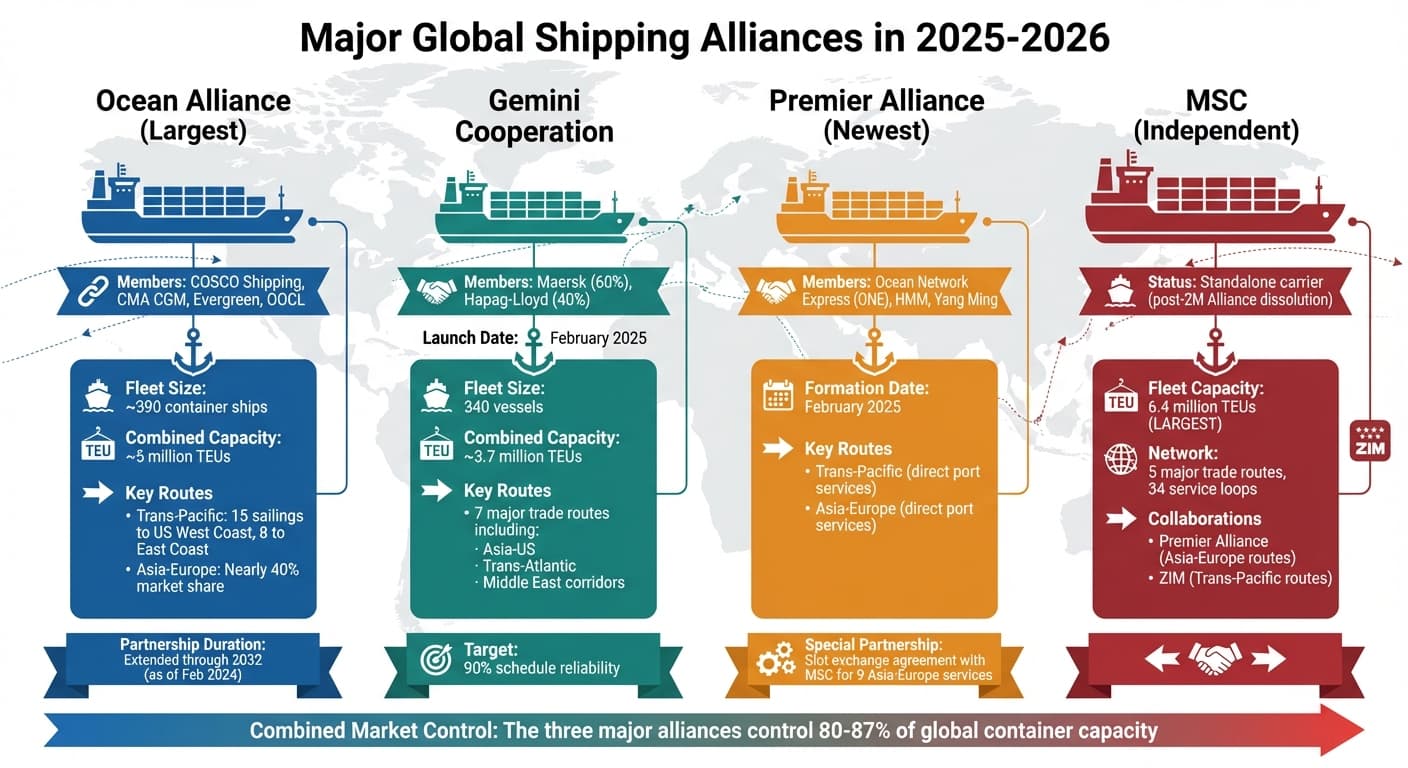
Major Global Shipping Alliances Comparison 2025-2026
The global shipping industry underwent significant changes in early 2025, with the restructuring of alliances reshaping trade dynamics. By January 2026, the sector had settled into a new framework, featuring three major alliances and one prominent standalone carrier. This shift has brought clearer operations and improved resource management.
The Ocean Alliance stands out as the largest and most consistent alliance, comprising COSCO Shipping, CMA CGM, Evergreen, and OOCL. Together, they operate around 390 container ships with a combined capacity of approximately 5 million TEUs. In February 2024, these carriers extended their partnership through 2032, demonstrating their long-term commitment. Ocean Alliance plays a key role in Trans-Pacific routes, offering 15 sailings to the U.S. West Coast and 8 to the East Coast. It also commands nearly 40% of the market share on Asia–Europe trade routes.
The Gemini Cooperation, formed by Maersk and Hapag-Lloyd, operates 340 vessels with a combined capacity of roughly 3.7 million TEUs (60% from Maersk and 40% from Hapag-Lloyd). Covering seven major trade routes, including Asia–US, Trans-Atlantic, and Middle East corridors, Gemini has set an ambitious target of achieving 90% schedule reliability.
The Premier Alliance emerged in February 2025, following the departure of Hapag-Lloyd from THE Alliance to join Gemini. This new alliance includes Ocean Network Express (ONE), HMM, and Yang Ming, offering direct port container services across both Trans-Pacific and Asia–Europe routes. Premier Alliance also maintains a slot exchange agreement with MSC for nine Asia–Europe services.
MSC (Mediterranean Shipping Company), now operating independently after the dissolution of the 2M Alliance, manages a fleet with a capacity of 6.4 million TEUs. Its independent network spans five major trade routes with 34 service loops. Despite its standalone operations, MSC collaborates with the Premier Alliance on Asia–Europe routes and partners with ZIM on Trans-Pacific routes. These alliances and partnerships continue to shape the operational landscape of global container shipping.
sbb-itb-c0b8770
Benefits and Challenges of Shipping Alliances
Benefits of Shipping Alliances
Shipping alliances offer substantial cost savings by pooling vessels, enabling carriers to share containers and port terminals without needing to maintain a global fleet on their own. By sharing space on massive ships - some capable of carrying up to 24,000 TEUs - members can spread fixed costs across more containers, which lowers per-unit expenses despite the steep price of individual vessels.
These alliances also cut variable costs like fuel and port fees. Through coordinated scheduling, joint stowage planning, and optimized routing, carriers reduce fuel consumption and streamline operations, which also helps lower their carbon footprint. Together, the three major alliances control roughly 80% of the global container market, giving them significant bargaining power to secure better port rates and terminal access.
For smaller carriers, alliances are a lifeline. Without the enormous capital needed to independently operate global routes, these carriers gain access to worldwide coverage while staying competitive. As McKinsey Partner Steve Saxon explains, "alliances promote competition by helping smaller lines survive and thus keeping prices low". Additionally, alliances enhance service reliability during crises - whether financial or natural - by providing backup capacity and contingency plans.
Challenges of Shipping Alliances
One major downside for shippers is the commoditization of services. Since alliance members share vessels and terminals, it becomes difficult for shippers to distinguish between carriers based on transit times or reliability. This lack of differentiation can make choosing a carrier feel like comparing identical options.
Operational challenges at ports add another layer of complexity. For example, in the Los Angeles–Long Beach area, alliance vessels may dock at any of seven different terminals, complicating truck coordination and chassis management. Shippers often express frustration over poor communication between terminals, ocean carriers, and land transport providers.
Alliance reshuffles can also lead to uncertainty. When the 2M Alliance dissolved in early 2025, shippers dealt with schedule disruptions and service changes as members reorganized their operations. Another concern is market concentration - since alliances control 80% to 87% of global capacity, shippers fear this might lead to supply limitations and higher costs.
Carrier vs. Shipper Perspectives
The benefits and challenges of shipping alliances affect carriers and shippers in different ways.
For carriers, alliances mean lower capital expenditures, shared risks, and greater operational efficiency through vessel sharing and coordinated schedules. They avoid the massive costs of independently serving global routes while still competing on pricing and customer acquisition.
Shippers enjoy advantages like broader route coverage and reduced freight rates. Between 2010 and 2015, alliance-driven competition and carrier oversupply saved shippers an estimated $23 billion. However, these perks come at a cost. Shippers face fewer service options, increased terminal complexities, and a reliance on the stability of alliance operations. For instance, while the Gemini Cooperation aims for 90% schedule reliability, the push for cost-cutting often results in less service differentiation and operational unpredictability at ports.
| Perspective | Primary Benefits | Key Challenges |
|---|---|---|
| Carriers | Lower capital costs, shared risks, economies of scale, operational efficiency | Difficulty standing out; reliance on partner performance |
| Shippers | Lower shipping rates, expanded route options, consistent capacity | Lack of service variety, port complexities, risk of alliance disruptions |
Impact of Shipping Alliances on Global Trade
Facilitating International Trade
Shipping alliances have reshaped the way goods travel across the globe, making trade routes more efficient and accessible. Smaller carriers now have the opportunity to reach global markets without the massive financial burden of expanding their fleets. These alliances deploy mega-vessels that can carry twice the capacity of older ships, spreading fixed costs across more containers. This approach not only increases revenue per voyage but also lowers per-unit shipping costs and reduces carbon emissions. By maximizing vessel capacity and cutting down on half-empty voyages, alliances help achieve sustainability goals while ensuring dependable service on key trade routes.
Currently, the three largest alliances - Ocean Alliance, Gemini Cooperation, and Premier Alliance - are expected to manage more than 87% of global shipping capacity by 2025. According to McKinsey Partner Steve Saxon:
"alliances promote competition by helping smaller lines survive and thus keeping prices low".
These operational efficiencies contribute to more stable pricing in a competitive market, benefiting both carriers and shippers alike.
Price Competitiveness and Stability
The cost-sharing efficiencies created by shipping alliances play a crucial role in stabilizing freight rates. By pooling resources - such as vessels and terminals - operational costs, which make up over 67% of a shipping line's total expenses, are distributed among alliance members. This allows alliances to offer consistent and competitive pricing structures.
However, the dynamics are far from simple. While alliances collaborate on operational aspects, they are legally required to set their own sales and pricing strategies due to Block Exemption Orders, which prohibit price-fixing. This creates a unique environment where carriers within the same alliance compete for customers despite sharing vessels. This vessel-sharing arrangement can also lead to service commoditization, making it more difficult for shippers to differentiate between carriers based on factors like transit times or reliability.
Logistics Provider Responses to Alliance Trends
As the efficiencies of shipping alliances continue to shape global trade, logistics providers have had to adapt quickly to new challenges. One major issue is the congestion at ports, often caused by the concentration of alliance vessels. This can lead to shortages of chassis and logistical bottlenecks, especially when alliance members use multiple terminals within the same port complex.
To address these challenges, companies like CR Express have stepped up with tailored solutions. CR Express operates a private chassis fleet - including 20', 40', and 45' options, as well as tri-axles for heavy containers - and offers over 500 container parking spots near Chicago’s major rail yards in Elwood/Joliet and Harvey. Their 280,000 sq ft of customs bonded warehouse space (CBW Class 3) ensures smooth transitions from ocean freight to final delivery. Services like container transloading, sorting by PO/SKU, and 7-day operations align seamlessly with alliance schedules.
"CR Express has been instrumental in streamlining our supply chain operations. Their bonded warehouse services and seamless customs handling have reduced our logistics costs by 30% while improving delivery times."
– Sarah Johnson, Supply Chain Director
With facilities strategically located near O'Hare International Airport and key rail terminals, CR Express is well-equipped to handle the complex coordination required by alliance operations. Their TSA-approved drivers, GDP-compliant facilities for pharmaceuticals, and same-day recovery capabilities provide the flexibility businesses need to navigate these evolving trends. As alliances move toward greater landside integration - such as joint terminal management and centralized truck dispatching - logistics providers offering integrated services are uniquely positioned to help businesses thrive in this changing landscape.
Conclusion
Shipping alliances have transformed global trade by enabling carriers to share resources that were previously out of reach for individual operators. By pooling vessels and other assets, these alliances now command a staggering 80% of the global container market, delivering cost efficiencies and environmental benefits.
The industry is evolving, with alliances like Ocean Alliance extending their partnerships through 2032, while emerging groups such as Gemini aim to achieve 90% schedule reliability. However, not all challenges have been solved. On land, fragmented terminals and coordination hurdles can erode the efficiencies gained at sea. As McKinsey Director Martin Joerss aptly put it, "The scale advantage realized at sea likewise comes to an end [on land]".
For businesses operating in this intricate landscape, success hinges on collaborating with logistics providers who grasp the nuances of these alliances. The concentration of alliance vessels at major ports introduces challenges like chassis shortages, terminal congestion, and disrupted cargo flows. Addressing these issues is critical - streamlined inland operations could save midsize alliance members around $100 million in U.S. landside costs, underscoring the importance of integrated logistics solutions.
CR Express tackles these complexities head-on with strategically placed hubs, a dedicated fleet of chassis, over 500 container parking spaces near Chicago rail yards, and a 280,000 sq ft customs-bonded warehouse operating seven days a week. Their TSA-approved drivers and GDP-compliant facilities ensure smooth transitions from ocean freight to final delivery.
As alliances continue to shape the future of global shipping, staying competitive will require leveraging advanced logistics infrastructure to maximize the benefits of these partnerships while navigating their inherent challenges.
FAQs
How do shipping alliances affect smaller carriers?
Shipping alliances give smaller carriers a chance to broaden their reach by teaming up with larger shipping lines. Through vessel-sharing agreements, these smaller players can tap into ports and routes that would otherwise be out of their reach. Plus, they get to load cargo onto larger, more fuel-efficient ships, which helps cut costs and boost efficiency. This setup often allows them to offer more competitive rates, leveling the playing field a bit in a tough industry.
But it’s not all smooth sailing. Smaller carriers can find themselves reliant on the decisions of their larger partners, like changes in schedules or capacity adjustments. If an alliance gets restructured or breaks apart, it can throw operations into chaos, causing service disruptions or reliability issues. While alliances bring clear advantages like cost savings and expanded market access, they also tether smaller carriers to the strategies and decisions of the industry’s heavyweights.
What challenges do shipping alliances face in the global trade industry?
Shipping alliances face several hurdles that can impact how well they function and remain stable. One of the most pressing issues is regulatory scrutiny. Governments, particularly in the United States and Europe, keep a close eye on these alliances to ensure they don't engage in anti-competitive behavior. For instance, concerns over antitrust violations have led to tighter oversight and even executive orders questioning their influence over the market. On top of that, alliances often grapple with instability caused by strategic shifts such as mergers, acquisitions, or members exiting agreements. These changes can disrupt operations and send ripples through the entire industry.
Another significant challenge is the lack of coordination beyond ocean shipping. While alliances work together to share vessels and optimize fuel use during sea transit, their collaboration usually stops at the port. Once containers are offloaded, trucking, rail, and terminal operations are managed independently, limiting opportunities for cost savings and efficiency. Synchronizing schedules, capacity, and service standards among multiple carriers becomes even harder during times of market turbulence, like port congestion or volatile freight rates. These complexities hinder alliances from fully streamlining their operations and delivering consistent service.
How do shipping alliances impact freight costs and service reliability?
Shipping alliances enable carriers to collaborate by sharing vessels, coordinating schedules, and optimizing routes. This collaboration often results in lower freight rates and a more efficient network. By pooling their resources, these alliances increase capacity on key trade routes, which helps reduce shipping costs and provides businesses with more stable pricing.
Another advantage of these alliances is improved service reliability. They offer access to a broader network of vessels and alternative routes, which can be a lifesaver if delays occur. For instance, if one ship runs behind schedule, cargo can be shifted to another vessel within the alliance to keep things on track. That said, the ever-changing nature of alliance structures and service patterns can sometimes complicate planning for shippers.
Working with a logistics provider like CR Express can help navigate these complexities. They offer end-to-end visibility, alternative transport options, and seamless integration of ocean freight with other services such as drayage, warehousing, and air cargo, ensuring a smoother shipping experience.