
10 Ways to Manage Environmental Supply Chain Risks
by CR Express Team, Logistics Team • 18 min read
10 Ways to Manage Environmental Supply Chain Risks
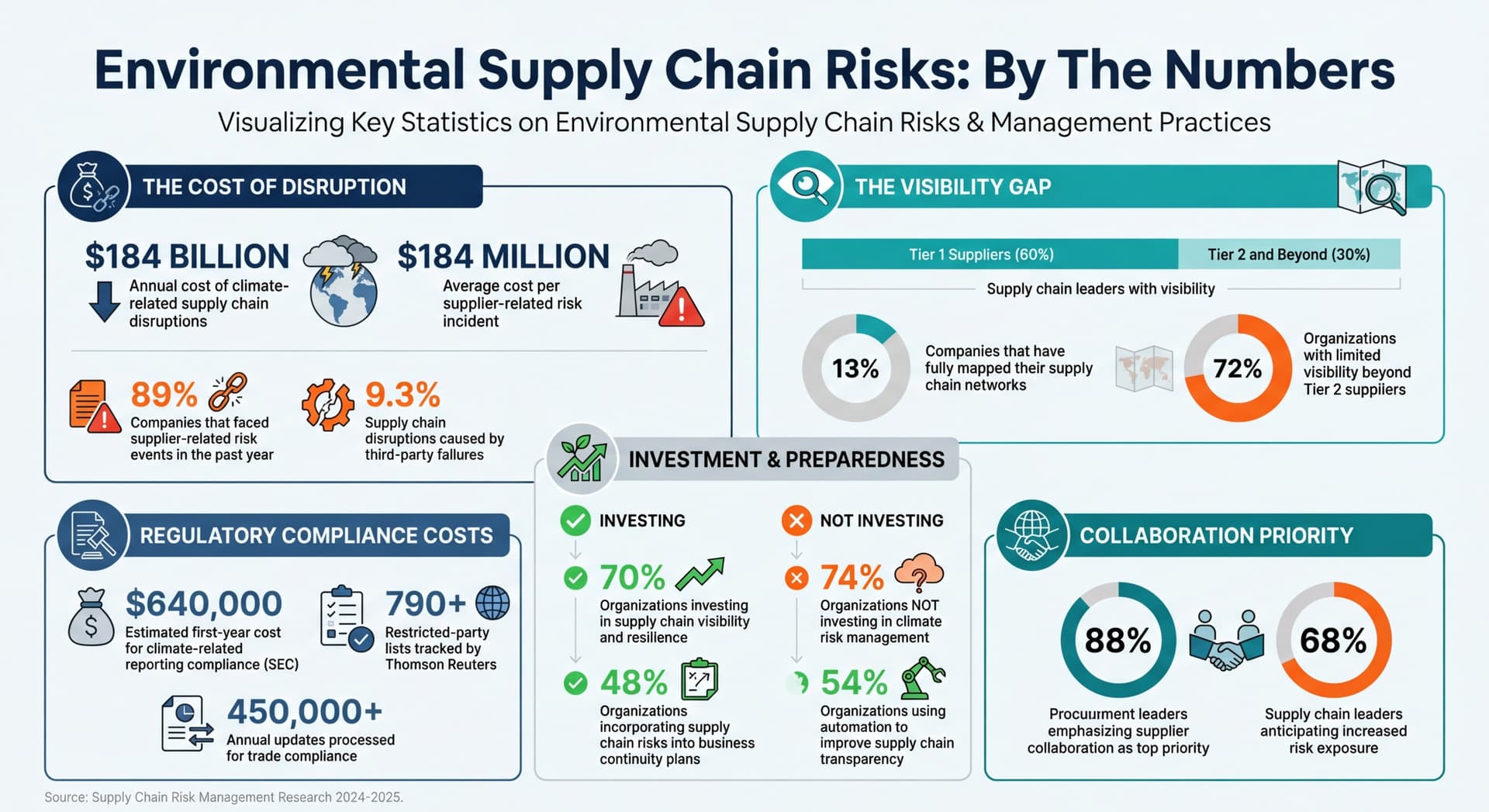
Supply chain disruptions are becoming a constant challenge, with climate-related events like wildfires and hurricanes leading the charge. These disruptions cost businesses $184 billion annually, yet less than half actively manage these risks. Meanwhile, regulations like the EU’s CSDDD and Germany’s LkSG demand stricter monitoring, adding compliance costs of up to $640,000 in the first year. To tackle these challenges, businesses must prioritize risk management, visibility, and collaboration. Here's how:
- Assess supplier ESG performance: Move beyond trust by using audits and automated tools for better oversight.
- Map supply chains: Identify risks by combining supplier data with climate and political risk information.
- Diversify suppliers: Spread sourcing to reduce reliance on single regions or suppliers.
- Use real-time analytics: Leverage technology to predict and respond to risks.
- Benchmark supplier performance: Use data to identify and address weak points.
- Optimize logistics: Reduce emissions and improve efficiency through smarter transportation strategies.
- Develop contingency plans: Prepare for natural disasters by spreading supplier operations geographically.
- Integrate risks into strategy: Align sustainability goals with business planning.
- Verify and audit data: Use automation for accurate monitoring and compliance.
- Build partnerships: Collaborate with suppliers for shared accountability.
These steps help businesses reduce risks, meet regulatory demands, and build more resilient supply chains.
Environmental Supply Chain Risk Management: Key Statistics and Impact
1. Assess Supplier Environmental, Social, and Governance Performance
Improving Risk Mitigation
The vulnerabilities in supply chains today make it clear: relying on trust alone isn’t enough. Businesses need to move beyond simple questionnaires and adopt rigorous ESG verification processes. This includes requiring third-party audits, tangible testing evidence, and detailed continuity plans.
The challenge becomes even more complex when considering suppliers beyond the first tier. While 60% of supply chain leaders have visibility into their Tier 1 suppliers, that number plummets to just 30% for Tier 2 and beyond. Strengthening verification practices and fostering collaboration can significantly improve visibility across the supply chain.
Enhancing Collaboration and Visibility
A thorough ESG assessment means digging into every layer of the supply chain. Automated screening tools are invaluable here, as they can cross-check supplier data against international watchlists and sanctions databases. For instance, Thomson Reuters tracks over 790 restricted-party lists and processes more than 450,000 updates annually to ensure trade compliance. Automation is becoming a key player in this space, with 54% of organizations already using it to improve supply chain transparency.
Focusing on high-risk areas is essential. By using risk-based segmentation, organizations can prioritize in-depth assessments for suppliers operating in regions or industries with heightened risks. As Karen Lobdell, Senior Product Manager at ONESOURCE Global Trade, aptly puts it:
"You can't mitigate what you haven't identified".
To address risks effectively, businesses should map supplier locations and align them with climate and political risk data. Rather than cutting ties with non-compliant suppliers immediately, companies can introduce corrective action plans and provide targeted training to help suppliers meet ESG standards. This approach not only mitigates risks but also strengthens relationships across the supply chain.
sbb-itb-c0b8770
2. Map Your Supply Chain for Environmental Risks
Improving Risk Mitigation
Most companies are aware of their direct suppliers, but only 13% have fully mapped their supply chain networks. Meanwhile, 72% report limited visibility beyond Tier 2 suppliers. This lack of insight can be risky since some of the biggest environmental threats often exist deeper in the supply chain - where raw materials are sourced, processed, or manufactured.
Geographic mapping offers a way to reduce these risks. By combining supplier location data with environmental risk information, you can pinpoint facilities in areas vulnerable to floods, wildfires, or water shortages. This approach helps calculate Total Time to Survive (TTS) and reduces the chances of extended disruptions.
Enhancing Collaboration and Visibility
Technology plays a key role in mapping deeper into the supply chain. AI and predictive analytics leverage historical data to spot risk trends before they escalate. Blockchain provides secure, unalterable records of product origins, while IoT sensors and RFID tags allow real-time tracking of shipments and conditions.
However, fragmented data remains a hurdle. Supply chain information is often scattered across procurement, logistics, and sustainability teams, making it difficult to get a complete picture. Breaking down these silos is essential for comprehensive risk management. The BCI Horizon Scan Report highlights this challenge:
"Complex interdependencies can quickly reduce visibility over risk".
Centralized platforms can address this issue by consolidating data into one system. These cloud-based tools create a unified source of information where teams can monitor supplier performance, compliance, and potential risks in real time.
Building Long-Term Resilience
Strategic mapping isn’t just about addressing immediate risks - it’s a foundation for long-term resilience. By understanding where suppliers are concentrated geographically, companies can proactively diversify before disruptions occur. For instance, if 80% of your components are sourced from a region vulnerable to typhoons, that’s a clear signal to spread out your supply base before storm season hits.
Mapping also highlights reliance on carbon-intensive materials, offering an opportunity to transition to more sustainable alternatives. This proactive approach connects supply chain strategy with broader environmental risk management goals, helping businesses stay ahead of potential challenges.
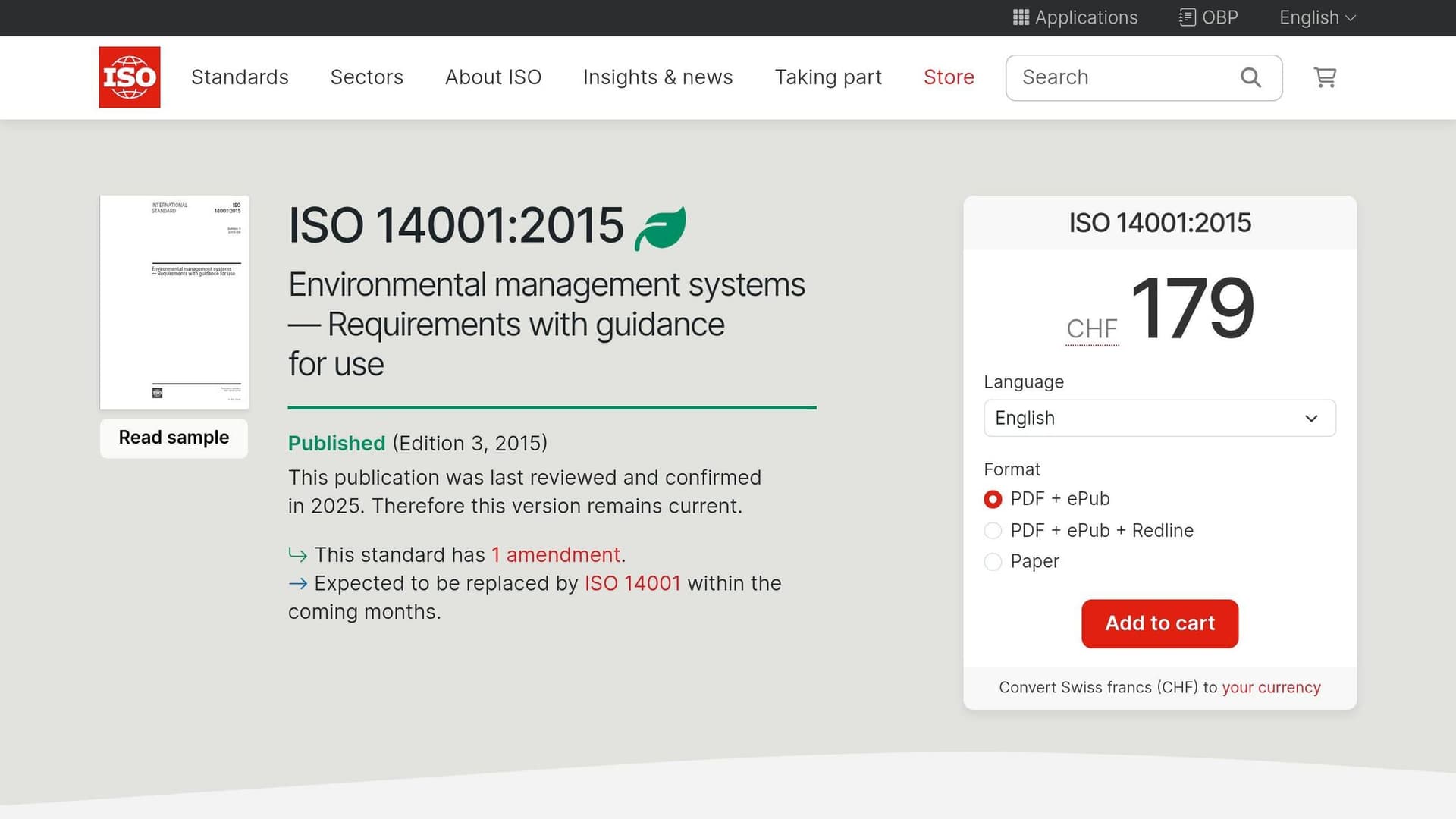
Environmental Risk Management in the Supply Chain with ISO 14001:2015 [live webinar]
3. Diversify Suppliers to Reduce Environmental Exposure
Expanding on supply chain mapping and ESG assessments, diversifying your supplier base is a powerful way to tackle environmental risks head-on.
Improving Risk Mitigation
Relying on a single supplier can leave your operations vulnerable. The data is clear: 89% of companies faced a supplier-related risk event in the past year, with disruptions racking up an average cost of $184 million per incident. On top of that, third-party failures account for 9.3% of all supply chain disruptions.
By spreading your sourcing across multiple suppliers, you can shield your operations from regional environmental shocks. For instance, if a hurricane disrupts one region, having suppliers in other areas ensures production doesn't come to a standstill. This approach shifts away from the lean model, which prioritizes minimal inventory but increases vulnerability, toward a more resilient and diversified strategy. Building these relationships early is key to ensuring a steady and reliable supply chain when challenges arise.
Building Long-Term Resilience
Diversification also means your suppliers are less likely to share the same environmental risks. For example, an agri-food company dealing with water scarcity in one region can pivot to suppliers in areas with better water availability.
Establishing these partnerships before disruptions occur requires the same level of scrutiny as your primary suppliers. This includes confirming their environmental standards, testing their capacity, and ensuring they can scale operations quickly when needed.
"It's no longer just trust; we need guarantees because we're so reliant on different suppliers".
Additionally, near-shoring can offer extra protection. By sourcing suppliers closer to home, you reduce transportation risks and cut down on the environmental impact of long-distance shipping. As climate-related disruptions become more frequent, having geographically closer suppliers allows for quicker responses, helping maintain operational continuity.
4. Use Real-Time Visibility and Predictive Analytics
Thanks to technology, detecting environmental threats early is now possible. With 70% of organizations focusing on improving supply chain visibility and resilience through tech investments, the trend toward data-driven risk management is gaining momentum.
Improving Risk Mitigation
Real-time visibility tools are essential for spotting climate-related disruptions and ESG (Environmental, Social, and Governance) non-compliance in deeper supply chain networks. The challenge? Only 13% of companies have fully mapped their supply chains, while 72% struggle with limited visibility beyond Tier 2. This lack of insight is risky because the most pressing environmental and social risks often lie hidden in these deeper tiers.
Predictive analytics takes it a step further by using historical data to identify risk patterns and prepare for worst-case scenarios. For instance, tools like Time to Recover (TTR) and Time to Survive (TTS) help organizations evaluate how long it takes suppliers to restore operations and how long the supply chain can meet demand during disruptions. A practical example comes from CACI, which adopted Ivalua's Source-to-Pay platform in 2024. This move digitized their procurement processes, resulting in 95% spend under management, 95% compliance, a 30% cut in operating costs, and a 30% boost in identified savings.
These technologies don't just reduce risks - they also set the stage for stronger collaboration across the supply chain.
Enhancing Collaboration and Visibility
Beyond risk management, advanced mapping and traceability systems streamline teamwork by simplifying data sharing. Automated tools consolidate sub-tier data, helping teams focus on critical risks instead of drowning in manual reports. A method called "management by exception" uses software to filter out anomalies in supplier data, directing attention to high-priority alerts. Today, 54% of organizations are already leveraging automation to improve supply chain visibility.
The aim is to move away from broad oversight and focus on targeted interventions in high-risk areas. Traceability technologies provide precise information on product origins and production paths, helping businesses avoid sourcing from regions with high carbon footprints or other environmental concerns. This approach not only minimizes risks but also aligns supply chains with sustainability goals.
5. Benchmark and Collaborate on Supplier Performance
Improving Risk Mitigation
Adding benchmarking to tools like real-time visibility and predictive analytics strengthens risk management efforts. It helps businesses tackle environmental risks by highlighting areas of concern. For example, using ESG risk maps and scorecards allows companies to identify high-risk suppliers and focus on corrective actions where they’re needed most. This is especially important considering that nearly 80% of organizations faced supply chain disruptions in 2024, with third-party failures contributing to 9.3% of incidents.
The shift from trust-based relationships to evidence-driven partnerships is changing how supplier management operates. A professional quoted in the BCI Horizon Scan Report explained:
"We investigate our suppliers' business continuity plans. A few years ago, you might have said, 'Yes, we have a plan,' and that would have been enough. Now companies want to see your plan, evidence of testing, and audits."
This modern approach relies on automated tools to flag deviations from environmental standards. Instead of manually reviewing every supplier, businesses can focus on high-risk cases - like those operating in areas with polluted water sources or significant carbon emissions. When combined with detailed supply chain mapping, benchmarking sharpens risk prioritization and helps drive meaningful improvements.
Enhancing Collaboration and Visibility
Benchmarking becomes even more effective when paired with active collaboration. Sharing performance data with suppliers creates opportunities to work together on improvement programs rather than simply cutting ties with those who underperform. For instance, if a supplier struggles to meet environmental goals, providing tailored action plans and e-learning resources can help them reduce emissions and waste more effectively.
Still, visibility remains a major hurdle. While 60% of supply chain leaders report transparency at Tier 1, that number drops to just 30% for Tier 2 and beyond. Multi-tier mapping combined with standardized benchmarks can help uncover hidden risks in these sub-tiers, where oversight is often weakest but environmental risks are still significant. By establishing shared KPIs - such as carbon footprint reduction targets or waste management goals - both parties can stay accountable to sustainability objectives. This collaborative approach to benchmarking lays the groundwork for advancing supply chain sustainability.
6. Optimize Logistics and Transportation for Sustainability
Reducing Environmental Impact
Transportation plays a massive role in supply chain emissions, so improving how goods move is essential for minimizing environmental risks. For instance, shifting freight from air to sea or rail can significantly reduce Scope 3 emissions. Similarly, smart route planning cuts down on fuel consumption and idling time. Programs like the EPA's SmartWay program provide tools for measuring and improving freight efficiency, offering benchmarks and public recognition to companies making strides in this area.
Another effective approach is near-shoring - bringing manufacturing closer to where products are consumed. This reduces the distance goods need to travel, lowering carbon emissions while also making supply chains more resilient. Additionally, optimizing truck capacity can slash logistics costs by up to 20%. These changes not only benefit the environment but also help businesses save money.
Improving Risk Mitigation
Real-time visibility tools are transforming how companies handle transportation risks. GPS tracking and IoT sensors allow logistics teams to monitor shipments continuously, which is especially useful for temperature-sensitive goods like fresh produce or pharmaceuticals. By keeping an eye on conditions during transit, companies can avoid spoilage and reduce waste.
Predictive analytics takes risk management a step further. AI-powered logistics systems can anticipate disruptions, such as congested ports or infrastructure issues, and reroute shipments accordingly. This not only prevents delays but also improves fuel efficiency. It’s no surprise that 54% of organizations now use automation to enhance supply chain visibility.
Enhancing Collaboration and Visibility
Collaboration is key to making transportation more efficient and sustainable. The "Three Ts" framework - Transparency, Traceability, and Trackability - offers a practical guide. Transparency involves mapping the entire supply chain, traceability focuses on tracking the origins of products, and trackability follows their geographic movement. While 60% of supply chain leaders report having transparency at Tier 1, only 30% extend that visibility to Tier 2 and beyond.
Breaking down silos between procurement, logistics, and sustainability teams is another crucial step. By using cloud-based platforms, companies can centralize data from multiple sources, quickly spot inefficiencies, and take corrective action.
At CR Express, we’ve embraced these practices by integrating GPS tracking, predictive analytics, and cloud-based collaboration tools into our operations. This commitment to sustainable, low-carbon logistics allows us to provide supply chain solutions that are both environmentally responsible and operationally effective.
7. Develop Climate-Resilient Sourcing and Contingency Plans
Strengthening Risk Mitigation
Natural disasters like hurricanes, wildfires, and droughts can wreak havoc on supply chains without warning. One way to reduce this risk is by spreading supplier operations across various regions. For instance, if your main supplier is located in a flood-prone area, having alternative suppliers in regions less affected by flooding can act as a safety net.
Today, businesses are raising the bar when it comes to supplier preparedness. Instead of relying on verbal assurances, companies now demand documented and tested business continuity plans. Suppliers are often required to provide evidence - like audits or disaster simulations - that they’re ready to handle emergencies.
Focusing on Long-Term Resilience
Achieving long-term resilience means looking beyond just Tier 1 suppliers. While 60% of supply chain leaders report visibility into their Tier 1 suppliers, only 30% can see into Tier 2 and deeper levels. Risks often exist further down the chain - such as a Tier 2 supplier operating in a drought-prone region or near an ecologically sensitive area.
Using tools to overlay supplier locations with climate risk data - like flood zones, wildfire paths, or areas prone to drought - can help businesses spot potential weak points early. This insight allows companies to prepare, whether by securing alternative raw materials or finding suppliers in safer areas, if a resource becomes scarce due to environmental challenges.
"Failing to embed sustainability and resilience in the supply chain could be costly enough to jeopardize long-term survivability of organizations across sectors and geographies".
Collaboration between sustainability teams and risk management departments is key. When they work together, businesses can create contingency plans that protect both environmental goals and operational stability. Ensuring these plans align with broader business objectives is essential for managing environmental risks in the supply chain effectively.
8. Integrate Environmental Risks into Business Strategy
Improving Risk Mitigation
Managing environmental risks has become an essential part of running a business today. When companies embed this into their strategies, they move beyond simple compliance and create opportunities for growth. To make this shift, it's crucial to get leadership on board so that sustainability becomes a key factor in procurement and investment decisions.
The statistics paint a clear picture: most companies have faced supplier-related disruptions, with each incident costing an average of $184 million. Despite this, 74% of organizations still aren't investing in climate risk management. By aligning environmental risk strategies with existing frameworks like Third-Party Risk Management (TPRM) and Business Continuity Management (BCM), businesses can address these gaps more effectively.
"A reactive approach to supply chain risk is no longer viable in today's global climate." - EcoVadis
Enhancing Collaboration and Visibility
While risk assessment and mapping are critical first steps, collaboration is what truly integrates these risks into the broader business framework.
One key challenge is visibility. While companies often have a clear view of their Tier 1 suppliers, oversight weakens significantly in deeper supply chain tiers. These sub-tiers are where many of the most severe environmental violations occur, often unnoticed.
Instead of simply cutting ties with suppliers who fall short, many businesses are adopting a collaborative approach. By working with suppliers to implement sustainable practices - like funding water treatment solutions - companies can prevent environmental harm from being outsourced to less responsible competitors. This approach not only safeguards the industry's reputation but also strengthens supply chain stability by addressing problems at their source.
Incorporating these collaborative efforts into supplier contracts ensures that environmental risk management becomes a formal and strategic part of business operations.
Building Long-Term Resilience
Embedding environmental performance metrics directly into supplier contracts is a game-changer for accountability. Companies can pinpoint "hotspots" in their supply chains - such as areas with high carbon emissions or heavy water usage - and focus their efforts where they can make the greatest difference. This builds on earlier mapping and diversification strategies, creating a seamless connection between operational resilience and environmental responsibility. Not only does this reduce environmental impact, but it also cuts operational costs over time through better resource efficiency and waste reduction.
Regulations are tightening as well. The EU's Corporate Sustainability Due Diligence Directive (CSDDD) and Germany's Supply Chain Diligence Act (LkSG) are pushing companies to take environmental risks seriously. While the SEC estimates that climate-related reporting could cost around $640,000 in the first year, the financial and reputational risks of ignoring these issues are far greater.
9. Implement Data Verification and Auditing Practices
Improving Risk Mitigation
Relying solely on supplier trust can be a gamble. Supply chain disruptions can cost businesses an average of $184 million, yet only 48% of organizations incorporate supply chain risks into their business continuity plans. That’s a lot of exposure for something so critical.
The key is shifting from basic questionnaires to evidence-backed verification processes. Automated compliance tools are a game-changer here - they not only send out questionnaires but also flag risky responses in real time. These systems can catch errors and even spot potential greenwashing. Beyond initial checks, post-entry audits dig deeper, uncovering issues like incorrect tariff classifications or duty miscalculations. These practices don’t just reduce risk; they also improve collaboration by ensuring accurate data flows throughout the supply chain.
Enhancing Collaboration and Visibility
Visibility into the deeper tiers of the supply chain is often limited, yet this is where most environmental violations occur. Third-party inspections help fill this gap by verifying critical factors like waste management, resource usage, and labor conditions through on-site evaluations.
Tools like AI-driven scorecards and analyst evaluations further standardize supplier performance metrics, offering clear benchmarks for sustainability. This transparency doesn’t just highlight problems - it fosters solutions. Instead of severing ties with underperforming suppliers, companies can pinpoint specific issues and work together on fixes, such as introducing water treatment systems, to drive real improvements.
Building Long-Term Resilience
New regulations, such as the EU's CSDDD and Germany's LkSG, now require companies to monitor and audit supplier emissions and practices. While the SEC estimates that initial climate-related reporting could cost around $640,000, the alternative - dealing with disruptions averaging $184 million - makes this investment seem like a no-brainer.
Automation plays a crucial role here. By enabling "management by exception", systems can continuously monitor operations and flag only the most critical anomalies for human review. This is vital when manual oversight becomes "practically impossible" and introduces unnecessary risks. Karen Lobdell, Senior Product Manager at Thomson Reuters, sums it up perfectly:
"You can't mitigate what you haven't identified".
10. Build Partnerships for Shared Accountability
Strong partnerships are a cornerstone of supply chain resilience, complementing earlier steps like risk mapping and mitigation.
Strengthening Collaboration and Visibility
Collaboration is no longer optional - 88% of procurement leaders now emphasize supplier collaboration as a top priority. The days of relying solely on trust are fading, replaced by partnerships grounded in evidence and verification.
While most companies maintain visibility over Tier 1 suppliers, Tier 2 often remains a blind spot. Transparent partnerships help bridge this gap, much like diversification and predictive analytics strengthen risk frameworks. By working together, companies and suppliers can develop corrective action plans, offer training, and share resources like peer comparison data and technical tools. These efforts empower smaller suppliers to calculate carbon footprints and align with environmental standards.
Enhancing Risk Management
In 2025, third-party failures accounted for 9.3% of supply chain disruptions, making them the leading cause of issues. The answer lies in shared accountability, supported by automation - not more questionnaires. Already, 54% of organizations use automated systems to boost supply chain visibility and map trading relationships.
Embedding ESG measures and clear service-level agreements into supplier contracts ensures accountability. Automated platforms streamline processes by flagging high-risk responses in real time, allowing managers to focus on exceptions while maintaining a steady watch over the network. This integrated approach creates a foundation for stable, long-term supply chain management.
Focusing on Long-Term Resilience
While 70% of organizations prioritize supply chain visibility and resilience in their investments, only 48% integrate supply chain risks into their business continuity plans. This gap leaves many companies vulnerable.
Take CACI, for example. In 2025, they introduced a digital procurement platform that improved supplier collaboration, achieved 95% compliance in Procure-to-Pay processes, and cut operating costs by 30%. They also identified 30% more savings. Similarly, strategic logistics partnerships can enhance communication, streamline transportation routes, and enable quicker responses to disruptions. Sharing data, conducting joint audits, and benchmarking performance all contribute to building a robust and adaptable network.
At CR Express, we believe that fostering transparent partnerships and leveraging automation are essential for maintaining continuous oversight and creating a resilient supply chain.
Conclusion
Managing environmental risks within the supply chain is no longer just a side consideration; it’s now a core part of business strategy. With 68% of supply chain leaders anticipating increased risk exposure and climate-related disruptions topping the list of concerns, companies must approach risk mitigation as an ongoing effort - not something to address sporadically. The strategies discussed here - ranging from network mapping and supplier diversification to real-time analytics and transparent partnerships - lay the groundwork for a resilient and adaptive supply chain.
Kristian Park, Global Third Party Risk Management Leader at Deloitte, emphasizes that sustainability and resilience are not mutually exclusive. In fact, prioritizing environmental goals often eliminates vulnerabilities, strengthening supply chains on both fronts.
However, there’s still work to be done. While 70% of organizations invest in supply chain visibility and resilience, only 48% incorporate disruption assessments into their continuity plans. This gap leaves businesses vulnerable. As Karen Lobdell from Thomson Reuters points out, the real question isn’t if supply chain risks will impact your business, but whether you’ll be prepared when they do.
Success depends on collaboration across procurement, logistics, sustainability, and risk management teams. It also requires consistent monitoring through the "Three Ts" - Transparency, Traceability, and Trackability - to ensure visibility at every level of the supply chain. Automation plays a key role here, helping teams focus on high-risk areas while managing complexity more efficiently.
CR Express exemplifies these principles by integrating SmartWay sustainability initiatives, advanced visibility tools, and leveraging its strategic location near Chicago’s major transportation hubs. By embedding collaboration, proactive planning, and continuous monitoring into your strategy, you can better navigate environmental challenges and safeguard your operations for the long haul.
FAQs
Where should I start if I only have Tier 1 supplier visibility?
Start by thoroughly examining your Tier 1 supplier network to spot potential risks and dependencies. Take a close look at their environmental, social, and governance (ESG) practices and ensure they comply with relevant regulations. Leveraging technology can be a game-changer here - it boosts visibility and helps you keep an eye on emerging risks. Work hand-in-hand with your suppliers to address weaknesses, focus on key areas for improvement, and reinforce the resilience of your supply chain. This initial step lays the groundwork for a supply chain that is both more secure and aligned with sustainable practices.
What data do I need to map climate risk across my supply chain?
To effectively map climate risks in your supply chain, start by collecting data on two key fronts: physical risks like floods, droughts, and wildfires, and transitional risks tied to climate change, such as regulatory shifts or market adaptations. Pay close attention to regional climate vulnerabilities, supplier emissions, and adherence to sustainability requirements.
Using tools like automated emissions tracking and supplier data validation can make this process more efficient. Additionally, creating visual risk maps can highlight high-risk areas, helping you prioritize mitigation efforts. This approach strengthens your supply chain’s ability to handle environmental challenges.
How can I verify supplier ESG claims without huge manual effort?
To check supplier ESG claims effectively, structured assessments and modern tools are key. Supplier ESG assessments offer a systematic way to evaluate environmental, social, and governance practices, often supported by reliable data and certifications. On top of that, advanced technologies like AI-powered platforms and traceability software make it easier to gather and monitor data. These tools can even provide evidence from the source, showcasing responsible practices. By using these solutions, businesses can simplify the verification process, cut down on manual work, and ensure accurate tracking of sustainability efforts.