
Best Practices for Vendor Partnerships in Logistics
by CR Express Team, Logistics Team • 11 min read

Best Practices for Vendor Partnerships in Logistics
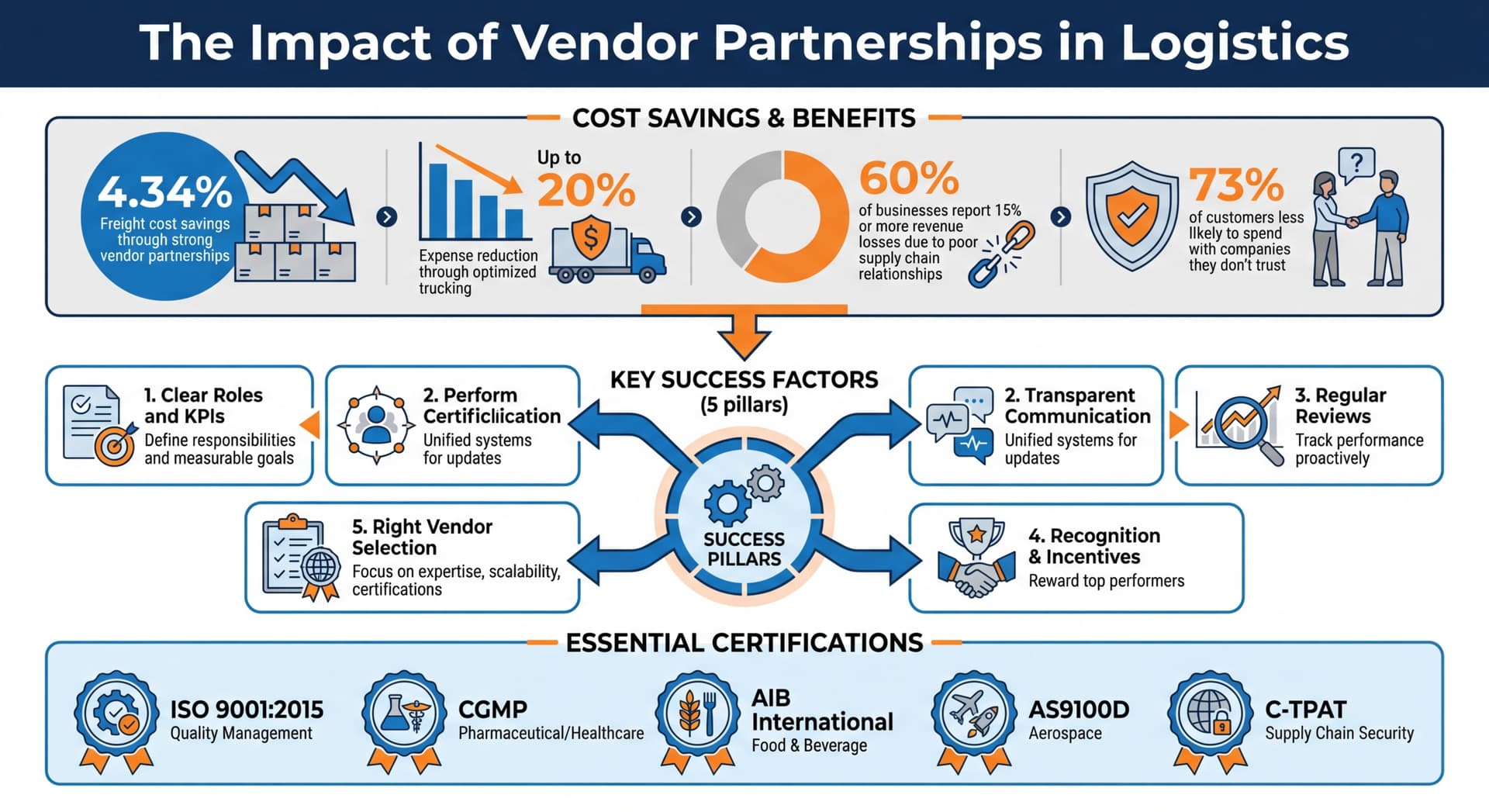
In logistics, strong vendor partnerships can reduce costs, prevent delays, and improve customer trust. Companies that treat vendors as partners often see better results, such as 4.34% freight cost savings or up to 20% expense reduction through optimized trucking. Poor vendor relationships, on the other hand, can lead to revenue losses, with 60% of businesses reporting 15% or more losses due to supply chain issues.
Here’s what works:
- Clear Roles and KPIs: Define responsibilities and set measurable goals (e.g., on-time delivery rates).
- Transparent Communication: Use unified systems for updates and document sharing.
- Regular Reviews: Track performance and address issues early.
- Recognition and Incentives: Reward top-performing vendors to maintain high standards.
- Right Vendor Selection: Focus on expertise, scalability, and certifications (e.g., ISO 9001, C-TPAT).
Strong vendor relationships aren’t just about cutting costs - they ensure reliability, build trust, and prepare your logistics for future challenges.
Key Statistics and Benefits of Strong Vendor Partnerships in Logistics
Mastering Supplier Relationship Management in Supply Chain | Best Practice | Process | Strategy
sbb-itb-c0b8770
How to Build Effective Vendor Partnerships
Creating strong vendor partnerships relies on establishing clear accountability and communication from the start. One of the main reasons logistics partnerships fail isn't due to lack of capability but rather unclear task ownership. Addressing this early through detailed contracts or professional memos can prevent miscommunications that might disrupt operations. These steps not only improve day-to-day efficiency but also contribute to long-term benefits like cost savings and improved reliability.
Set Clear Roles, Responsibilities, and Expectations
Start by defining who is responsible for key tasks such as carrier management, customs documentation, insurance claims, and daily communication. Ask questions like, "What does your discovery process look like?" or "Which aspects of the carrier relationship fall under my responsibility versus yours?". This level of clarity ensures accountability and helps avoid operational gaps.
To maintain performance, establish measurable benchmarks through Key Performance Indicators (KPIs) and Service-Level Agreements (SLAs). These metrics allow both parties to monitor progress and address potential issues before they escalate. As Paul Lavous from SFI Logistics explains:
"A logistics partner quickly becomes an extension of the team rather than just a supplier".
This seamless integration is only possible when everyone understands their role from the outset. Once roles are defined, focus on creating effective communication channels.
Establish Transparent Communication Channels
Disjointed communication can slow down processes and create inefficiencies. A unified digital platform - like a Transportation Management System (TMS) or an order management system - ensures all conversations are traceable and accessible to relevant stakeholders.
Organize communication by purpose. For instance, use one channel for shipment status updates and another for sharing documents. Set clear expectations for response times based on the type of inquiry, and provide contextual data like shipment priorities, delivery constraints, or seasonal fluctuations. This enables your vendor to make informed decisions without requiring constant oversight. Companies like Essentra have demonstrated how integrated collaboration tools can lead to measurable savings.
Use Contracts with Measurable Performance Metrics
Contracts should include performance metrics that follow the SMART framework: Specific, Measurable, Attainable, Relevant, and Time-based. Key metrics to track might include:
- On-time delivery rates: The percentage of shipments arriving on or before the promised date.
- Perfect order rates: Orders received in full, with the correct products and no errors.
- Lead time accuracy: How closely quoted delivery times align with actual outcomes.
"Vendor collaboration in logistics thrives on clarity, not guesswork." – GoComet
How to Maintain Long-Term Vendor Relationships
Building a partnership is one thing - keeping it strong over time takes consistent effort. The best logistics relationships go beyond simple transactions, treating vendors as strategic partners instead. With clearly defined roles and open communication, long-term collaboration thrives on trust and accountability. This approach not only strengthens the supply chain but also encourages teamwork when challenges arise. Here are some practical ways to assess performance and nurture these partnerships.
Build Trust Through Data Sharing
Trust starts with transparency. Sharing operational data - like shipment priorities, seasonal demand trends, and real-time tracking - helps vendors plan better and allocate resources efficiently. But it’s not just about the numbers; context matters too. When vendors understand the reasons behind time-sensitive air freight shipments or the impact of holiday surges, they can make informed decisions without needing constant instructions. Tools that automate data sharing have been shown to cut freight costs and reduce delays.
Conduct Regular Performance Reviews
Accountability grows when performance is regularly reviewed. Rather than only contacting vendors when problems arise, set up a routine schedule to evaluate key metrics like delivery times, documentation accuracy, and responsiveness. This helps identify trends - such as a vendor struggling during peak seasons - so issues can be addressed early.
"You can only fix what you track." – GoComet
Performance reviews should be a two-way street. Encourage vendors to share their challenges and collaborate on solutions. Tools like digital dashboards and carrier scorecards provide a unified view, minimizing disputes and highlighting opportunities for improvement. These reviews not only solve problems but also reinforce what’s working well.
Acknowledge Vendor Performance and Offer Incentives
Recognition plays a big role in building loyalty. Simple gestures, like certificates, performance awards, or even a personal call to celebrate milestones, can boost morale and encourage high standards. These efforts may even earn you preferential treatment during tight capacity periods.
Performance-based incentives take it a step further. Offering exclusive contracts, long-term agreements, or profit-sharing opportunities to top performers strengthens partnerships. Gabriel Swain from Tradogram sums it up well:
"Nothing solidifies a partnership like shared risk." – Gabriel Swain, Tradogram
Beyond financial incentives, providing benefits like demand visibility, greater autonomy, or networking opportunities can also deepen loyalty. By consistently rewarding excellence, you create a system where vendors remain committed to your shared success.
How to Select the Right Logistics Vendors
Choosing the right logistics vendor goes beyond simply comparing prices. To avoid costly delays and ensure long-term success, focus on three key areas: expertise, scalability, and regulatory compliance. These factors determine whether a vendor can meet your current needs and adapt as your business evolves.
Check Vendor Expertise and Industry Experience
A vendor's experience in your specific industry is more important than general logistics knowledge. Specialized handling can mean the difference between smooth operations and expensive mistakes. For example, the pharmaceutical industry requires temperature-controlled storage with round-the-clock monitoring and compliance with Good Distribution Practices (GDP). Meanwhile, the automotive sector relies on just-in-time delivery systems and strategies to manage supply chain disruptions. As Corrigan Logistics puts it:
"Logistics is the backbone of a business's success."
When evaluating vendors, ask detailed questions about their Transportation Management System (TMS), real-time tracking capabilities, and use of data analytics. If international shipping is involved, confirm their expertise in customs clearance. Industry-specific requirements, such as FDA compliance for healthcare or heightened security for high-value goods, are non-negotiable. Also, assess their financial stability and safety records to ensure reliability.
Confirm Vendor Scalability and Flexibility
As your business grows, your logistics partner must be able to scale alongside you. Vendors should have the infrastructure to handle increasing capacity needs and manage seasonal fluctuations. A strong geographic presence and the ability to optimize resources - like reducing unused truck space - can lower logistics costs by up to 20%.
David McConnehey, Director of Marketing and Communications at Buchanan Logistics, highlights the importance of adaptability:
"The 7-C's of Logistics - Connect, Create, Customize, Coordinate, Consolidate, Collaborate, and Contribute - provide a valuable guide for today's supply chain management... adopting the 7-C's will be crucial for building resilient supply chains that can handle disruptions and respond to changing market needs."
Look for vendors who offer tailored solutions rather than a one-size-fits-all approach. During disruptions, they should provide proactive alternatives, like shifting from ocean freight to air freight or rerouting shipments, instead of merely reporting delays. Ask about their supplier diversification strategies and how they've managed past capacity challenges.
Verify Certifications and Regulatory Compliance
Certifications are a critical indicator of a vendor’s ability to meet industry standards and regulatory requirements. For highly regulated industries, they’re essential. For example, pharmaceutical logistics requires CGMP certification, food-grade operations benefit from AIB International credentials, and aerospace shipments demand AS9100D compliance. Additionally, C-TPAT certification helps secure supply chains and reduces risks at borders.
| Certification | Focus Area | Industry Relevance |
|---|---|---|
| ISO 9001:2015 | Quality Management Systems | General Logistics |
| CGMP | Current Good Manufacturing Practice | Pharmaceutical & Healthcare |
| AIB International | Safety and Cleanliness Standards | Food & Beverage |
| AS9100D | Aerospace Quality Standards | Aerospace & Defense |
| C-TPAT | Supply Chain Security | International Trade |
Kanban Logistics emphasizes the importance of these credentials:
"Logistics quality certifications serve as an independent validation of a 3PL's capabilities, assuring you – and your customers – that your logistics provider adheres to industry best practices and regulatory requirements."
Regular audits are also essential to maintain compliance and reduce risks. For international operations, check for Foreign Trade Zone (FTZ) certification, which can help defer or eliminate customs duties and taxes. Certified vendors often have more efficient processes, resulting in fewer mistakes and better overall performance.
Examples of Successful Vendor Partnerships in Logistics
These examples highlight how the right mix of technology and strategic location can transform vendor partnerships into powerful business advantages. By focusing on integration and geography, companies can move beyond basic transactions to build partnerships that drive efficiency and reliability.
Using Integrated Technology for Better Coordination
Essentra, a global manufacturer, faced significant challenges managing shipments across multiple vendors due to disconnected communication systems. By adopting GoComet's platform, which centralized shipment tracking and automated document sharing, Essentra improved coordination, reduced delivery delays, and streamlined payment processing.
Similarly, GlobalTranz implemented a Transportation Management System (TMS) that integrates with over 75 LTL carriers and 45,000 truckload carriers. This system offers real-time tracking, automated alerts, and cost comparisons - all within a single interface. By eliminating the need for manual processes, GlobalTranz significantly enhanced operational efficiency. Meanwhile, Buchanan Logistics took it a step further by incorporating AI-driven tools and chatbots. These tools proactively provide updates, helping suppliers and partners address potential delivery delays or quality issues before they escalate.
Centralized platforms like these also reduce compliance errors and improve data accuracy by automating updates. Surveys have shown that poor communication can have a substantial financial impact, reinforcing the importance of these technological solutions. These examples pave the way for understanding how strategic geographic advantages can further strengthen vendor partnerships.
Improving Delivery Speed Through Location Advantages
CR Express provides a great example of leveraging geographic positioning for logistics success. Based in Elk Grove Village, Illinois - just a few miles from Chicago O'Hare International Airport - the company uses its proximity to this major hub to streamline delivery timelines. With over 500 container parking spots near key railyards in Chicago and 7-day-per-week railyard access, CR Express achieves same-day recovery and next-day delivery across more than 200 zip codes within a 60-mile radius of O'Hare.
This strategic location allows CR Express to optimize routes and maximize truck capacity, leading to potential cost savings. Additionally, being close to multiple transportation modes - air, rail, and highway - enables quick adjustments during disruptions. For industries handling time-sensitive cargo, such as pharmaceuticals or automotive parts, these location benefits not only improve delivery speed but also minimize the risk of costly delays.
Conclusion
Building strong vendor partnerships in logistics requires more than just focusing on costs. The shift from basic transactions to meaningful partnerships creates opportunities for shared growth and long-term success. When vendors truly understand your goals - whether that's reducing expenses, expanding your business, or enhancing customer satisfaction - they can align their efforts to meet those priorities.
The principles discussed throughout this article work together seamlessly. Clear communication helps prevent costly mistakes and delays. Trust and transparency, achieved through data sharing, allow vendors to make informed decisions that benefit your operations. Meanwhile, measurable performance metrics ensure accountability and drive ongoing improvement. Together, these practices provide a solid foundation for choosing and managing vendors who can grow alongside your business.
Selecting the right partners is just as critical as managing them effectively. Vendors with the right expertise, the ability to scale with your needs, and proper certifications minimize risks while boosting efficiency. The examples shared earlier highlight how strategic vendor coordination can lead to measurable savings.
Trust plays a crucial role in these relationships. Studies show that 73% of customers are less likely to spend with companies they don’t trust. Vendor partnerships directly influence both your company's reputation and its financial performance. By combining well-defined roles, trust built on data, and performance tracking, you can create a supply chain that withstands disruptions and supports your growth.
As logistics continues to evolve with trends like AI automation, sustainability, and digital integration, resilient vendor partnerships are more essential than ever. Following the principles outlined here ensures your business is prepared to adapt to these changes while remaining flexible enough to scale operations as needed.
FAQs
Which KPIs matter most for logistics vendors?
Key performance indicators (KPIs) for logistics vendors are crucial for tracking success and maintaining accountability. Some of the most important KPIs include:
- Return on Investment (ROI): A measure of the financial performance of logistics operations.
- Compliance Rate: Tracks adherence to regulations and contractual obligations.
- Supplier Lead Time: Monitors the time it takes for suppliers to deliver goods.
- Defect Rate: Assesses the quality of goods or services provided.
- Order Accuracy: Ensures orders are fulfilled correctly.
- Capacity: Evaluates the vendor's ability to handle current and future demand.
These metrics not only help evaluate performance but also ensure that vendors meet their commitments and strengthen their relationships with partners. Additionally, the "7-C's" framework - Connect, Create, Customize, Coordinate, Consolidate, Collaborate, and Contribute - offers a structured approach to optimizing supply chain operations, making them more reliable and efficient.
How do you fix vendor issues without hurting the relationship?
To address vendor issues while keeping the relationship intact, prioritize clear communication and working together to solve problems. Approaches like negotiation or mediation can lead to solutions that work for both parties. Establishing trust and fostering open conversations are key to sustaining successful logistics partnerships over time.
What should you audit before signing a logistics vendor?
Before committing to a logistics vendor, take the time to thoroughly review their operations to ensure they align with your expectations for compliance, performance, and dependability. Focus on key aspects like whether they have clearly documented procedures, effective contingency plans for handling disruptions, and real-time shipment tracking technology. Check if they meet industry certifications such as TSA or GDP, and confirm they have the capacity to manage your specific cargo requirements. Conducting this kind of audit helps reduce potential risks and ensures the vendor supports your business objectives.