
10 Benefits of Freight Consolidation for Sustainability
by CR Express Team, Logistics Team • 14 min read
10 Benefits of Freight Consolidation for Sustainability
Freight consolidation combines smaller shipments into full truckloads, reducing the number of vehicles needed and optimizing space. This method addresses major logistics inefficiencies, such as wasted fuel, empty miles, and underutilized truck capacity. Here’s why it matters:
- Cuts Carbon Emissions: Fewer trucks on the road lower greenhouse gas emissions by 10–30%.
- Reduces Fuel Consumption: Fully loaded trucks use less fuel per unit of cargo.
- Maximizes Cargo Space: Efficient use of trailer space reduces waste and costs.
- Eases Traffic Congestion: Fewer vehicles mean less strain on roads and urban areas.
- Minimizes Road Wear: Consolidated shipments reduce infrastructure damage.
- Decreases Noise Pollution: Fewer trucks lead to quieter urban deliveries.
- Reduces Empty Backhauls: Aligning routes eliminates wasteful empty trips.
- Lowers Energy Use: Efficient loading and intermodal transport save energy.
- Supports SmartWay Goals: Aligns with EPA standards for fuel efficiency.
- Promotes Greener Supply Chains: Meets corporate sustainability targets while cutting costs.
Freight consolidation not only improves logistics efficiency but also supports cleaner, quieter, and more resource-efficient operations. It’s a practical solution for reducing costs and meeting growing environmental demands.
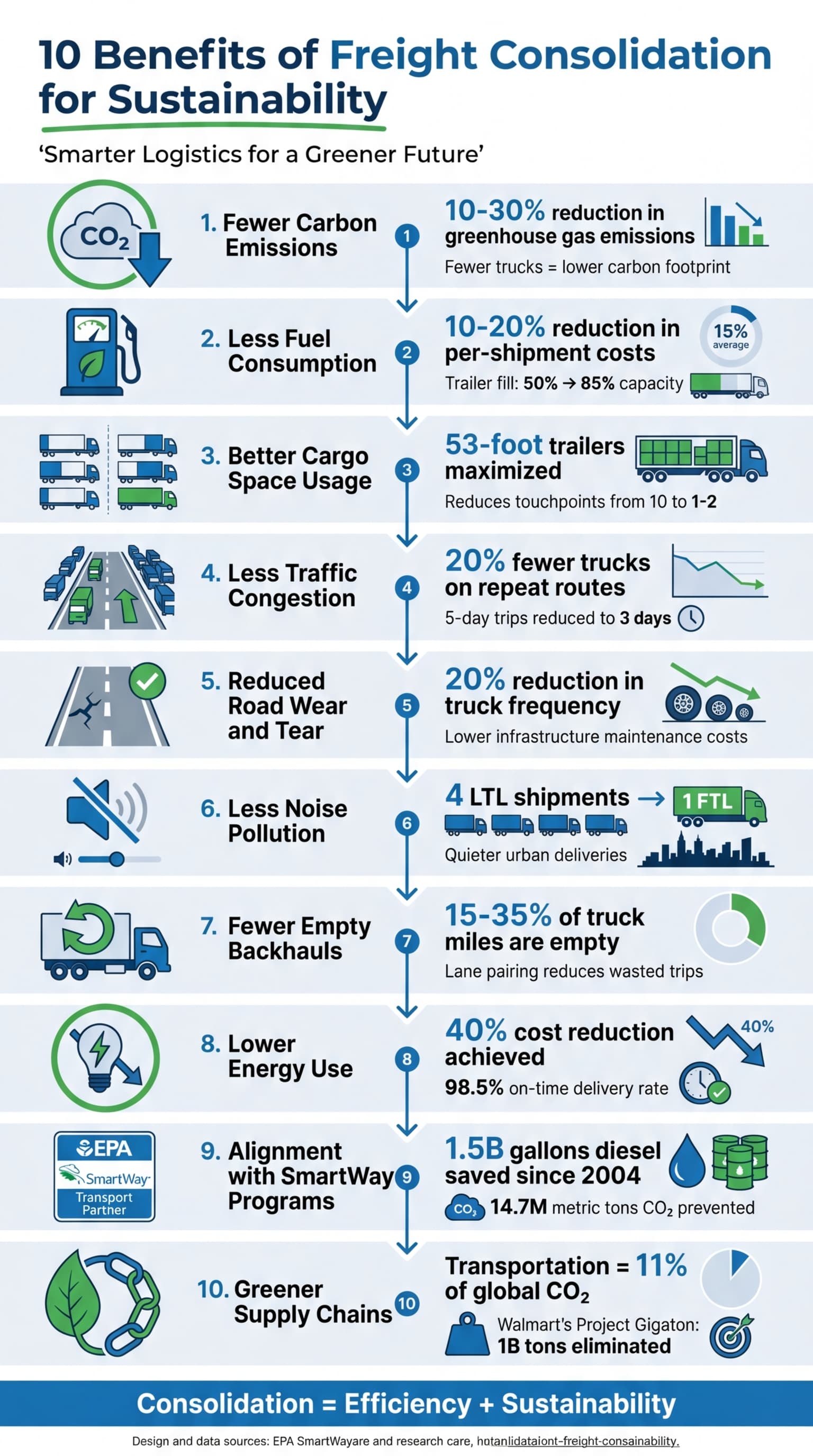
10 Environmental Benefits of Freight Consolidation with Key Statistics
How Does Less-than-Truckload (LTL) Consolidation Boost Logistics Efficiency?
sbb-itb-c0b8770
1. Fewer Carbon Emissions
Consolidating smaller shipments into full truckloads significantly reduces the number of vehicles needed to transport the same amount of goods, which helps cut down emissions. In contrast, LTL (Less-Than-Truckload) shipping spreads cargo across multiple trucks, each burning fuel and releasing greenhouse gases. By packing more freight into a single truck, consolidation directly reduces the number of vehicles on the road.
The environmental benefits are clear. Rick LaGore, CEO of InTek Freight & Logistics, highlights this:
"The carbon footprint improves under LTL consolidations because there are fewer trucks in the solution. Integrating intermodal options further improves linehaul efficiency".
Depending on the strategy and how routes are optimized, this approach can lower greenhouse gas emissions by 10% to 30%.
A major factor in this improvement is the elimination of wasted capacity. For example, a truck designed to carry 80,000 pounds but traveling half-empty wastes fuel on every mile. Consolidation ensures trucks are fully loaded before hitting the road, reducing the carbon intensity per unit of freight. Instead of using three trucks at 50% capacity, one fully loaded truck can handle the job, cutting emissions dramatically.
LTL shipping often relies on a hub-and-spoke system with multiple stops, transfers, and cross-docks. Each stop adds idling, fuel consumption, and emissions. Consolidated freight, on the other hand, moves more directly, typically requiring only 2 to 3 "touches", compared to numerous handling points in traditional LTL shipping. This streamlined process minimizes idling and fuel waste. As Averitt explains:
"Instead of spreading smaller shipments across multiple trucks, a shipper can consolidate everything into one – effectively slashing their carbon footprint".
The benefits don’t stop there. When consolidation incorporates intermodal transportation - a mix of truck and rail - the long-haul portion becomes even more fuel-efficient. This combination further reduces fuel usage, setting the stage for additional environmental gains, as discussed in the next section. For more logistics insights, explore our latest industry expertise.
2. Less Fuel Consumption
Freight consolidation swaps out multiple partially filled trucks for one fully loaded truck, reducing fuel usage and making better use of trailer space. This efficient loading process leads to a noticeable drop in fuel consumption.
When trucks operate below their capacity, they waste fuel. By filling trailers more effectively - both in terms of weight and space - consolidation significantly lowers the amount of fuel used per unit of cargo transported .
As Freight Quote puts it:
"Better trailer fill cuts the number of trucks needed. Fewer vehicles mean lower fuel use, less driver time, and fewer non-productive miles".
Pool distribution takes this a step further by grouping upstream orders into a single full truckload for the longer haul. From there, smaller local trucks handle the final deliveries using optimized routes, which reduces empty miles and idling .
The financial benefits go hand in hand with these fuel savings. For many companies, transportation represents over 60% of their total supply chain costs. By increasing trailer fill rates from 50% to 85%, shippers often achieve a 10% to 20% reduction in per-shipment costs. These savings directly reflect the decreased fuel consumption per unit of cargo.
Consolidation also paves the way for intermodal transport, where rail takes over the consolidated long-haul segment. Rail is naturally more fuel-efficient than long-haul trucking, further cutting fuel use when delivery timelines allow. Combining full truckloads with rail transport amplifies these fuel savings, creating a highly efficient system that benefits both businesses and the environment.
3. Better Cargo Space Usage
Freight consolidation transforms multiple half-filled trucks into a single, fully loaded vehicle - usually a 53-foot dry van or an intermodal container. This method takes full advantage of both cubic capacity and weight limits, ensuring that every inch of space is utilized effectively. Alongside this efficient space usage, consolidation also brings the added benefit of cutting fuel consumption and lowering emissions.
Half-empty trucks waste precious cargo space while still burning fuel. By combining smaller LTL (less-than-truckload) shipments - typically fewer than six pallets - into one full load, consolidation reduces empty space in trailers that would otherwise consume energy without maximizing capacity.
Moving away from the traditional LTL hub-and-spoke system to direct line-hauls enhances these advantages even further. Instead of passing through multiple terminals, consolidated shipments head straight to regional "pool points", where they are broken down for final delivery. This shift cuts the number of touchpoints from as many as 10 to just 1 or 2, significantly reducing the risk of cargo damage while keeping trailers fuller for longer. This streamlined approach not only improves efficiency but also reduces unnecessary energy use during operations.
David McConnehey, Director of Marketing and Communications at Buchanan Logistics, highlights this dual benefit:
"Optimizing truck capacity is not just an operational improvement; it is also a significant financial strategy that can turn challenges into opportunities for better profitability and sustainability".
Efficient use of cargo space means fewer trucks are needed to transport the same amount of goods. This can lead to a 10% to 20% reduction in emissions, making it a win for both business and the environment.
4. Less Traffic Congestion
Freight consolidation helps cut down the number of trucks on the road by combining multiple shipments into one truckload. This approach reduces the need for as many vehicles to transport the same amount of goods, easing the strain on highways, urban areas, and port facilities. For example, consolidation can lead to 20% fewer trucks on repeat routes.
It’s not just public roads that benefit - consolidation also decreases dock congestion at shipping and receiving facilities. Fewer trucks arriving at docks means fewer backups and shorter driver detention times. With smoother operations, trucks spend less time idling while waiting for a loading bay, allowing for quicker and more efficient long-haul trips.
Reduced truck traffic also means less time lost in traffic jams. This streamlined process can significantly speed up delivery times compared to traditional hub-and-spoke systems. For instance, cross-country shipments that typically take 5 days can be shortened to just 3 days, thanks to consolidation bypassing the usual logistics bottlenecks.
InTek Freight & Logistics highlights the broader impact:
"road congestion is as well".
This becomes even more critical as freight volume in the United States grows by 2.4% annually, making freight consolidation a key strategy to prevent overwhelming infrastructure.
There’s also a notable environmental upside. Consolidation reduces "empty miles" - the distance trucks travel without carrying cargo - ensuring that each vehicle operates at full capacity. This not only improves efficiency but also contributes to a cleaner, less congested transportation network.
5. Reduced Road Wear and Tear
Freight consolidation doesn't just cut emissions - it also eases the strain on our roads. Heavy trucks are tough on highways, bridges, and other infrastructure. By replacing multiple smaller trips with fewer, fully loaded trucks, consolidation reduces both carbon emissions and road wear, which helps lower repair costs and lessens the environmental toll. Bundling shipments into a single truckload protects critical infrastructure and can reduce truck frequency by about 20%. This is especially important as projections show HGV traffic increasing by 12% and LGV traffic soaring by 108% between 2015 and 2050. Fewer trucks on the road mean less wear and tear, preserving road quality and trimming long-term maintenance expenses.
This benefit is particularly noticeable in areas near industrial centers and ports, where heavy truck traffic often accelerates pavement deterioration. Consolidation helps alleviate these localized challenges. Additionally, transitioning from Less-Than-Truckload (LTL) to Full Truckload (FTL) operations ensures that trucks are used efficiently. By moving the same amount of freight with fewer trips, we can extend the lifespan of highways and reduce the need for disruptive and costly repairs.
In short, less road wear means fewer repairs, lower infrastructure costs, and a smaller environmental footprint from construction activities. Freight consolidation strengthens sustainability efforts across the board.
6. Less Noise Pollution
Freight consolidation doesn’t just cut down on emissions and fuel use - it also helps create quieter neighborhoods. By combining multiple LTL (less-than-truckload) shipments into a single FTL (full truckload), the number of trucks on the road is significantly reduced. For example, retail consolidation services can merge up to four LTL shipments into one FTL, which eliminates the need for three additional trucks along that route.
This impact is particularly noticeable in crowded urban areas, where constant truck activity can be a major source of disruption for residents. Consolidated shipments mean fewer trips through city streets, which reduces the noise caused by stop-and-go traffic, frequent braking, and the loud acceleration of heavy vehicles. Additionally, fewer trucks at loading docks mean less idling noise, fewer reverse alarms, and reduced maneuvering sounds, all of which are common in urban delivery zones.
"Reduced fuel consumption, decreased noise pollution in urban delivery areas, and fewer vehicles to manufacture and maintain collectively contribute to a greener and more sustainable planet." - DAT
Quieter logistics operations benefit not just the immediate residents but also strengthen ties between businesses and the communities they serve. Companies adopting alternative fuel vehicles, such as electric trucks or those powered by renewable natural gas, amplify these benefits. These vehicles operate much more quietly than traditional diesel trucks, making them an excellent choice for noise-sensitive environments. On top of that, route optimization software helps avoid unnecessary travel through residential areas and reduces idling in traffic, further cutting down on noise.
The result? A more livable urban environment. Freight consolidation not only enhances operational efficiency but also improves the quality of life for communities - a kind of "hidden ROI" for businesses committed to sustainable practices. At CR Express, we incorporate these strategies into our supply chain solutions, ensuring that our operations contribute to quieter, healthier communities while maintaining high efficiency.
7. Fewer Empty Backhauls
Empty backhauls - when trucks return without cargo - are a major inefficiency in trucking. In the U.S., an estimated 15% to 35% of all truck miles are driven empty. This not only increases operating costs but also contributes to environmental strain.
Freight consolidation tackles this problem by using strategies like lane pairing and co-loading to align outbound and inbound routes, effectively reducing empty trips. For instance, a truck delivering consolidated freight from Chicago to Atlanta could pick up a return load heading back to the Midwest. This turns what would have been wasted miles into profitable ones. Digital freight exchanges play a key role by instantly matching available truck space with return shipments, improving overall vehicle utilization.
"Coming back empty is wasted energy like running your car with nothing in it." - Komal Puri, AVP Marketing, FarEye
The environmental impact is worth noting too. A modest 10% boost in vehicle utilization across a regional fleet can prevent thousands of tons of CO₂ emissions each year. Consolidation also enables "milk runs", where trucks make multiple stops within a region, replacing single-destination trips that often result in empty returns.
These strategies bring clear advantages. Minimizing empty backhauls reduces costs per mile, maximizes asset use, and supports a more sustainable supply chain. At CR Express, our cross-docking services and vast carrier network help cut down on empty miles, shorten dock dwell times, and lower costs, keeping trailers productive throughout their routes.
8. Lower Energy Use
Consolidation isn't just about cutting fuel consumption - it’s also a powerful way to improve energy efficiency across the board. By fully utilizing trailer space, each shipment reduces the energy used per unit of cargo. In simple terms, fewer trucks are needed, and the energy required for each item drops significantly.
The impact is clear in the numbers. Boosting trailer fill rates from 50% to 85% can trim 10–20% of operational waste and related costs. For example, one major food producer cut transportation expenses by 40% and achieved an impressive 98.5% on-time delivery rate by switching to full truckload consolidation. These improvements come from eliminating the inefficiencies of sending out multiple partially loaded trucks along the same routes.
"A truck carrying multiple shipments will be more efficient in terms of fuel usage than several trucks carrying individual loads." - Cario
Traditional less-than-truckload (LTL) shipping often involves multiple cross-dock events, which consume extra energy for warehouse operations and equipment. Consolidation reduces these events to just 2–3 touches, cutting down on energy use and easing dock congestion.
Another way to lower energy use is by shifting LTL shipments to intermodal transport, which significantly reduces energy consumption during long-haul transit. At CR Express, our transloading and cross-docking services are designed to maximize trailer utilization and minimize energy waste, helping businesses make their shipments more efficient and environmentally friendly. This approach not only saves fuel but also ensures every aspect of transportation is as energy-efficient as possible.
9. Alignment with SmartWay Programs
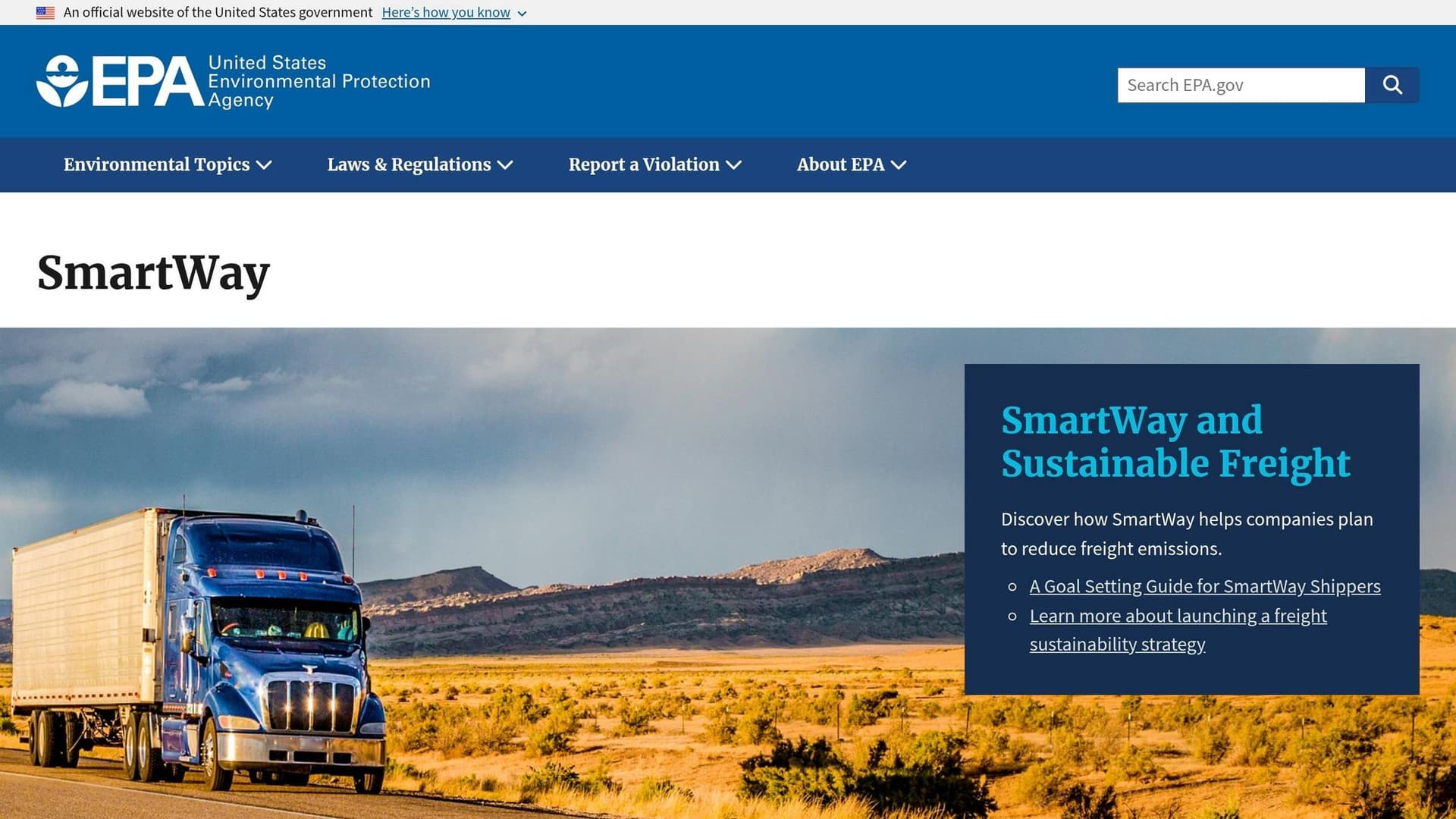
Freight consolidation fits seamlessly with SmartWay, an EPA initiative focused on cutting down empty miles and maximizing cargo efficiency. By combining shipments into full loads, businesses directly support SmartWay's goals of improving energy use and minimizing emissions. These efficiencies are at the heart of the program's environmental successes.
The numbers tell the story. Since its inception in 2004, SmartWay partners have collectively saved 1.5 billion gallons of diesel, prevented 14.7 million metric tons of CO2 emissions, and reduced fuel costs by $55.4 billion. Research indicates that consolidation strategies aligned with SmartWay can slash greenhouse gas emissions by as much as 30%.
"SmartWay partners have prevented the release of millions of tons of harmful emissions, including CO2, NOx and particulate matter – and saved $55.4 billion in fuel costs." - US EPA
These achievements highlight why SmartWay remains a key standard for environmentally responsible freight practices.
For businesses aiming to meet sustainability goals, aligning with SmartWay through freight consolidation offers tangible benefits. More than 4,000 companies across North America are part of this program, using consolidation methods to track and enhance their environmental impact. Leading retailers like Walmart, Amazon, and CVS increasingly favor brands that employ consolidation to reduce supply chain emissions, making SmartWay participation a competitive edge.
As a SmartWay sustainability partner, CR Express helps businesses meet program standards while cutting costs. Through transloading and cross-docking services, we optimize trailer use and lower emissions, empowering shippers to achieve clear sustainability targets and showcase their commitment to greener supply chains.
10. Greener Supply Chains
Freight consolidation plays a vital role in creating greener supply chains while also cutting costs. The transportation and logistics sector is responsible for 11% of global CO2 emissions, making consolidation an important strategy for businesses aiming to reduce their carbon footprint. By improving load efficiency, companies not only address environmental concerns but also comply with increasingly stringent regulations. This approach connects operational efficiency with strategic environmental goals.
The benefits of freight consolidation extend to both finances and sustainability. For example, a major food manufacturer transitioned from fragmented LTL shipping to full truckload consolidation, reducing transportation costs by 40% and achieving a 98.5% on-time delivery rate. Similarly, a footwear brand adopted pool distribution, cutting freight costs by 12.4%. These examples highlight how improving efficiency can align with environmental objectives, proving that sustainability and profitability can go hand in hand.
"By reducing the number of trucks on the road and lowering CO2 emissions, freight consolidation supports corporate environmental targets." - Cario
Retailers are increasingly demanding that suppliers meet carbon reduction targets, making green logistics a competitive necessity rather than a choice. Walmart's "Project Gigaton" initiative is a prime example, successfully eliminating one billion tons of greenhouse gas emissions from its global supply chain through supplier collaboration on efficiency and consolidation. Additionally, research shows that 73% of customers are likely to spend less with companies they don't trust, illustrating how transparent sustainability efforts can directly influence revenue.
CR Express aligns with these principles by offering transloading and cross-docking services designed to improve both cost efficiency and environmental outcomes. With a strategic location in Chicago and nationwide FTL capabilities, our consolidation approach helps reduce emissions and fuel usage while maintaining operational flexibility. This ensures shippers can meet their sustainability goals without compromising efficiency or performance.
Conclusion
Freight consolidation brings both environmental and logistical advantages by maximizing truckloads, cutting fuel consumption, and lowering emissions. This approach tackles several challenges at once - fewer trucks on the road mean reduced traffic congestion, less wear and tear on highways, lower noise levels, and less strain on infrastructure.
Operationally, consolidation makes a big difference. It reduces shipment handling by threefold, which helps minimize damage claims, shortens transit times by up to 1.2 days, and cuts freight costs by over 12%. These benefits show that efficiency and sustainability can go hand in hand, rather than being opposing goals.
With trucking capacity expected to tighten in early 2026, shippers who embrace consolidation will be better equipped to handle constraints and rising costs while staying aligned with environmental and regulatory requirements. Moving from fragmented shipping to consolidated methods marks a significant step forward in logistics strategy.
CR Express aligns with these benefits by offering consolidated and cross-docking services designed to meet sustainability goals. With 280,000 sq ft of warehouse space near Chicago’s logistics hubs and a 26-year track record as a SmartWay partner, we help optimize cargo space, reduce empty miles, and deliver both environmental and financial benefits.
FAQs
When should I use freight consolidation instead of LTL?
Freight consolidation works perfectly when multiple smaller shipments are bound for the same destination and can be grouped into a single full truckload. This method makes the most of available space, cuts down on transportation expenses, and reduces the number of trips needed - leading to greater efficiency. It’s particularly useful for businesses that regularly send small shipments, offering cost savings, smoother logistics, and a smaller environmental footprint compared to shipping each load individually through LTL (less-than-truckload) services.
Will consolidation increase transit time or risk of delays?
Consolidation might occasionally extend transit times or introduce delays because of the extra effort required to coordinate and combine shipments. On the flip side, it usually results in better efficiency and lower costs by maximizing cargo space and cutting down on redundant trips.
How can I measure the emissions savings from consolidation?
You can estimate emissions reductions from freight consolidation by using carbon calculators. These tools evaluate greenhouse gas emissions savings by factoring in fewer trips and better use of cargo space. Some logistics providers also track and share internal data, with reports indicating up to a 13% drop in GHG emissions in some cases. By analyzing metrics like fuel consumption, trip numbers, and emissions data before and after consolidation, businesses can clearly measure their environmental impact.